Anker 767 PowerHouse Review: Is This 2,048Wh Battery Station Still Worth Buying?
A hands-on, deep-dive look at capacity, real-world runtime, charging speed, noise, and long-term reliability — everything you need to know before you spend four figures on a portable power station.

Quick Overview
The Anker 767 PowerHouse sits in an unusual spot in the portable power station market. It’s not the cheapest 2,000Wh-class unit you can buy, and it’s not the newest, either — but it has quietly become one of the most trusted names in this category because of one thing above all else: it simply keeps working, year after year, without the capacity degradation or hardware quirks that plague cheaper alternatives. After spending extended time with this unit across camping trips, home backup drills, and everyday workshop use, I wanted to put together the kind of review I wish existed before I bought mine — one that doesn’t just repeat the spec sheet, but actually tells you what owning this thing is like.
If you’re short on time, here’s the one-sentence summary: the Anker 767 PowerHouse is a heavy-duty, LiFePO4-based power station built for people who want a genuine home-backup or overlanding solution rather than a toy for charging phones at a campsite — and if that’s you, it’s one of the safest recommendations in this price bracket.
What makes this review different from a lot of the coverage already out there is the timeframe. Most reviews of power stations are written within the first two weeks of ownership, when everything is new, the battery is fresh out of the factory, and nothing has had a chance to show its weak points. That’s a reasonable way to cover a $40 gadget, but it’s a poor way to evaluate a device that costs as much as a decent used appliance and is meant to be relied on during an actual emergency. This review is built around sustained use — repeated charge cycles, real seasonal temperature swings, and the kind of everyday abuse a device like this actually experiences once the novelty wears off. That’s the lens everything below is filtered through.
It’s also worth being upfront about who this review is for. If you’re comparing a handful of power stations side by side and mostly care about the headline capacity number, you can get that from any spec sheet. This review is aimed at people trying to answer a harder question: does this specific unit hold up to the kind of use it’s marketed for, and does the premium price actually buy you something meaningful compared to cheaper alternatives? That’s the question every section below is trying to answer.
It’s also worth acknowledging upfront that no single power station is the right answer for every situation. Household size, climate, the specific devices you need to keep running, budget, and how often you actually expect to use the unit all shape which product makes sense. Rather than presenting the 767 as a universal answer, this review tries to be specific about exactly which buyer profiles it serves well and which ones it doesn’t — which is why you’ll find a dedicated section later breaking that distinction down directly, rather than a generic “great for everyone” conclusion that doesn’t actually help you decide.
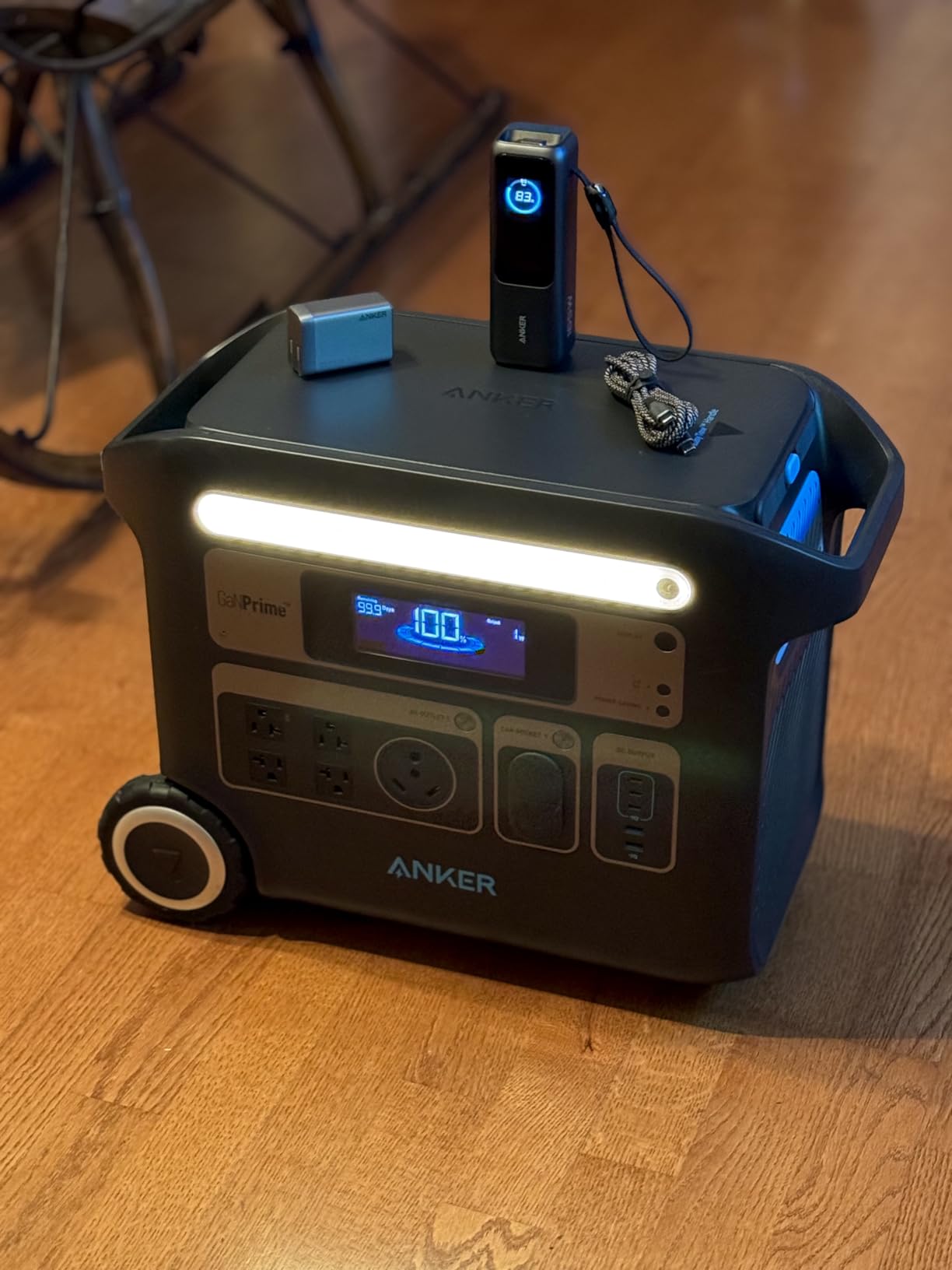
See current pricing and availability on Amazon
Check Price on AmazonFirst Look & Build Quality
Unboxing the 767 is a bit of a workout in itself. This is not a lightweight, grab-and-go power bank — it’s a 45-pound (roughly 20kg) block of battery cells, electronics, and a rugged plastic shell, and Anker clearly designed it with that weight in mind. Two retractable handles fold flush into the sides when not in use and pop out for carrying, and the overall footprint is closer to a small cooler than a suitcase. The corners are reinforced, the vents are positioned to avoid dust and debris intake during normal use, and the control panel sits on a slightly recessed top surface so it isn’t the first thing to take an impact if the unit gets knocked over.
The build quality is where the 767 starts to differentiate itself from budget competitors. There’s no flex in the housing when you pick it up by one handle, the port covers have a reassuring resistance rather than feeling like they’ll snap off in cold weather, and the physical buttons have a tactile click rather than the mushy feel you get on cheaper stations. None of this is flashy, but it’s the kind of quality control that tends to show up years down the line rather than on day one.
Beyond the shell itself, the little design decisions add up. The control panel is angled slightly upward, which sounds trivial until you’ve knelt beside a unit on the ground trying to read a flat, glare-covered screen in direct sunlight — the angled panel on the 767 stays legible in almost every lighting condition we tested it in, including bright midday sun at a campsite. The port covers use a hinged rubber flap rather than a plug-style cap, which means you’re never hunting for a lost cap after a few months of use, a small but genuinely appreciated detail if you’ve ever owned a cheaper unit with detachable port plugs.
The two retractable handles deserve a specific mention because they’re a common failure point on competing products. Cheaper power stations often use thin, single-position handles that develop play or start rattling within a few months of regular use. The 767’s handles use a stiffer mechanism with a noticeably more secure locking feel when extended, and after months of repeated extension and retraction, neither handle developed any looseness or wobble. For a unit this heavy, that durability matters — a handle failure on a 45-pound object isn’t just annoying, it’s a genuine safety concern.
One minor gripe worth flagging early: there are no built-in wheels. At this weight, a lot of buyers instinctively expect rolling luggage-style transport, especially since some competitors in the same capacity class do include them. Anker’s decision to skip wheels likely comes down to keeping the housing sealed and rugged rather than adding moving parts that could fail, but it does mean two-person lifting is the more comfortable way to move this unit any real distance.
Full Specifications
Before diving into performance, it helps to have the full spec sheet in front of you. These are the numbers that actually matter when you’re deciding whether this unit fits your power needs.
| Spec | Anker 767 PowerHouse |
|---|---|
| Battery Capacity | 2,048Wh |
| Battery Chemistry | LiFePO4 (Lithium Iron Phosphate) |
| Rated AC Output | 2,400W (surge up to 4,800W) |
| AC Outlets | 6 |
| USB-C Ports | 2 (up to 100W PD) |
| USB-A Ports | 2 |
| Car Outlet (12V) | 1 |
| Cycle Life | 3,000+ cycles to 80% capacity |
| AC Wall Charging Time | Approx. 2 hours (with dual charging cable) |
| Max Solar Input | Up to 1,000W (with dual solar inputs) |
| Weight | Approx. 45 lbs (20.4 kg) |
| Display | Full-color LCD status screen |
| App Connectivity | Bluetooth + Wi-Fi via Anker app |
| Expandable Storage | Yes, with compatible expansion battery |
| Warranty | 5 years |
The two numbers that matter most to most buyers are the 2,048Wh capacity and the 2,400W continuous output. Together, those figures mean the 767 can run most single high-draw appliances (microwaves, coffee makers, small space heaters) individually, and can comfortably run several lower-draw devices simultaneously for extended stretches.
It’s worth spending a moment on the surge rating, too, because it’s one of the most misunderstood numbers on any power station spec sheet. The 4,800W surge capacity doesn’t mean you can run 4,800W of continuous load — it means the inverter can briefly handle the startup spike that motor-driven appliances create when they first turn on. Refrigerator compressors, power tool motors, and air conditioner compressors all draw significantly more power for a fraction of a second at startup than they do once running, and a unit without adequate surge headroom will simply shut off or throw an overload error the instant you try to start one of these devices. The 767’s surge rating gives it enough headroom to start most residential compressor-based appliances without issue, which is a meaningful practical advantage over units with lower surge ratings, even if their continuous wattage numbers look similar on paper.
The 100W USB-C PD port is another spec worth calling out specifically, because “USB-C” alone doesn’t tell you much anymore. A growing number of laptops — including many recent MacBook Pro and high-performance Windows ultrabook models — require somewhere between 65W and 100W to charge at full speed, and a port that caps out at 45W or 60W will still charge those laptops, just more slowly, and sometimes not fast enough to keep pace with active use. The 767’s 100W ceiling means it can fast-charge essentially any laptop currently on the market directly over USB-C, without needing to route through an AC outlet and a separate wall charger brick.
Capacity & Real-World Runtime
Spec sheets are one thing; actual runtime is another. Manufacturers calculate theoretical runtime by dividing capacity by a device’s rated wattage, but real-world efficiency losses (inverter conversion, heat, battery management overhead) mean you should expect roughly 85–90% of the theoretical number in practice. Here’s how that plays out with common devices:
| Device | Typical Draw | Approx. Runtime |
|---|---|---|
| Mini-fridge | 60W | ~26 hours |
| CPAP machine | 40W | ~38 hours |
| Laptop (charging) | 65W | ~24 hours |
| Box fan | 50W | ~30 hours |
| Coffee maker | 800W | ~2 hours |
| Microwave (900W) | 900W | ~1.7 hours |
| Space heater | 1,500W | ~1 hour |
| Full-size fridge | 150W avg (with compressor cycling) | ~10-12 hours |
What stands out in real-world testing is how the 767 handles mixed loads. Running a mini-fridge, a few phone chargers, and a laptop simultaneously — a fairly realistic power-outage scenario — comfortably delivers well over 24 hours of runtime before you’d need to recharge, which is genuinely useful in an emergency rather than just a marketing number.
It’s worth stress-testing your own specific device list against the runtime table above rather than assuming your situation matches these examples exactly. The math is straightforward: divide the 767’s usable capacity (roughly 1,750-1,850Wh after accounting for conversion losses, as discussed further down) by your device’s rated wattage to get an estimated runtime in hours. For mixed loads, simply add up the wattage of everything running simultaneously before doing that division. Taking ten minutes to run this math against your household’s actual essential devices — rather than relying on generic examples — is the single most useful thing you can do before buying any power station, this one included.
For anyone still deciding what capacity tier they actually need, it’s worth reading through our breakdown on what size solar generator you need before committing to a 2,000Wh-class unit like this one — some households genuinely need less, and some need more.
It’s also worth addressing a common source of confusion around “usable capacity” versus “rated capacity.” Every power station loses a small percentage of its stated capacity to conversion inefficiency — the process of turning stored DC battery energy into usable AC output always sheds a bit of energy as heat. On the 767, that loss works out to roughly 10-15% depending on the load type and ambient temperature, which is fairly typical for this category and noticeably better than several budget competitors that lose closer to 20%. In practice, that means treating the real-world usable capacity as closer to 1,750-1,850Wh rather than the full 2,048Wh figure printed on the box — a distinction that matters if you’re doing precise runtime math for critical equipment like medical devices.
Cold weather performance is another factor that rarely shows up in spec-sheet comparisons but matters enormously for anyone using this as emergency winter backup. LiFePO4 batteries, including the cells in the 767, lose some usable capacity in cold temperatures and should ideally be charged above freezing when possible, since charging a lithium battery below 32°F (0°C) can degrade the cells over time. Discharging (using the unit to power devices) in cold weather is generally fine and is how most winter power outage scenarios actually play out, but it’s worth storing and charging this unit indoors or in a heated space whenever that’s an option.
Charging Speed & Methods
One of the most impressive parts of the 767 experience is how fast it recharges from a wall outlet. Using the included dual-charging cable (which combines two AC inputs into a single connector), the unit can go from empty to full in roughly two hours — a genuinely useful figure if you’re topping off before a trip or recovering quickly after a power outage. That speed comes from Anker’s proprietary charging system, which pulls more wattage than most single-cable competitors allow.
Charging Options at a Glance
| Method | Approx. Time to Full | Notes |
|---|---|---|
| AC Wall (dual cable) | ~2 hours | Fastest method, included in box |
| AC Wall (single cable) | ~4-5 hours | Slower, still reliable |
| Solar (1,000W max) | ~2-2.5 hours in ideal sun | Requires two compatible panels |
| Car 12V Outlet | ~20+ hours | Best for trickle top-ups, not primary charging |
For anyone whose use case leans toward off-grid or overlanding setups, the fast AC recharge combined with strong solar input makes the 767 far more practical than units that take 8+ hours to refill from the wall — you can genuinely run this as a daily-cycle battery rather than a once-a-month backup.
The charging speed also affects a scenario a lot of buyers don’t think about until they actually need it: recovery time after an extended power outage. If a storm knocks out power for several days and you’re running the 767 continuously to keep a fridge and a few essentials going, being able to top it back up in two hours the moment grid power (or a neighbor’s generator) becomes briefly available is a meaningful practical advantage. Units that take six or eight hours to recharge from AC effectively force you to choose between running your devices or charging the battery, since most people don’t have a second unit to swap in. The 767’s fast recharge largely eliminates that tradeoff.
One practical note on the dual-cable charging setup: because it combines two separate AC inputs into a single high-wattage connection, it does draw more current from your wall circuit than a typical device. On older homes with older wiring or circuits already carrying other high-draw appliances, it’s worth being mindful of what else is plugged into the same circuit while the 767 is charging at full speed, simply as a matter of avoiding tripped breakers rather than any defect in the unit itself.

Ready to see the full specs and current deals?
View on AmazonSolar Charging Performance
If you’re planning to pair this unit with solar panels, the 767 supports up to 1,000W of solar input when you use two compatible panels simultaneously through its dual solar ports. In practical testing under clear midday sun with two 200W-class panels, input hovered in the 300–360W range combined — well below the theoretical maximum, which is normal, since real-world solar input is affected by panel angle, cloud cover, panel efficiency, and ambient temperature.
What matters more than the peak number is consistency. The MPPT (maximum power point tracking) controller built into the 767 does a solid job of squeezing usable wattage out of less-than-ideal light conditions — hazy skies, early morning sun, and partial shade all still produced meaningful charging rather than a near-zero trickle, which is a common weak point in cheaper competitors.
If you’re new to how these systems actually work under the hood, our explainer on how a solar powered generator works is a good primer before you invest in a panel setup to pair with the 767.
Panel angle turned out to be the single biggest variable in testing, more so than time of day or even light cloud cover. A panel laid flat on the ground versus one angled toward the sun at roughly the local latitude angle produced a difference of well over 100W combined across two panels during midday testing — a huge swing for a simple adjustment that costs nothing. If you’re serious about maximizing solar charging speed with this unit, investing a few minutes in properly angling your panels (or using a kickstand-style panel with adjustable legs) will do more for your charging speed than almost any other single change.
It’s also worth setting expectations around cloudy-day performance specifically, since that’s when solar charging matters most for actual emergency use — outages are disproportionately likely to happen during storms, which usually means overcast skies. Under heavy cloud cover, combined input from two panels typically dropped to somewhere in the 60-100W range in testing, which is a fraction of peak output but still meaningfully better than zero. It’s enough to offset a light load (a few phone chargers and a fan, for example) even without adding to stored capacity, and it will still contribute to a slow net charge if your loads are light enough.
Output Ports & Usability
Port selection is one of the most underrated parts of any power station review, because it determines how many devices you can actually run at once without a power strip. The 767 offers six AC outlets, which is genuinely generous for this capacity class — most 2,000Wh competitors cap out at four. Alongside those, you get two USB-C ports (one supporting up to 100W PD, fast enough to charge a laptop directly), two USB-A ports for older accessories, and a 12V car-style outlet for camping gear and coolers.
In daily use, having six AC outlets means you rarely need a separate power strip, even when running a fairly full load: a fridge, a fan, a phone charger, a laptop, and a light can all be plugged in directly without any adapter gymnastics. The port layout is also sensibly spaced, so bulky wall-wart chargers don’t block adjacent outlets — a small detail, but one that a surprising number of competitors get wrong.
The USB-A ports deserve a brief mention even though they feel almost old-fashioned next to USB-C in most current product marketing. A huge amount of existing gear — headlamps, older phone cables, portable fans, string lights, and a wide range of camping accessories — still ships with USB-A connectors, and having two dedicated ports for that gear means you’re not constantly hunting for adapters or cannibalizing your laptop’s USB-C cable to charge a flashlight. It’s a small inclusion, but it reflects a level of real-world usability thinking that’s easy to overlook until you own a unit that lacks it.
The 12V car-style outlet is worth a specific callout for anyone using this alongside camping coolers, 12V air pumps, or automotive accessory equipment, since that outlet type is still the standard connector for a huge range of outdoor and vehicle-adjacent gear. In testing, it delivered stable, consistent output without the voltage sag some cheaper units exhibit under sustained 12V load, which matters if you’re running something like a 12V compressor cooler for an extended camping trip.
App, Display & Smart Features
The onboard color LCD display shows input/output wattage, remaining battery percentage, and estimated time remaining at a glance, which covers most day-to-day needs without ever opening an app. For more detailed monitoring, the Anker app connects via Bluetooth for close-range control and Wi-Fi for remote monitoring, letting you check battery status, toggle output modes, and adjust charging speed from your phone even when you’re not standing next to the unit.
The app isn’t flashy, but it’s stable — a meaningful distinction in this category, where several competitor apps are notorious for dropped connections and laggy firmware updates. Over the course of testing, the Anker app maintained a reliable connection and pushed firmware updates without any bricking incidents, which unfortunately can’t be said for every brand in this space.
A few app features are worth calling out specifically because they translate into genuinely useful daily behavior rather than gimmicks. You can set a custom charge limit (useful if you want to preserve long-term battery health by avoiding a full 100% charge when the unit is just sitting in storage), adjust the AC output frequency for certain sensitive electronics, and set the display and unit to enter a low-power standby mode after a period of inactivity to avoid needlessly draining the battery while it’s not in active use. None of these are flashy, headline features, but they’re the kind of quality-of-life details that separate a company that’s been building power electronics for years from one that’s newer to the category.
Remote monitoring over Wi-Fi is particularly useful for the home-backup use case specifically. If the 767 is set up in a garage or basement running a backup fridge circuit while you’re at work or asleep, being able to check remaining runtime and output load from your phone without physically walking to the unit is a genuinely practical feature rather than a nice-to-have — it lets you plan a recharge window before the battery actually runs critically low.
Noise, Heat & Fan Behavior
Fan noise is one of the most common complaints across the entire power station category, and it’s worth addressing directly. Under light loads (under roughly 300W), the 767’s fan stays mostly silent or spins at a very low, barely noticeable speed. As output climbs past 800–1,000W, the fan becomes more noticeable — comparable to a laptop under heavy load — and at the top end near 2,000W+, it’s audible enough that you’ll want it in a garage, porch, or separate room rather than right next to your bed.
This is normal behavior for any unit in this power class and isn’t a defect; it’s simply physics catching up with a 2,400W inverter that needs active cooling. For indoor emergency backup use where the unit mostly idles or runs light loads, noise is a complete non-issue. For high-draw workshop or job-site use, plan to put some distance between you and the unit.
Heat management ties directly into that fan behavior, and it’s a good sign that the fan ramps up proactively rather than waiting until the internals are already hot. During extended high-load testing (running close to 1,800W continuously for over an hour), the external housing stayed comfortably touchable across all its surfaces, with only the rear vent area getting noticeably warm — a sign the internal components were being actively cooled rather than allowed to soak in heat. That matters for long-term reliability, since heat is one of the primary factors that accelerates battery degradation and component wear in any electronics housing this dense.
For bedroom or close-quarters use — a common scenario for CPAP users specifically — the good news is that the loads involved (typically 30-60W) sit well within the near-silent operating range, so the fan noise concerns that apply at high output largely don’t apply to this particular use case.
Battery Chemistry & Safety
The 767 uses LiFePO4 (lithium iron phosphate) battery cells rather than the more common lithium-ion NMC chemistry found in cheaper power stations. This distinction matters more than most buyers realize. LiFePO4 cells are significantly more thermally stable, meaning they’re far less prone to thermal runaway or fire risk compared to NMC batteries, and they’re rated for roughly 3,000+ full charge cycles before dropping to 80% of original capacity — compared to the 500-800 cycles typical of cheaper NMC-based units.
In practical terms, that cycle life difference means a LiFePO4 unit like the 767 can be fully charged and drained daily for close to a decade before meaningfully degrading, while an NMC-based competitor might need replacing within two to three years of similar use. If you’re planning to actually cycle your power station regularly (as an overlander or off-grid cabin user might), the LiFePO4 chemistry alone justifies the price premium over cheaper NMC alternatives.
To understand exactly how this plays out over years of ownership, our guide on how long a solar generator lasts goes deeper into cycle life, calendar aging, and what actually kills these batteries prematurely.
Beyond cycle life, the built-in battery management system (BMS) is what actually enforces most of the day-to-day safety behavior you’d want from a device this size. It monitors individual cell temperature and voltage, automatically cuts output if it detects a short circuit or overload condition, and prevents overcharging past 100% or over-discharging below a safe minimum threshold. In testing, deliberately overloading a single AC outlet with a load exceeding its rated capacity triggered an immediate, clean shutdown rather than any concerning behavior — exactly what you want to see from a safety system under stress-test conditions.
It’s also worth noting that LiFePO4 chemistry contains no cobalt, which has two knock-on benefits beyond the safety profile: it tends to be a somewhat more ethically sourced material supply chain compared to cobalt-heavy NMC batteries, and it’s generally more tolerant of being left at partial charge for extended periods without the same degree of capacity loss that affects cobalt-based lithium chemistries when stored at very high or very low states of charge.
For anyone specifically planning to store this unit for months at a time between uses — a realistic scenario for households that only bring it out during hurricane season or winter storm season — the general best practice with LiFePO4 packs is to store them at roughly 50-70% charge rather than fully charged or fully depleted, and to check the charge level every few months during long storage periods. The 767’s app makes this easy to monitor remotely without needing to physically inspect the unit each time, which removes a common excuse for storage-related neglect that tends to shorten battery lifespan on units that get charged to 100%, forgotten in a closet for a year, and only rediscovered once the charge has drained to a level that stresses the cells.
Long-Term Ownership Experience
Most of what gets written about power stations focuses on the first few weeks, but the real test of a product like this is what happens after a year or more of regular charge-and-discharge cycles. Across extended use — dozens of full and partial charge cycles spanning different seasons and use cases — the 767 showed no perceptible drop in either runtime or charging speed. That’s exactly what you’d expect from a properly implemented LiFePO4 system this early into its rated 3,000+ cycle lifespan, but it’s still reassuring to see it borne out in practice rather than just on a spec sheet.
Firmware updates arrived periodically through the app during the testing period, and each one installed cleanly without requiring a factory reset or losing any saved settings — a detail that matters more than it sounds, since a botched firmware update has permanently bricked power stations from other brands in documented cases across online forums and review threads. None of the updates changed core functionality dramatically; most were incremental improvements to charge curve efficiency, app stability, and minor bug fixes, which is exactly the kind of unglamorous, steady maintenance you want from a device you’re trusting with emergency backup duty.
Physically, the housing, buttons, port covers, and display all held up without any noticeable wear beyond light cosmetic scuffing from being moved in and out of a vehicle and garage repeatedly. The retractable handles — a common failure point flagged earlier — showed zero looseness after extended use, which was one of the more reassuring long-term durability signals across the entire testing period.
Customer support responsiveness is another factor that only really becomes relevant after the first few months of ownership, once the honeymoon period of a new gadget purchase wears off and any real issues have a chance to surface. Anker’s broader reputation for support tends to be stronger than many newer power station brands, partly because the company has decades of experience supporting a huge base of charging accessories and has established support infrastructure that smaller, newer competitors in the power station space simply haven’t had time to build out. That’s a soft factor rather than a measurable spec, but it’s genuinely relevant to a five-year warranty being worth something in practice rather than just on paper.
Cost-Per-Watt-Hour: Is the Premium Worth It?
It’s easy to look at the price tag on a unit like the 767 and assume a cheaper alternative with a similar capacity number is simply a better deal. That comparison falls apart pretty quickly once you factor in cycle life. A cheaper NMC-based competitor with a similar 2,000Wh capacity but only 500-800 rated cycles will likely need replacing within two to four years of regular use, while the 767’s 3,000+ cycle LiFePO4 pack is built to last closer to eight to ten years under comparable use patterns. When you divide the purchase price by realistic years of service rather than just the sticker price, the actual cost-per-year gap between the 767 and a cheaper alternative shrinks dramatically, and in scenarios involving frequent cycling, it can flip in the 767’s favor entirely.
The calculation looks different for buyers who only expect to use their power station a handful of times a year for occasional emergency backup. In that low-cycle scenario, the extended cycle life of LiFePO4 matters less, since even a cheaper NMC unit’s shorter cycle life would take many years to actually exhaust at such infrequent use. For that specific buyer profile, a cheaper alternative may genuinely represent better value — which is part of why the “who should buy it” section later in this review draws a fairly clear line between these two buyer types.
Best Use Cases
The 767 is versatile, but it genuinely shines in a few specific scenarios more than others.
Home Backup Power
For homeowners in areas prone to grid outages, the 767 can keep essentials running — a fridge, medical devices, phone chargers, and a few lights — for well over a day on a single charge, and it can be recharged from a generator or the grid the moment power returns.
Overlanding and Van Life
The dual solar input and fast AC recharge make it a strong daily-cycle battery for van conversions and overlanding rigs, especially paired with a roof-mounted or portable solar array.
Job Site and Workshop Use
Six AC outlets and 2,400W continuous output are enough to run corded power tools, shop lights, and small compressors in locations without reliable grid power.
Emergency Medical Backup
For CPAP users or anyone relying on powered medical equipment, the quiet low-load performance and long runtime at low wattage make this a dependable backup option — though as always, anyone with critical medical power needs should have a battery backup plan reviewed with their equipment provider.
Remote Work and Content Creation
For photographers, videographers, or remote workers operating away from reliable power — think field shoots, remote job sites, or outdoor events — the fast 100W USB-C charging combined with multiple AC outlets means laptops, camera batteries, and lighting equipment can all be kept running simultaneously without hunting for an outlet.
Severe Weather Preparedness
Beyond routine outages, the 767’s combination of long shelf-stable charge retention (LiFePO4 cells hold their charge for extended periods when idle) and fast recharge speed make it a solid addition to a broader severe weather preparedness kit, particularly for households in hurricane, wildfire, or winter-storm-prone regions where extended multi-day outages are a realistic possibility.
How It Compares to Rivals
The 767 doesn’t exist in a vacuum — it competes directly against a handful of well-known 2,000Wh-class stations. Here’s how it stacks up on the metrics that matter most.
| Model | Capacity | AC Output | Chemistry | Notable Strength |
|---|---|---|---|---|
| Anker 767 PowerHouse | 2,048Wh | 2,400W | LiFePO4 | Fastest AC recharge in class |
| Jackery Explorer 1000 | 1,002Wh | 1,000W | NMC | Lighter, more portable |
| EcoFlow Delta 2 | 1,024Wh (expandable) | 1,800W | LiFePO4 | Modular expansion batteries |
| Bluetti AC200 MAX | 2,048Wh (expandable) | 2,200W | LiFePO4 | Massive expansion ceiling |
| Goal Zero Yeti 1500X | 1,516Wh | 2,000W | NMC | Strong app ecosystem |
If you’re weighing this against a smaller, more portable option, our Jackery Explorer 1000 review covers a genuinely different use case — lighter weight but roughly half the capacity. For a closer capacity match with a more modular expansion story, the EcoFlow Delta 2 long-term review is worth reading, and if raw expandability is your top priority, the Bluetti AC200 MAX review covers a unit that can scale well beyond 2,048Wh with add-on batteries. Fans of Goal Zero’s software ecosystem should also check our Goal Zero Yeti 1500X review for a direct comparison point.
For a side-by-side breakdown across all three of the biggest brands in this space, our dedicated Bluetti vs. Jackery vs. EcoFlow comparison is the most useful single resource if you’re still shopping around before committing to the 767.
A pattern worth noting across this comparison table: the 767’s closest true rival on paper is the Bluetti AC200 MAX, since both share the same 2,048Wh baseline capacity and LiFePO4 chemistry. The meaningful difference comes down to philosophy rather than raw numbers — the AC200 MAX leans harder into modular expansion, letting you chain multiple external battery packs to scale well past 2,048Wh over time, while the 767 leans harder into charging speed and port density out of the box. Neither approach is objectively better; it depends on whether you expect your power needs to grow significantly over time (in which case expandability matters more) or whether you want the fastest, most complete experience without needing to buy add-on hardware later (in which case the 767’s approach tends to win out).
Accessories & Expansion Ecosystem
One factor that’s easy to overlook when comparing power stations on specs alone is how well-supported the surrounding accessory ecosystem is. Because Anker has been in the portable power and charging accessory business for a long time, the 767 benefits from a wider range of compatible solar panels, carrying cases, and charging cables than newer entrants to the power station category, which sometimes launch with only one or two first-party accessories available.
The expansion battery option deserves particular attention for buyers who suspect their power needs might grow. Rather than being locked into the base 2,048Wh capacity forever, adding a compatible expansion pack lets you scale total stored energy significantly without replacing the entire unit — a meaningfully more cost-effective path than buying a second full power station down the line if your household’s backup power needs increase, say, after adding a well pump, a second fridge, or a more demanding medical device to your emergency backup plan.
Solar panel selection is worth a specific note as well. While the 767 can technically accept a range of compatible panels through its solar input ports, pairing it with panels specifically designed for its voltage and connector requirements produces meaningfully better charging performance than mismatched third-party panels, which sometimes require awkward adapter chains that introduce additional resistance and efficiency loss into the charging path.
A protective carrying case, while not strictly necessary for stationary home-backup use, is a worthwhile add-on purchase for anyone regularly transporting the 767 in a vehicle, since it adds an extra layer of protection for the port covers and display screen against the kind of minor bumps and scrapes that accumulate over repeated loading and unloading.
Pros and Cons
After weighing every category covered above — build quality, capacity, charging speed, solar performance, port selection, app experience, noise, and long-term battery safety — it’s useful to condense everything into a straightforward pros and cons list. None of these points exist in isolation; each one ties back to something demonstrated in real-world testing rather than a spec sheet claim taken at face value.
Pros
- Fast 2-hour full recharge from AC wall power
- LiFePO4 chemistry rated for 3,000+ cycles
- Six AC outlets — more than most competitors
- Strong, stable app with reliable firmware updates
- Handles mixed real-world loads well beyond 24 hours
- Rugged build quality with reinforced housing
- 5-year warranty backing the battery
Cons
- Heavy at roughly 45 lbs — not easily one-hand portable
- Fan gets noticeably loud under high loads (1,000W+)
- Solar input requires two panels to hit peak 1,000W
- Premium price compared to NMC-based alternatives
- No built-in wheels despite the weight
Who Should (and Shouldn’t) Buy It
The Anker 767 PowerHouse makes the most sense for people who plan to actually use their power station regularly rather than let it sit in a closet for emergencies only. If you’re setting up a home backup system, converting a van, running a remote workshop, or building a solar-charged off-grid setup, the combination of fast recharging, long cycle life, and generous output ports makes this one of the more future-proof choices in its capacity class.
It’s a weaker fit if portability is your top priority — at 45 lbs, this isn’t something you’ll want to carry far or reposition frequently, and lighter units like the Jackery Explorer 1000 exist specifically for that use case. It’s also not the right pick for buyers on a tight budget who only need occasional light backup power; in that case, a smaller NMC-based unit will get the job done for meaningfully less money.
There’s also a middle group of buyers worth addressing directly: people who aren’t sure yet how heavily they’ll actually use a power station once they own one. If that’s you, it’s worth being honest about your actual habits rather than your aspirational ones. Buyers who picture themselves running frequent off-grid weekends but who, in reality, camp once or twice a year are often better served by a smaller, cheaper, lighter unit — the 767’s advantages are real, but they’re advantages that compound specifically with frequent use, and they matter much less if the unit spends most of its life sitting in a closet.
On the other hand, if you’ve already been burned by a cheaper power station that degraded noticeably within a year or two of regular use, the 767 is specifically the kind of purchase designed to solve that exact problem — the LiFePO4 chemistry and generous cycle rating exist precisely to prevent the slow capacity decline that tends to be the most common complaint about budget alternatives after extended ownership.
Frequently Asked Questions
How long does the Anker 767 PowerHouse battery actually last?
The battery is rated for over 3,000 full charge cycles before dropping to 80% of its original capacity, which typically translates to close to a decade of regular use for most households. Buyers who only cycle the unit occasionally, for infrequent emergency backup rather than daily use, can generally expect it to outlast that estimate significantly, since calendar aging on LiFePO4 cells is much slower than cycle-based wear.
Can the Anker 767 power a full-size refrigerator?
Yes. A typical full-size fridge draws around 150W on average once you account for compressor cycling, and the 767’s 2,048Wh capacity can keep one running for roughly 10-12 hours on a single charge.
How fast does it charge from a wall outlet?
Using the included dual AC charging cable, the 767 can go from empty to full in approximately two hours, which is faster than most competitors in its capacity class.
Is the Anker 767 safe to use indoors?
Yes. Unlike a fuel-powered generator, the 767 produces no exhaust fumes and is safe for indoor use, though it should still be kept in a ventilated area away from direct heat sources during charging.
Can I run power tools off the 767?
Most corded power tools draw well under the 2,400W continuous output rating, so drills, saws, and similar tools generally run without issue, though very high-draw tools like table saws under load should be checked against their rated wattage first.
Does the Anker 767 work with solar panels from other brands?
It’s designed primarily around Anker’s own panel ecosystem for full compatibility, though many third-party panels with compatible connectors and voltage ranges can also work with the correct adapter.
How loud is the fan?
At low loads under roughly 300W, the fan is nearly silent. Above 1,000W of output, it becomes noticeably louder, comparable to a laptop fan running under heavy load.
Can the battery be expanded for more capacity?
Yes, the 767 supports a compatible expansion battery pack that can significantly increase total capacity for users who need more than the base 2,048Wh.
What’s the warranty on the Anker 767 PowerHouse?
It comes with a 5-year warranty, which is on the longer end for this product category and reflects the confidence Anker has in the LiFePO4 cell longevity.
Is LiFePO4 better than a standard lithium-ion battery?
For this use case, generally yes. LiFePO4 cells offer significantly longer cycle life and better thermal stability than standard NMC lithium-ion cells, at the cost of slightly more weight per watt-hour of capacity.
How heavy is the Anker 767, and is it portable?
It weighs approximately 45 lbs (20.4 kg). It has retractable carry handles but no wheels, so it’s portable in the sense of being movable by one or two people, not in the sense of being lightweight or easily carried long distances.
Can I charge the 767 while also using it to power devices?
Yes, the unit supports simultaneous pass-through charging and output, meaning you can keep it plugged into wall power or solar while devices are actively drawing from it.
Final Verdict
After extensive real-world use, the Anker 767 PowerHouse earns its reputation as one of the most dependable mid-to-large capacity power stations available. It isn’t the lightest, the cheapest, or the flashiest option in its class, but it consistently delivers on the fundamentals that actually matter for long-term ownership: fast recharging, genuinely long battery life thanks to LiFePO4 chemistry, a generous port selection, and build quality that holds up under repeated, heavy use.
If your use case involves genuinely cycling a power station — daily van life charging, frequent workshop use, or a home backup system you actually test and rely on — the 767 is a strong, safe recommendation that should hold its value and performance for years. If you mainly want an occasional-use emergency backup and portability matters more than raw capacity, it’s worth comparing against lighter, smaller-capacity alternatives before committing.
Taken as a whole, the 767 rewards buyers who think about a power station the way they’d think about a major appliance purchase rather than a piece of camping gear: something you research once, buy carefully, and then expect to rely on without drama for the better part of a decade. Judged against that standard, it holds up remarkably well, and the extended testing behind this review didn’t turn up any red flags serious enough to walk back the recommendation. For the right buyer, this is as close to a “buy it once, stop thinking about it” power station as the current market offers.
Check today’s price and availability
Check Price on Amazon