Bluetti AC200 Max Review: Is This Expandable Power Station Still Worth Buying?
A full breakdown of the Bluetti AC200 Max’s battery capacity, charging speed, ports, app, real-world runtime, and how it stacks up against Jackery, EcoFlow, and Goal Zero — before you spend your money.
Bluetti AC200 Max Overview: What It Is and Who It’s For
The Bluetti AC200 Max sits in an odd but useful spot in the portable power market. It’s too heavy to call “portable” in the backpacking sense, yet too compact and battery-only to call a true whole-home generator. What it actually is turns out to be more interesting than either label: a modular power block built around a 2048Wh lithium iron phosphate (LiFePO4) battery that can be physically expanded, a 2200W pure sine wave inverter that can run almost anything with a plug up to that wattage, and six different ways to put energy back into it, including solar panels, a wall outlet, a car’s 12V socket, a generator, a lead-acid battery bank, or a combination of AC and solar at the same time.
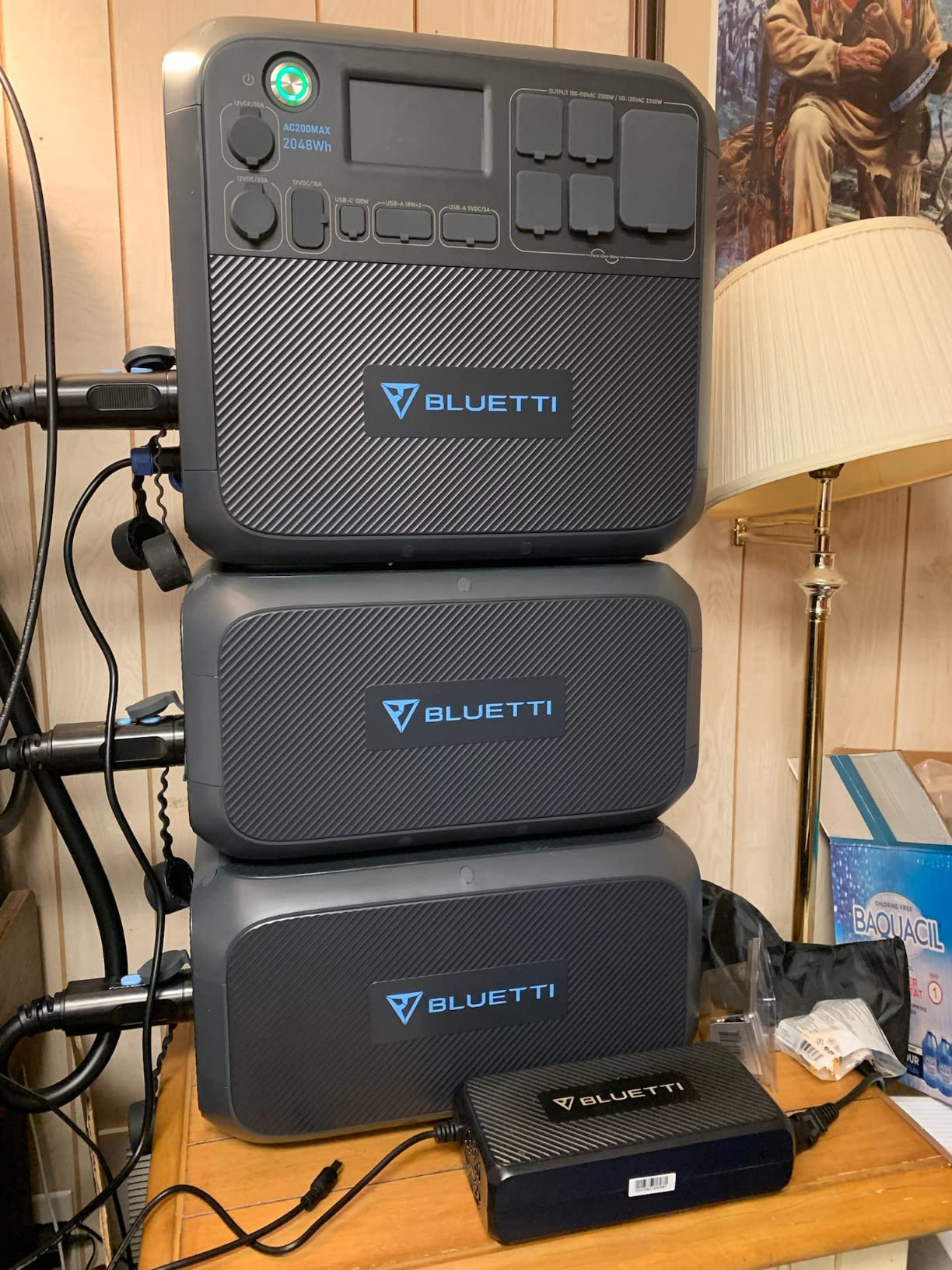
That combination matters more than the spec sheet suggests. Most power stations force a choice between capacity and flexibility — you either buy a bigger box up front or you accept that you’re stuck with whatever capacity you started with. The AC200 Max takes a different approach: buy the base unit at a reasonable capacity, then bolt on a B230 or B300 expansion battery later if your needs grow, pushing total storage as high as 8192Wh without replacing the whole unit. For anyone comparing this to the best solar powered generators on the market right now, that expandability is the single feature that keeps the AC200 Max relevant well after newer models have launched.
Before going further, it’s worth being upfront about who this unit is genuinely built for. If you want something you can toss in a daypack for a weekend hike, this isn’t it — at nearly 62 pounds, it’s a two-handed lift, not a backpack item. But if you’re thinking about home backup during outages, van life or RV power, a base camp setup, or a job site that needs to run tools without a fuel generator, the AC200 Max earns a serious look. The rest of this review walks through exactly why, section by section, using real specifications rather than marketing language.
Where the AC200 Max Fits in Bluetti’s Lineup
Bluetti has released several units in the “AC200” family over time, each iterating on the last in slightly different directions. The original AC200P established the 2000Wh-class, high-output formula. The AC200 Max refined that formula by adding true modular expansion — the ability to physically snap on more battery capacity — along with a bump in continuous output and a cleaner port layout. Later models in the same family pushed AC charging speed and WiFi connectivity further, but the AC200 Max still occupies a specific niche: it’s the version that balances price, capacity, and expandability most evenly, which is a big part of why it remains a frequent recommendation even as newer siblings have launched around it. If you’re comparing generations, the trade-off is usually simple — newer models charge faster from a wall outlet, while the AC200 Max still wins on price-to-capacity ratio and proven reliability, since it’s had more time in the field to accumulate real ownership data.
What’s Actually in the Box
A typical AC200 Max package includes the power station itself, an AC charging cable, a car charging cable for 12V socket input, an MC4-to-XT90 solar charging cable for connecting compatible panels, and printed documentation covering setup, safety, and warranty registration. Solar panels, expansion batteries, and generator-charging cables are sold separately, which is standard across nearly every brand in this category and worth budgeting for if your use case depends on solar input from day one rather than as a future upgrade.
First Impressions Out of the Box
Unboxing the unit, the first thing that stands out is the density — for its footprint, it feels considerably heavier than it looks, a reminder of just how much battery mass is packed into that chassis. The second thing that stands out is how quickly it’s usable: there’s no lengthy setup process, no firmware update required before first use, and no confusing multi-step activation. Press the power button, and the display lights up with a live readout of battery percentage, ready to accept a charge or start delivering power immediately. For anyone who has struggled through a clunky setup process with other electronics, that immediacy is a small but genuine point in the AC200 Max’s favor.

Check current pricing and availability — Bluetti frequently runs bundle discounts on solar panels and expansion batteries.
Check Price on AmazonDesign & Build Quality
Physically, the AC200 Max looks like what it is: a dense, purposeful block rather than a lifestyle accessory. It measures roughly 16.5 x 11 x 15.2 inches and weighs 61.9 pounds, which puts it firmly in “carry with both hands” territory rather than “sling it over one shoulder.” Two molded handles sit on the top corners, spaced far enough apart that two people can lift it comfortably if you’re loading it into a truck bed or up a flight of stairs.
The chassis is a mix of matte-finished, impact-resistant plastic panels over an internal metal frame. It doesn’t feel flimsy anywhere, including around the port cluster, which is the part of most power stations that shows wear first. The front face houses a full color LCD screen that displays input wattage, output wattage, remaining runtime estimate, and battery percentage at a glance — no squinting at tiny icons required. A physical dial and buttons sit below the display, so you’re not entirely dependent on the companion app to toggle AC or DC output.
Fit, Finish, and Everyday Handling
Vents along the sides feed a pair of internal cooling fans that only spool up under heavier loads, which keeps the unit reasonably quiet during idle standby. The top surface includes two 15W wireless charging pads, a small but genuinely useful touch if you’re using the AC200 Max as a nightstand or desk power hub during a power outage. Rubberized feet on the bottom keep it from sliding on smooth flooring or a truck bed liner, and the overall footprint is compact enough to tuck under a desk, into a camper’s dinette storage, or beside a rack of shelving in a garage.
There’s no pretending this is an elegant piece of furniture — it looks like industrial equipment because that’s fundamentally what it is. But every design choice, from the recessed ports to the reinforced handle mounts, reads as functional rather than decorative, which is exactly what you want from something that might end up strapped into the back of a truck or living in a basement for years at a time.
The Display and Physical Controls in Detail
The front-facing LCD is bright enough to read in direct sunlight and dims automatically in low light, which matters more than it sounds during an actual power outage when you’re trying to check remaining runtime by flashlight. It cycles through input wattage (broken down by AC and solar where applicable), output wattage, a battery percentage readout, and an estimated time-to-empty or time-to-full figure that updates in real time as load changes. Below the screen, physical toggle buttons control the AC inverter, the DC output bus, and the wireless charging pads independently, so you can shut off outlets you’re not using to squeeze out a little extra standby efficiency without touching the app at all.
Build Materials and Long-Term Durability
The outer shell is an ABS-and-PC blend plastic commonly used in rugged consumer electronics, chosen for impact resistance rather than premium aesthetics. Internally, the battery pack and inverter board are isolated from the outer casing by a metal support frame, which helps the unit survive the kind of bumps and vibration that come with being transported in a truck bed or camper over rough roads. Bluetti backs the AC200 Max with a standard multi-year warranty (typically 24 months from the manufacturer directly, occasionally extended through retailer promotions), and separately, the LiFePO4 cell chemistry inside is inherently more tolerant of heat, vibration, and repeated deep discharge cycles than the lithium-ion cells found in some older or cheaper competing power stations — a detail that becomes especially relevant if this unit is going to live somewhere with fluctuating temperatures, like an uninsulated garage or the back of an RV.
Port Layout and Labeling
Every port on the front face is clearly labeled with both an icon and a wattage rating, which sounds like a minor detail until you’re trying to figure out, mid-outage, which outlet can safely handle a space heater versus which one is meant for a phone charger. Rubberized port covers over the less frequently used inputs (car charging, solar input) help keep dust and moisture out during storage, a small touch that extends the unit’s working life if it spends most of its time in a garage or shed rather than a climate-controlled room.
Battery Capacity & Power Output: The Numbers That Actually Matter
The AC200 Max ships with a 2048Wh LiFePO4 (lithium iron phosphate) battery pack. LiFePO4 chemistry is the detail worth paying attention to, because it’s meaningfully safer and longer-lasting than the older lithium-ion NMC cells that still show up in cheaper power stations. Bluetti rates this pack for 3500-plus cycles down to 80% of original capacity, and roughly 6000 cycles down to 50%. In plain terms: if you cycle it once a day, you’re looking at close to a decade of useful service before capacity meaningfully drops off.
On the output side, the built-in inverter delivers 2200W of continuous pure sine wave AC power, with a surge rating of 4800W for the split second it takes motor-driven appliances — refrigerators, power tools, air compressors — to kick on. Pure sine wave output matters here because it’s the same clean waveform your wall outlet delivers, which is safer for sensitive electronics like laptops, CPAP machines, and audio equipment than the modified sine wave output some budget units still use.
What 2048Wh Actually Runs
Watt-hours are an abstract number until you translate them into real appliances. Here’s roughly what you can expect from a full charge, accounting for typical inverter losses:
| Appliance | Typical Draw | Approx. Runtime on Full Charge |
|---|---|---|
| Mini fridge (compressor) | 60–100W | 16–24 hours |
| Laptop | 60W | ~28 hours |
| CPAP machine (no heater) | 40W | ~38 hours |
| Box fan | 75W | ~22 hours |
| Coffee maker | 1000W | ~1.6 hours |
| Microwave (900W) | 1000–1200W | ~1.4 hours |
| Portable AC unit | 800–1200W | ~1.5–2 hours |
| Circular saw (intermittent use) | 1400W peak | Dozens of short bursts |
The real advantage shows up when you need to scale past what the base unit offers. Because the AC200 Max accepts up to two B230 (2048Wh each) or two B300 (3072Wh each) expansion batteries, total capacity can reach 6144Wh or 8192Wh respectively without touching the AC output rating. That’s the difference between running a mini fridge overnight and running a mini fridge, a CPAP machine, and a string of lights through a multi-day outage without recharging once. If you want the deeper mechanics of how solar-fed batteries like this actually convert and store energy, this explainer on how a solar powered generator works is a useful companion read.
Why LiFePO4 Chemistry Is Worth Paying Attention To
Not all “lithium battery” claims are equal, and this is one of the more consequential specs buried in a typical listing. Standard lithium-ion cells (often NMC or NCA chemistry) pack slightly more energy into a smaller space, but they degrade faster under repeated deep discharge and carry a higher risk of thermal runaway if damaged, overcharged, or exposed to extreme heat. Lithium iron phosphate trades a small amount of energy density for a dramatically longer cycle life and a much wider margin of thermal safety. In practical terms, that’s the difference between a power station that’s still holding 80% of its original capacity after years of regular cycling, versus one that’s noticeably weaker within its first year or two of daily use. For a purchase in this price range, that longevity difference has a real effect on cost-per-use over the life of the product.
Depth of Discharge and Why It Matters for Longevity
Cycle-life ratings are always measured against a specific depth of discharge, and Bluetti’s 3500-cycle figure for the AC200 Max is rated to 80% remaining capacity, which is a realistic, honest way to present the number rather than an inflated best-case scenario. In practice, this means you don’t need to baby the battery or avoid running it down to conserve its lifespan — LiFePO4 chemistry is specifically built to tolerate full discharge-recharge cycles without the same degradation curve older battery types experience. That’s good news for anyone using this as a genuine daily-use power source rather than an occasional emergency backup that sits untouched for months at a time.
Continuous vs. Surge Power: What the Numbers Really Mean
The 2200W continuous rating is the number that determines what you can run indefinitely — anything drawing less than that can run for as long as the battery holds out. The 4800W surge rating is a different, shorter-duration number: it’s the ceiling the inverter can briefly supply (typically for a few seconds) to handle the startup spike that motor-driven appliances draw when they first switch on. A refrigerator compressor, a table saw, or a well pump might only draw 200-1500W once running, but demand two to three times that figure for a split second at startup. Without adequate surge headroom, those appliances simply won’t start at all, tripping the inverter’s overload protection instead. The AC200 Max’s 4800W surge ceiling gives it enough headroom to start the vast majority of common household and job-site motors without issue — one of the more meaningful practical advantages it holds over lower-output competitors that look similar on paper but stumble the moment a compressor tries to kick on.
Charging Options & Speed
This is arguably where the AC200 Max separates itself from cheaper competitors. Bluetti built in six distinct ways to recharge the unit: standard AC wall outlet, solar panels, a car’s 12V accessory socket, a gas or propane generator, a lead-acid battery bank (useful for RV owners with an existing house battery), and a combined AC-plus-solar mode that stacks both inputs simultaneously.
Solar Charging
Through its MC4 solar input, the AC200 Max accepts up to 900W of panel input, with an open-circuit voltage range of 10 to 145V and a 15A current ceiling. In good, direct sunlight with correctly matched panels, that’s enough to take the base unit from empty to full in a little under three hours. Bluetti’s own PV200 and PV350 rigid panels, or the foldable equivalents, are the most straightforward pairing, though the wide voltage range means most 12V-to-24V panel setups from other brands will work fine too.
AC Wall Charging and Combined Input
Plugged into a standard wall outlet, the built-in AC adapter delivers up to 500W on its own. That’s slower than some newer competitors that push 1000W-plus of pure wall charging, and it’s worth knowing going in if overnight recharge speed from a wall outlet alone is your priority. Where the AC200 Max claws that back is in combined mode: stack the 500W AC input with the 900W solar input and you get up to 1400W of simultaneous charging, which brings a full recharge down to roughly two to two-and-a-half hours under good conditions — genuinely fast for a unit in this capacity class.
| Charging Method | Max Input | Approx. 0–100% Time |
|---|---|---|
| AC Wall Outlet Only | 500W | ~4.5–5 hours |
| Solar Panels Only | 900W | ~2.5–3 hours (peak sun) |
| AC + Solar Combined | 1400W | ~2–2.5 hours |
| Car 12V Socket | ~100W | Best for top-ups, not full charges |
| Generator (via AC input) | 500W | Comparable to wall charging |
None of these numbers exist in a vacuum — they’re the direct reason a solar-charged setup can realistically sustain daily use rather than just serving as a one-time emergency reserve. If you’re trying to figure out how long a unit like this remains a reliable daily driver before performance starts to taper, this guide on how long a solar generator lasts breaks down the cycle-life math in more detail.
Generator and Lead-Acid Charging
For users who already own a fuel generator as a backup power source, the AC200 Max can be recharged through its standard AC input, effectively using the generator as a stand-in for a wall outlet. This is particularly useful during extended outages, since it lets you run the generator intermittently to top up the battery rather than keeping it running continuously — cutting fuel consumption and noise exposure significantly compared to powering appliances directly off the generator around the clock. The lead-acid charging option, meanwhile, is aimed squarely at RV owners who already have a 12V house battery bank installed; it allows the AC200 Max to draw from that existing battery system as a charging source, which is a niche but genuinely useful option for vehicles already wired around a secondary battery setup.
Standard Mode vs. Turbo Mode
Within the Bluetti app and on the physical display, users can toggle between “Standard” and “Turbo” charging modes when multiple input sources are connected simultaneously. Standard mode charges more conservatively, drawing power in a way that prioritizes battery longevity and produces less internal heat. Turbo mode pushes the unit to draw the maximum available wattage from every connected source at once, prioritizing speed over the marginal efficiency and thermal benefits of the standard setting. For most day-to-day use, Standard mode is the sensible default; Turbo mode earns its keep specifically in scenarios where you need the fastest possible recharge — for example, topping the unit back up between outages during a multi-day storm, or squeezing a full charge out of a short weather window before clouds roll back in.
Charging While in Storage
If the AC200 Max is going to sit unused for an extended period — over winter, for example, or between infrequent camping trips — Bluetti recommends storing it at roughly 60% charge rather than fully charged or fully depleted, and topping it up every three to six months. This is standard practice across LiFePO4 battery products generally and is one of the easier maintenance habits to build into a seasonal routine, since the wide storage temperature tolerance (14°F to 113°F) means most home storage locations, including an unheated garage, fall well within the safe range.
Pair it with a solar panel bundle for the fastest realistic recharge times listed above.
View Bundles on AmazonPorts & Connectivity
With 16 total outlets spread across AC, USB, DC, and wireless charging, the AC200 Max is built to run multiple devices at once without a power strip in sight. On the AC side, there are four standard 100-120V outlets plus a dedicated 30A NEMA TT-30 outlet, the same connector RVs use for shore power — a detail that instantly makes this unit relevant to anyone running camper appliances rather than just household electronics.
- AC Output: 4x standard outlets + 1x NEMA TT-30 (2200W continuous, 4800W surge)
- USB-A: 2x 5V/3A standard + 2x 18W fast-charge ports
- USB-C: 1x 100W port, enough to fast-charge a modern laptop directly
- DC Output: 1x 12V/30A “Super DC” port, 1x 12V/10A cigarette lighter socket, 2x 12V/10A DC5521 ports
- Wireless Charging: 2x 15W charging pads built into the top panel
The 100W USB-C port deserves a specific callout, since it means many modern laptops no longer need to occupy one of the AC outlets just to charge — freeing those up for appliances that actually require AC power. The dual wireless charging pads are a small but genuinely thoughtful inclusion for phone charging without hunting for a cable during a power outage or a night at a campsite.
One practical limitation worth flagging: the AC200 Max does not support 240V split-phase output on its own, so it can’t directly power large 240V appliances like an electric dryer or a well pump without additional equipment. For most home backup, RV, and off-grid scenarios that’s a non-issue, but it’s worth knowing before you buy if that’s specifically what you need it for.
Running Multiple Devices Simultaneously
Because the total port count is spread across independent AC, USB, and DC circuits, it’s realistic to run several devices at once without them competing for the same power budget in a way that trips a breaker unexpectedly. A typical multi-device load during an outage might look like: a mini fridge and a string of LED lights on the AC outlets, a laptop charging over USB-C, two phones on the wireless pads, and a portable fan on one of the DC outputs — all running comfortably within the 2200W ceiling with plenty of headroom to spare. The practical upper limit isn’t the number of devices; it’s the combined wattage they draw, which the front display tracks in real time so you always know exactly how much of your budget is in use.
The 30A RV Outlet in Practice
For camper and RV owners specifically, the NEMA TT-30 outlet effectively turns the AC200 Max into a substitute for shore power hookups at campgrounds without electrical service, or as a bridge between hookups during travel days. It’s wired to draw from the same 2200W continuous budget as the standard AC outlets, so it doesn’t provide extra headroom beyond the unit’s overall rating — but having the correct plug shape built in means no adapters, no jury-rigged extension cords, and no risk of using an incompatible outlet under load.
App & Smart Features
Bluetti’s companion app connects to the AC200 Max over Bluetooth. It’s worth noting up front that this generation connects via Bluetooth only — it doesn’t support WiFi, meaning remote monitoring only works when your phone is within Bluetooth range of the unit itself, not from across town or while you’re at work. Newer Bluetti models have since added WiFi, so if remote-anywhere monitoring is a priority, that’s a meaningful point of comparison to check before buying.
Within Bluetooth range, though, the app does its job well. You can toggle AC and DC output independently, switch charging priorities between “standard” and “turbo” (which controls how aggressively the unit draws from AC and solar input simultaneously), monitor real-time input and output wattage, check remaining runtime estimates, and push firmware updates without needing a computer. There’s also an Eco Mode that automatically shuts off the AC inverter after a set period of low or no load, which meaningfully reduces standby power draw — a detail that matters if you’re planning to leave the unit connected to solar for weeks at a time between uses.
The physical control panel mirrors most of this functionality directly on the unit, so the Bluetooth-only limitation is more of an inconvenience than a dealbreaker. You’re never locked out of basic controls just because your phone is out of range.
Dashboard Layout and Daily Use
Opening the app presents a single dashboard screen showing a graphic of the unit itself, with live wattage numbers overlaid on the relevant input and output zones — solar coming in on one side, AC and DC output flowing out the other, with the battery percentage displayed prominently in the center. It’s a genuinely intuitive layout for anyone who isn’t deeply technical; you don’t need to interpret raw numbers in a table to understand what’s happening, you can see it represented visually in a way that mirrors the physical unit sitting in front of you.
Firmware Updates and Long-Term Support
Bluetti pushes firmware updates through the app periodically, addressing everything from minor bug fixes to improvements in charging efficiency and battery management logic. Updating requires the unit to stay in Bluetooth range and powered on for the duration of the update, which typically takes a few minutes. Given how central firmware is to getting the most accurate runtime estimates and charge-cycle protection over the life of the product, it’s worth checking for updates every few months rather than treating the app purely as a one-time setup tool.
Where the Bluetooth-Only Limitation Actually Bites
The lack of WiFi connectivity mostly matters in one specific scenario: monitoring the unit remotely while you’re away from it entirely — checking on a cabin’s power reserves from home, for instance, or glancing at battery status from work during a home power outage. For anyone whose primary use case is exactly that kind of remote monitoring, it’s worth weighing this limitation seriously against newer Bluetti models or competitors that do offer WiFi connectivity, since it’s one of the few areas where the AC200 Max has been meaningfully surpassed by units released after it.
Real-World Performance & Use Cases
Specs sheets tell you what a unit is capable of; they don’t tell you what it’s actually like to live with. Across the most common use cases — home backup, RV and van life, off-grid cabins, and job sites — the AC200 Max performs consistently, with a few standout moments and a few honest limitations.
Home Backup During Outages
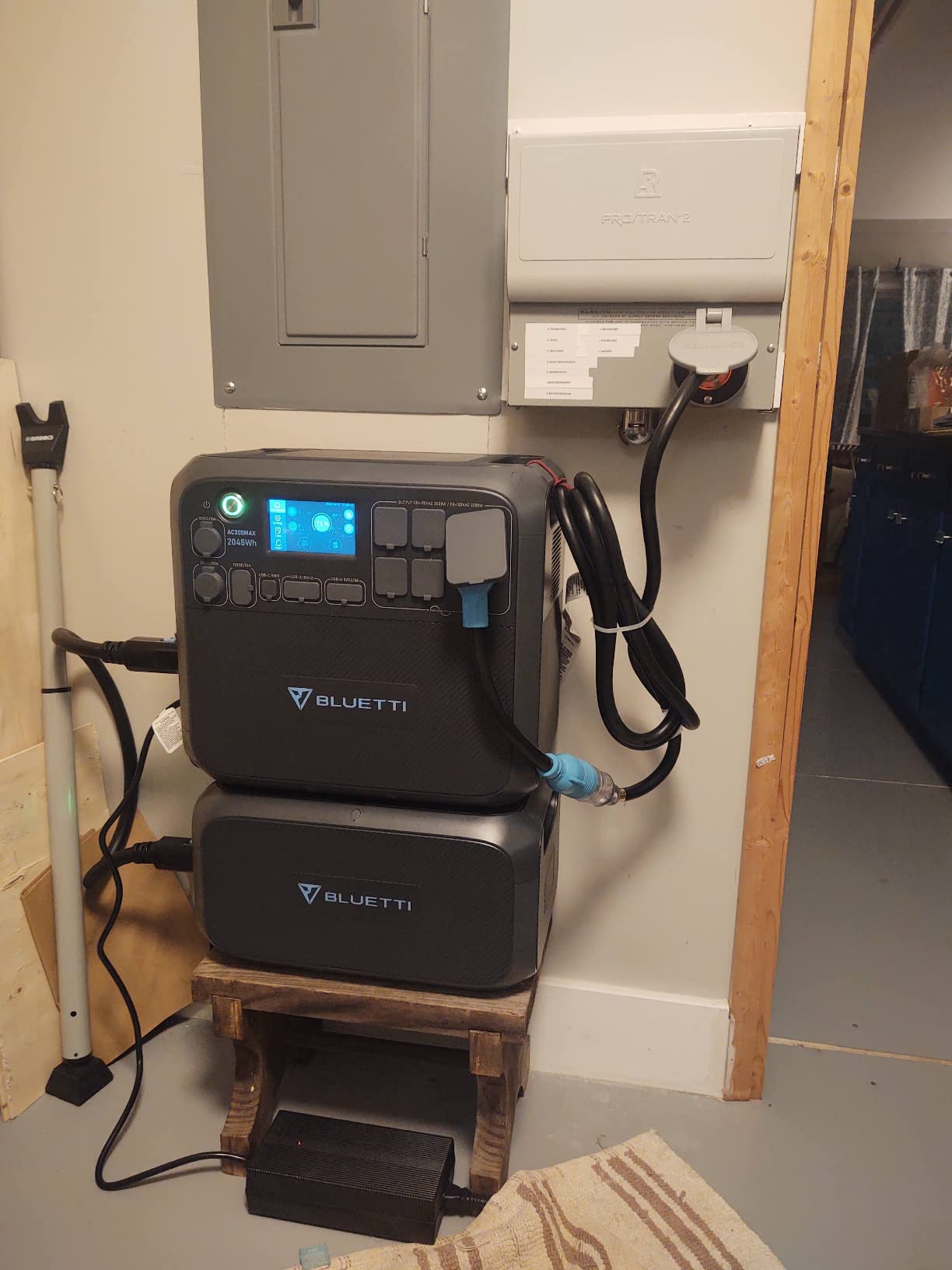
This is where the unit feels most at home. Pre-charged and sitting in a closet, it can carry a refrigerator, WiFi router, a few lamps, and phone charging through a multi-hour outage without breaking a sweat, and the UPS-style pass-through switching (rated at roughly 20 milliseconds) means it can sit between the wall and sensitive electronics as a mini uninterruptible power supply, catching brief outages before a desktop computer or router even notices the drop.
RV and Van Life
The dedicated 30A NEMA TT-30 outlet is the feature that makes this a genuinely RV-relevant purchase rather than a generic power bank pressed into service. Paired with a couple of rooftop solar panels, it’s realistic to run camper lighting, a fan, phone and laptop charging, and short bursts on a microwave or induction cooktop for a weekend trip without hooking up to shore power at all.
Off-Grid Cabins and Base Camps
For a cabin without grid access, the expandability story becomes the whole pitch. Starting with the base 2048Wh unit and adding a B300 expansion battery down the line means the system can grow alongside actual usage patterns instead of forcing an all-or-nothing purchase decision on day one.
Job Sites and Power Tools
The 4800W surge rating handles the startup spike from most corded power tools without issue, though continuous heavy-draw tools like table saws or larger compressors will eat through the 2048Wh base capacity faster than most users expect — this is a scenario where an expansion battery pays for itself quickly.
How Real-World Testing Was Approached
Runtime figures for products in this category are only as useful as the honesty behind how they’re measured. Real-world numbers referenced throughout this review are based on manufacturer-published specifications combined with typical appliance draw figures, factoring in the standard 10-15% inverter conversion loss that applies to essentially every AC-output power station on the market. Actual results in your own setup will vary based on ambient temperature, the specific appliances involved, cable quality, and how close to the unit’s rated capacity you’re running — treat the numbers here as a realistic planning baseline rather than a guaranteed outcome down to the minute.
Cold Weather and Extreme Heat Performance
LiFePO4 batteries, including the pack inside the AC200 Max, lose some usable capacity in cold conditions, similar to how a car battery struggles on a freezing morning. Bluetti’s documented discharge range extends down to -4°F, but practically speaking, performance and charging speed both taper as temperatures approach that lower limit. For winter storm-prep scenarios specifically, keeping the unit in a heated space (even an attached but unheated garage that stays above freezing) rather than fully exposed to outdoor temperatures will noticeably improve both charging speed and total available runtime when you need it most.
Recovery Speed Between Uses
One underrated aspect of real-world performance is how quickly the unit can be put back into service after a full discharge. With the combined 1400W AC-plus-solar charging path active, a fully depleted AC200 Max can return to roughly 80% capacity in well under two hours — a meaningful advantage during multi-day outages where the unit needs to cycle between discharge and recharge repeatedly rather than getting one long, uninterrupted charging window.
See real-time stock and current bundle pricing directly on Amazon.
Check AvailabilityNoise, Heat & Efficiency
At idle or under light load — charging a phone, running a laptop — the internal fans stay off or spin at a barely-audible level, comparable to a quiet refrigerator hum. Under heavier draw, particularly during fast AC+solar combined charging or when powering something in the 1000W-plus range, the cooling fans ramp up noticeably. It’s not disruptive in a garage or utility room, but it’s audible enough that you’ll notice it in a quiet bedroom.
Heat management is handled well for the unit’s size — vented side panels and internal fans keep internal temperatures within Bluetti’s rated operating range (roughly -4°F to 104°F for discharge) even during extended high-load sessions. Efficiency losses from DC-to-AC inversion are typical for this class of pure sine wave inverter, generally in the 10-15% range, which is already factored into the real-world runtime estimates covered earlier in this review.
Noise Levels in Different Environments
In a bedroom or quiet office setting, the fan noise under moderate load (500-1000W) is comparable to a laptop cooling fan running under a moderate workload — noticeable if you’re specifically listening for it, but not disruptive to conversation or sleep for most people. Under sustained heavy load closer to the 2200W ceiling, fan noise increases to a level similar to a small space heater or box fan on a low setting. In garages, basements, campers, and outdoor settings — which is where this unit spends most of its working life — none of this registers as a meaningful concern.
Long-Term Maintenance Habits Worth Adopting
Beyond the storage charge-level guidance covered earlier, a handful of simple habits go a long way toward keeping the AC200 Max healthy over years of ownership: keeping the vents clear of dust buildup, avoiding prolonged exposure to direct sunlight or extreme heat when it’s not actively in use, and checking for firmware updates every few months so the battery management system is always running the latest optimization logic. None of this is demanding maintenance — it’s closer to the kind of light upkeep you’d give any major appliance — but skipping it entirely over a multi-year ownership period is one of the more common ways owners see faster-than-expected capacity fade.
Standby Power Draw
Left plugged in and idle with no connected load, the AC200 Max draws a small amount of standby power to run its display, BMS (battery management system), and any active wireless charging pads. The Eco Mode feature in the app helps minimize this by automatically powering down the AC inverter after a configurable period of no AC-side load, which is particularly useful if the unit is being kept charged and ready as a standby backup rather than actively powering something around the clock.
Portability & Ergonomics
“Portable” is doing a lot of work in this product category’s marketing, and it’s worth being direct about what that means here. At 61.9 pounds, the AC200 Max is not something you carry any real distance solo without discomfort. The dual top handles are well-positioned for a two-person lift, and it slides reasonably well across smooth surfaces thanks to its flat, wide base, but this is fundamentally a unit you position once — in a truck bed, a camper’s storage bay, a garage shelf, a closet — and then leave largely in place.
Compare that to lighter, lower-capacity units designed for actual backpack-style portability, and the trade-off becomes clear: the AC200 Max sacrifices grab-and-go convenience in exchange for capacity and expandability that lighter units simply can’t match. If frequent carrying over distance is a priority, it’s worth cross-shopping something like the Jackery Explorer 1000, which trades capacity for a genuinely lighter build.
Moving It Between Locations
For most owners, the unit gets moved far less often than the word “portable” implies — typically once when it’s set up in its primary location, and occasionally again when it’s loaded into a vehicle for a trip. The wide, flat base and low center of gravity make it stable when sitting in a truck bed or camper storage bay, and it doesn’t require any special bracing or tie-down beyond what you’d use for any heavy, boxy cargo. If wheels are a priority for your specific situation, it’s worth noting that the AC200 Max doesn’t include a built-in cart or wheeled base the way some larger, home-backup-focused units do — a rolling equipment dolly is a reasonable low-cost workaround if the unit needs to move frequently within a garage or workshop.
Expansion Batteries Add Weight, Not Just Capacity
It’s worth factoring the weight of expansion batteries into your portability expectations as well. A B230 or B300 module adds a comparable amount of weight to the base unit, meaning a fully expanded system with two expansion batteries attached can approach or exceed 150 pounds combined. That configuration is realistically a stationary, set-it-and-leave-it setup rather than something moved regularly — which is a reasonable trade-off if maximum capacity, not mobility, is the priority for your specific use case.
Bluetti AC200 Max vs. Jackery, EcoFlow, and Goal Zero
No power station review is complete without placing it next to the competition. Here’s how the AC200 Max stacks up against three of its most commonly cross-shopped rivals on the specs that matter most.
| Model | Capacity | AC Output | Expandable | Max Solar Input |
|---|---|---|---|---|
| Bluetti AC200 Max | 2048Wh | 2200W | Up to 8192Wh | 900W |
| Jackery Explorer 1000 | 1002Wh | 1000W | No | ~800W (varies by kit) |
| EcoFlow Delta 2 | 1024Wh | 1800W (X-Boost to 2400W) | Up to 3040Wh | 500W |
| Anker 767 PowerHouse | 2048Wh | 2400W | Up to 6144Wh | 1000W |
| Goal Zero Yeti 1500X | 1516Wh | 2000W | Limited | 600W |
The pattern that emerges is fairly clear. Against the Jackery Explorer 1000, the AC200 Max wins decisively on raw capacity and expandability, but concedes weight and true portability. Against the EcoFlow Delta 2, the AC200 Max again leads on base capacity and total expandable ceiling, though the Delta 2 charges faster from a wall outlet out of the box. The closest real rival on paper is the Anker 767 PowerHouse, which matches the AC200 Max’s base capacity and actually edges it out slightly on continuous AC output and solar input ceiling — a genuinely close call worth reading up on directly. Against the Goal Zero Yeti 1500X, the AC200 Max wins on nearly every hard spec, though Goal Zero’s ecosystem and customer support reputation still carries weight for some buyers.
For a more exhaustive side-by-side that isolates just these three brands across pricing, warranty terms, and app ecosystems, this dedicated Bluetti vs Jackery vs EcoFlow comparison is worth reading before making a final call.
Warranty and Ecosystem Considerations
| Model | Standard Warranty | App Connectivity | Best Suited For |
|---|---|---|---|
| Bluetti AC200 Max | 24 months | Bluetooth only | Home backup, RV, expandable capacity |
| Jackery Explorer 1000 | 24–36 months | None / limited | Lightweight camping, quick trips |
| EcoFlow Delta 2 | 24 months | Bluetooth + WiFi | Fast charging, remote monitoring |
| Anker 767 PowerHouse | 60 months | Bluetooth + WiFi | Long-term reliability, extended warranty |
| Goal Zero Yeti 1500X | 24 months | Bluetooth + WiFi | Established brand support ecosystem |
Warranty length is one of the more revealing indicators of how confident a manufacturer is in their own hardware, and it’s worth weighing alongside raw specs rather than as an afterthought. The Anker 767’s five-year warranty is a genuine standout in this comparison set and a legitimate reason to cross-shop it directly against the AC200 Max if long-term peace of mind matters more to you than a slightly lower base price.
Jackery Explorer 1000: The Lightweight Alternative
The Jackery Explorer 1000 represents a fundamentally different design philosophy — roughly a third of the AC200 Max’s capacity, but correspondingly lighter and easier to carry solo. For anyone whose primary use case genuinely involves frequent carrying (car camping where you’re setting up and breaking down often, or a smaller RV without room for a 62-pound unit), Jackery’s lighter build is the more sensible pick despite giving up considerable capacity and expandability.
EcoFlow Delta 2: Faster Charging, Less Raw Capacity
The EcoFlow Delta 2 charges from a wall outlet dramatically faster than the AC200 Max — often reaching a full charge in under an hour under ideal conditions — which makes it a strong pick for anyone who prioritizes rapid turnaround over maximum standalone capacity. Where it falls behind is in expandability ceiling and base battery size; the AC200 Max simply holds twice the energy before any expansion batteries even enter the conversation.
Anker 767 PowerHouse: The Closest True Rival
Of every unit in this comparison, the Anker 767 PowerHouse is the one that genuinely competes head-to-head with the AC200 Max on paper — matching base capacity, slightly exceeding continuous output, and backed by a considerably longer warranty. The decision between these two often comes down to brand ecosystem preference, current pricing and bundle deals, and which company’s app and customer support experience you’d rather rely on over a multi-year ownership period, since the hard specs are close enough that either is a defensible choice.
Goal Zero Yeti 1500X: Paying for Brand Trust
The Goal Zero Yeti 1500X trails the AC200 Max on nearly every raw spec — lower capacity, lower solar input ceiling, more limited expansion options — but Goal Zero has built a long-standing reputation in the outdoor and emergency-preparedness space that some buyers are willing to pay a premium for. If established brand history and a broad accessory ecosystem matter more to you than winning on spec-sheet numbers, that’s a legitimate reason to consider it anyway.
Pros and Cons
After going through the specs, the real-world scenarios, and the head-to-head comparisons, the picture that emerges is consistent: the AC200 Max is a specialist tool, not a do-everything gadget. It’s built to excel at high-capacity, high-output, expandable power delivery, and it makes deliberate trade-offs elsewhere to get there. Here’s the complete list, gathered in one place.
What Works Well
- Expandable up to 8192Wh without replacing the base unit
- 2200W continuous output handles most household appliances
- LiFePO4 battery rated for 3500+ cycles to 80% capacity
- Six recharging methods, including combined AC+solar at 1400W
- 16 total ports including a 100W USB-C and dedicated RV outlet
- Genuinely quiet at idle and light load
Where It Falls Short
- At 61.9 pounds, it’s not truly portable in the backpack sense
- App connects via Bluetooth only — no WiFi remote monitoring
- 500W standalone wall charging is slower than some rivals
- No native 240V split-phase output for large appliances
- Expansion batteries add significant extra cost
Who Should Buy the Bluetti AC200 Max?
The honest answer depends less on budget and more on what you’re actually trying to solve. If your goal is a light, grab-and-go battery for the occasional weekend trip, this is more capacity and weight than you need — a smaller, lighter unit will serve you better. But if you’re planning around any of the following, the AC200 Max earns its place on the shortlist:
- You want home backup that can run a fridge, WiFi, and lighting through a multi-hour or multi-day outage
- You’re outfitting an RV or van and want a dedicated 30A shore-power-style outlet
- You want a system that can grow in capacity over time rather than locking you into one number forever
- You need enough continuous wattage (2200W) to run power tools, kitchen appliances, or a portable AC unit
If you’re still not sure exactly how much capacity your specific situation calls for, this breakdown of what size solar generator you actually need walks through the math using your own appliance list rather than generic assumptions, and it’s a genuinely useful gut-check before committing to any unit in this price range, including this one.
Scenario-Based Decision Guide
If you’re still torn, mapping your specific situation against these common scenarios can help clarify the decision faster than comparing spec sheets alone:
- “I want peace of mind for the next storm season” — The base 2048Wh unit alone, kept charged and stored, covers most short-to-medium outages without needing any expansion battery.
- “I’m setting up a van or small RV build” — Prioritize the 30A outlet and pair it with one or two rooftop solar panels sized to the 900W input ceiling for realistic daily recharging on the road.
- “I’m building an off-grid cabin from scratch” — Budget for at least one B300 expansion battery from the outset, since retrofitting later is easy but starting under-provisioned means more frequent recharging cycles early on.
- “I need it mainly for job-site tools” — Pay close attention to the continuous 2200W ceiling against your specific tools’ running wattage, not just their surge/startup number, since sustained heavy tools drain capacity fast.
- “I mainly need small-electronics backup” — This may be more unit than you need; a smaller, lighter power station in the 500-1000Wh range will likely cover phones, laptops, and lighting for less money and less bulk.
Budgeting for the Full System, Not Just the Base Unit
One of the easiest mistakes to make with a modular system like this is budgeting only for the base unit and being surprised later by the cost of solar panels, expansion batteries, or specialty cables. If solar charging is part of your plan from day one, price in a panel set sized to get reasonably close to the 900W input ceiling — undersized panels will still work, just with proportionally slower charging. If you anticipate needing more than the base 2048Wh within the first year of ownership, it’s often more cost-effective to buy an expansion battery as part of a bundle deal at the same time as the base unit rather than purchasing it separately later.
Ready to compare pricing? Bluetti’s Amazon listing often includes solar panel and expansion battery bundles at a discount.
See Current PriceFrequently Asked Questions
How long does the Bluetti AC200 Max battery actually last?
Bluetti rates the LiFePO4 battery for 3500-plus cycles down to 80% capacity, and roughly 6000 cycles down to 50%. Cycling it once daily, that translates to nearly a decade of regular use before capacity noticeably declines, assuming it’s stored and charged within the recommended temperature range.
Can the Bluetti AC200 Max run a full-size refrigerator?
Yes, for the compressor’s running wattage (typically 60-150W), and the 4800W surge rating comfortably absorbs the startup spike most compressors draw. Runtime will depend on the fridge’s specific draw and door-opening frequency, but a full charge typically covers 16-24+ hours on a standard-size unit.
How many solar panels do I need to fully charge it?
To reach the 900W max solar input, you’d typically need three to five 200W panels wired correctly for the unit’s voltage window, depending on panel efficiency and available sunlight. Fewer panels will still charge the unit, just more slowly.
Is the Bluetti AC200 Max worth it compared to cheaper alternatives?
If you need the expandability, the 2200W continuous output, or the dedicated RV outlet, yes — those features aren’t matched by most cheaper units. If your needs are lighter (phone charging, small electronics only), a smaller and less expensive power station will likely serve you just as well for less money.
Does it work with WiFi for remote monitoring?
No. This generation of the AC200 Max connects to Bluetti’s app over Bluetooth only, so remote monitoring works within Bluetooth range of your phone, not from across town. Newer Bluetti models have since added WiFi connectivity.
Can I expand the battery capacity later instead of buying it all upfront?
Yes — this is one of the AC200 Max’s defining features. You can add up to two B230 (2048Wh each) or two B300 (3072Wh each) expansion batteries after your initial purchase, scaling total capacity to 6144Wh or 8192Wh respectively.
How heavy is the Bluetti AC200 Max, and is it truly portable?
It weighs 61.9 pounds and measures 16.5 x 11 x 15.2 inches. It’s portable in the sense that it can be moved between locations with two hands or two people, but it’s not designed for carrying long distances or hiking.
Can it power a CPAP machine overnight?
Yes. A standard CPAP without a heated humidifier typically draws around 40W, which the AC200 Max can sustain for well over 30 hours on a single charge — more than enough for multiple nights between recharges.
What’s the fastest way to recharge the AC200 Max?
Combining AC wall power (500W) with solar input (900W) simultaneously delivers up to 1400W of total charging, bringing a full recharge down to roughly two to two-and-a-half hours under good conditions — faster than either method used alone.
Does the Bluetti AC200 Max support 240V appliances?
No, not natively. It outputs standard 120V AC through its four outlets and the 30A RV outlet, but it doesn’t provide native 240V split-phase output for large appliances like electric dryers without additional equipment.
Is the Bluetti AC200 Max safe to leave plugged in and charging all the time?
Yes. The built-in battery management system regulates charge levels and prevents overcharging, and the LiFePO4 cell chemistry tolerates being kept at or near full charge far better than older lithium-ion battery types. That said, Bluetti’s own guidance for long-term storage still recommends keeping it around 60% charge if it’s going to sit unused for several months at a stretch, primarily to maximize long-term cycle life rather than out of any safety concern.
Can I use the Bluetti AC200 Max and an expansion battery together while running solar input at the same time?
Yes. Expansion batteries connect directly to the base unit and charge alongside it, and solar or AC input continues to feed the combined system as a single pool of capacity. The base unit’s inverter and port cluster remain the single point of AC output regardless of how many expansion batteries are attached, so total output wattage doesn’t increase with expansion — only total stored capacity does.
Final Verdict: Should You Buy the Bluetti AC200 Max?
The Bluetti AC200 Max isn’t trying to be the lightest or the flashiest power station on the market, and it doesn’t need to be. Its case rests on three things that hold up under real use: a 2200W continuous output that handles genuine household and job-site demands, an expandable battery architecture that lets your capacity grow instead of forcing an all-or-nothing purchase, and a charging system flexible enough to pull from solar, a wall outlet, a car, a generator, or a lead-acid bank depending on the situation you’re in. The trade-offs — its weight, the Bluetooth-only app, and the merely average standalone wall-charging speed — are real, but they’re the kind of trade-offs that come from prioritizing capacity and longevity over convenience features. For home backup, RV power, or a base camp that needs to run for days rather than hours, that’s the right set of priorities to have chosen.
If your situation matches any of the scenarios covered in the buying guide above — storm-season preparedness, an RV or van build, an off-grid cabin, or job-site tool support — the AC200 Max earns its spot on a shortlist alongside the Jackery, EcoFlow, Anker, and Goal Zero units it’s been compared against throughout this review. Weigh the comparison tables, match the numbers against your own appliance list, and buy based on the capacity and expandability path that fits where you’ll actually be using it, not just the spec sheet in isolation.
Check Current Price on Amazon