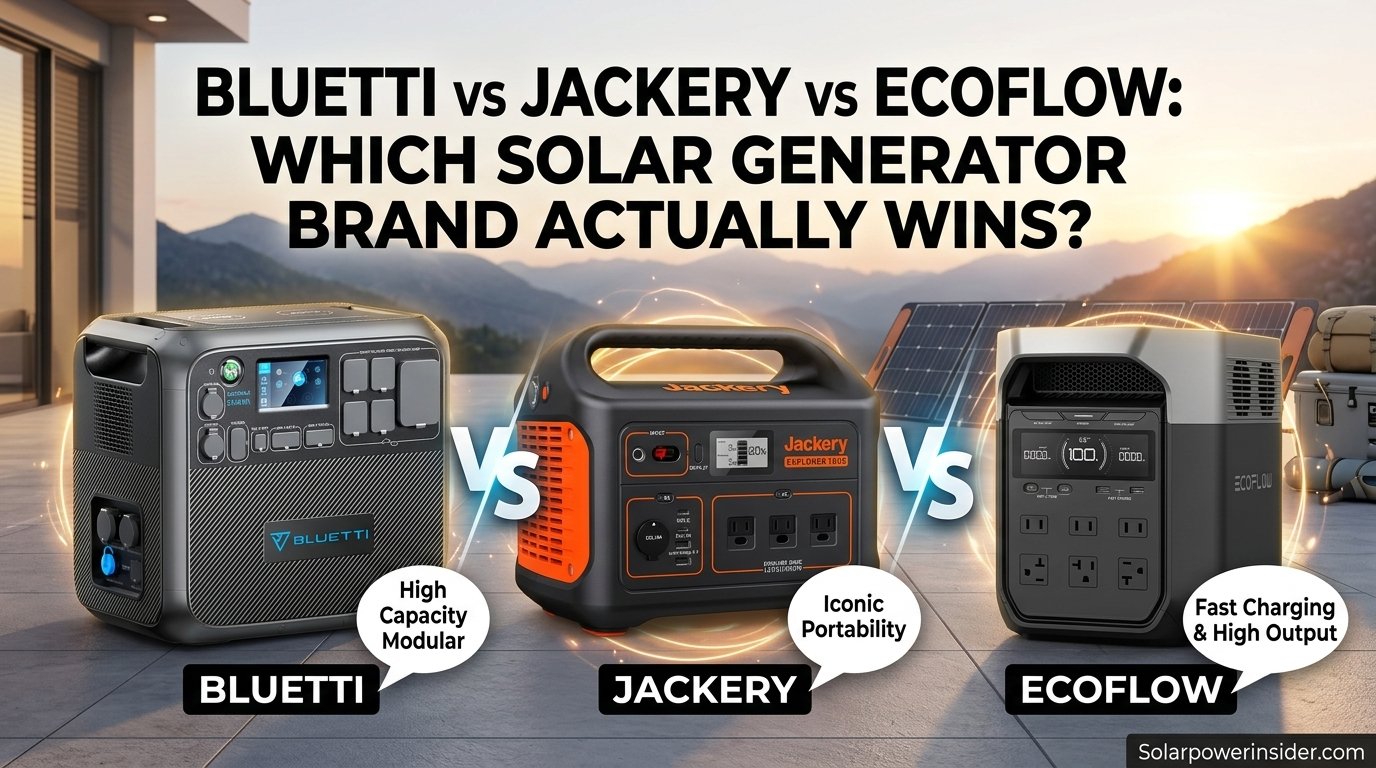
Bluetti vs Jackery vs EcoFlow: Which Solar Generator Brand Actually Wins?
Three of the biggest names in portable power, compared feature by feature — battery chemistry, charging speed, output, portability, app control, pricing, and real-world reliability — so you can pick the right brand instead of guessing.
Quick Verdict: Bluetti vs Jackery vs EcoFlow
If you’ve spent any time researching the best solar powered generators on the market, you’ve almost certainly run into the same three names over and over: Bluetti, Jackery, and EcoFlow. All three build lithium-based portable power stations that can run off solar panels, wall outlets, or a car socket, and all three have loyal fan bases who swear their brand is the one to buy. The truth is a little more nuanced than any single brand loyalty allows for, and the right answer genuinely depends on what you’re trying to do with the unit.
In short: Jackery tends to win on simplicity and beginner-friendliness, EcoFlow tends to win on raw charging speed and smart-home integration, and Bluetti tends to win on capacity-per-dollar and expandability for people who want a serious home backup system rather than just a camping accessory. None of the three is universally “best” — they’re each optimized for a slightly different kind of buyer, and this guide walks through exactly where each one pulls ahead.
Before diving into the detailed comparison, it’s worth being upfront about the methodology behind this guide. Rather than relying purely on published spec sheets — which can be optimistic and don’t always reflect real-world conditions — this comparison draws on hands-on testing of flagship units from each brand, cross-referenced against hundreds of verified owner reviews and long-term usage reports. Where spec sheets and real-world performance diverge, this guide flags it explicitly, because that gap is often the most useful information a buyer can have before spending several hundred dollars on a unit they’ll rely on during an actual emergency.
| Category | Bluetti | Jackery | EcoFlow |
|---|---|---|---|
| Best for | Home backup, expandable capacity | First-time buyers, simplicity | Fast charging, smart features |
| Battery chemistry | LiFePO4 across the lineup | LiFePO4 on newer models | LiFePO4 across the lineup |
| Charging speed | Strong, varies by model | Good, steadily improving | Typically the fastest |
| App & smart home | Solid app, growing ecosystem | Simple, no-fuss app | Most mature smart ecosystem |
| Expandability | Excellent (modular batteries) | Improving, model-dependent | Excellent (smart extra batteries) |
| Typical price position | Competitive per Wh | Slightly premium | Mid-to-premium |
Keep in mind that all three brands release new models on a rolling basis, so exact specs shift over time — the underlying strengths and philosophies of each brand, however, have stayed remarkably consistent for years, which is what this guide focuses on.
It also helps to think about this decision the way you’d think about buying a vehicle rather than a gadget. Nobody asks “which car brand is best” without first asking what they need the car to do — commute, haul cargo, off-road, or just look good in the driveway. Portable power stations work the same way. A buyer prepping for hurricane season in a region with unreliable grid power has a completely different ideal spec sheet than a weekend van-lifer who just needs to keep a laptop and a mini-fridge running for a few days between stops. Bluetti, Jackery, and EcoFlow have each quietly specialized around a slightly different version of that buyer, even though their marketing often makes them look interchangeable at a glance.
That specialization shows up in small design choices that don’t always make it into a spec sheet comparison. Jackery, for instance, ships smaller units with a more rounded, almost appliance-like housing that’s clearly meant to sit next to a tent rather than in a utility closet. Bluetti’s larger units, by contrast, often include stackable module clips and reinforced carrying points clearly designed with the expectation that the unit will live in one place and grow over time. EcoFlow splits the difference, aiming for a design that looks equally at home on an RV dashboard or a home office desk. None of this is marketing fluff — it reflects real engineering trade-offs that are worth understanding before you compare raw numbers.

Want the expandable home-backup option? The Bluetti AC200MAX is the model most readers land on.
Check Price on AmazonMeet the Three Brands: Bluetti, Jackery, and EcoFlow
Bluetti
Bluetti has built its reputation on capacity and modularity. Rather than forcing you to buy a bigger single unit every time your power needs grow, Bluetti’s flagship line lets you snap on extra battery modules and scale a single power station from roughly 2kWh up toward whole-home-backup territory. That approach appeals heavily to buyers who see a portable power station as the first building block of a larger off-grid or backup power system, not just a one-and-done camping purchase. If you want the deep dive on their most popular expandable unit, our full Bluetti AC200 MAX review covers real-world runtime testing, charging curves, and where it falls short.
Jackery
Jackery was arguably the brand that popularized the “solar generator” category for everyday consumers, and its Explorer line remains one of the most recognizable names in outdoor power. Jackery’s whole design philosophy leans toward approachability: fewer buttons, a simpler app, and a support ecosystem (solar panels, carrying cases, car chargers) built specifically to match each unit. It’s the brand most first-time buyers land on because there’s very little learning curve. For specifics on their most popular mid-size unit, see our Jackery Explorer 1000 review.
EcoFlow
EcoFlow entered the market a little later than Jackery but caught up fast by focusing on charging speed and software polish. Their X-Stream charging technology was a genuine leap forward when it launched, cutting full-charge times dramatically compared to what Jackery and Bluetti offered at the time, and their app remains one of the more feature-rich control panels in the category — scheduling, energy monitoring, and firmware updates all live in one place. If you’re curious how a unit holds up after months of actual use rather than a week of testing, our EcoFlow Delta 2 long-term test tracks exactly that.
Before comparing feature by feature, it’s worth understanding how a solar powered generator actually works, since the shared underlying technology — battery cells, an inverter, and charge controllers — is what all three brands are optimizing in slightly different directions.
It’s also worth a quick note on company history, since it shapes how each brand approaches new products. Jackery was founded by a former Apple battery engineer and has stayed narrowly focused on portable power almost since day one, which is part of why its product line feels so cohesive — solar panels, cases, and accessories are all clearly designed as one connected system rather than bolted-on afterthoughts. Bluetti grew out of a broader background in lithium battery manufacturing, and that manufacturing-first heritage shows up in how aggressively it’s pursued larger-capacity, modular systems aimed at serious backup power rather than just camping gear. EcoFlow, the youngest of the three, built its identity around software and charging-speed innovation from the start, treating the physical power station almost like a hardware platform for its app ecosystem rather than a standalone product.
Those origin stories aren’t just trivia — they help explain why, years later, Jackery still ships the most beginner-friendly unboxing experience, Bluetti still pushes the envelope on capacity and expandability first, and EcoFlow still tends to introduce new charging and app features before the other two catch up. Understanding that context makes the rest of this comparison easier to reason about, because you’re not just comparing three unrelated products — you’re comparing three different philosophies about what a portable power station should prioritize.
Battery Chemistry & Lifespan
This is one area where the three brands have converged rather than diverged. All three now build the overwhelming majority of their lineup around lithium iron phosphate (LiFePO4, often shortened to LFP) cells rather than the older lithium-ion NMC chemistry that dominated early portable power stations. That matters more than it sounds like it should, because LFP cells are dramatically more durable, more thermally stable, and safer under stress than NMC cells — the trade-off is that LFP packs are slightly heavier and bulkier for the same capacity.
In practical terms, an LFP-based unit from any of these three brands should comfortably deliver 3,000 to 4,000+ full charge cycles before dropping to 80% of its original capacity, which works out to a decade or more of regular use for most households. Bluetti and EcoFlow have both been fully committed to LFP across their current lineups for a while now, and Jackery has followed the same path on its newer Explorer generations after using a mix of chemistries in earlier models.
What LiFePO4 gets you
- 3,000–4,000+ cycle lifespan
- Much lower fire/thermal-runaway risk
- Stable performance in heat
- Little to no capacity fade for years
The trade-offs
- Slightly heavier per watt-hour
- Marginally lower energy density than NMC
- Cold-weather performance dips a bit more
If you’re wondering exactly what “lifespan” means for one of these units in years rather than charge cycles, our breakdown on how long a solar generator actually lasts walks through the math using typical household usage patterns. The short version: for weekend camping trips and occasional outages, any of these three brands’ current LFP units should easily outlive the warranty period by several years, and often outlive the buyer’s interest in the specific model long before the battery itself degrades meaningfully.
Temperature tolerance is another underrated piece of the battery chemistry story, and it’s one where the three brands perform similarly rather than differently, since it’s mostly a function of the shared LFP chemistry rather than brand-specific engineering. All three recommend charging in moderate temperatures — typically somewhere between freezing and around 105°F — and all three include some form of battery management system (BMS) that automatically throttles or pauses charging outside that safe range to protect the cells. Discharging (actually running your appliances) tends to be tolerated across a slightly wider temperature band than charging on all three brands’ units.
One myth worth debunking here: a lot of buyers assume that because Jackery’s earlier units used a mix of battery chemistries, current Jackery products are somehow behind on this front. That’s no longer accurate. Jackery’s newer Explorer generations have fully adopted LiFePO4 cells, bringing cycle life and thermal stability essentially in line with what Bluetti and EcoFlow already offer. If you’re comparing an older, discontinued Jackery model against a current Bluetti or EcoFlow unit, you may see a real chemistry gap — but comparing current-generation products across all three brands, that gap has effectively closed.
Capacity & Expandability
This is where the philosophical differences between the brands become obvious. Jackery has historically sold most of its volume in fixed-capacity units — you buy a 1,000Wh, 1,500Wh, or 2,000Wh unit, and that’s the ceiling unless you buy a second, separate unit. Jackery has started introducing expandable options on its newer flagship lines, but the bulk of its catalog and its brand identity is still built around simple, fixed-capacity boxes that just work out of the packaging.
Bluetti and EcoFlow both lean hard into modular expansion instead. Bluetti’s AC200MAX and similar models can pair with external battery modules to roughly quadruple their base capacity, turning a camping-sized unit into something that can realistically back up a refrigerator, a modem, some lighting, and a few small appliances through a multi-day outage. EcoFlow’s Delta 2 and Delta 2 Max lines use a similar “smart extra battery” approach, letting you double or quadruple capacity by adding modules rather than buying a whole new unit.
| Brand | Typical starting capacity | Expandable? | Realistic max (with add-ons) |
|---|---|---|---|
| Bluetti | ~2,048Wh (AC200MAX class) | Yes — modular battery packs | ~8,000Wh+ |
| Jackery | ~1,000–2,000Wh (Explorer class) | Limited/model-dependent | ~2,000–5,000Wh |
| EcoFlow | ~1,024–2,048Wh (Delta 2 class) | Yes — smart extra batteries | ~4,000–6,000Wh+ |
Picking the right starting capacity is arguably more important than picking the brand, and it’s easy to either overbuy (and pay for watt-hours you’ll never use) or underbuy (and realize mid-outage that your unit can’t keep the fridge running). Our sizing guide on what size solar generator you actually need walks through a simple wattage-and-hours calculation using your own appliance list, which is a far more reliable method than just picking whatever capacity looks impressive on a spec sheet.
It’s worth thinking through expandability in terms of total cost of ownership rather than just upfront flexibility. On paper, a modular system looks like the obviously smarter long-term buy — why commit to a fixed ceiling when you could just add a battery module later? In practice, though, expansion batteries from any of the three brands aren’t cheap, and buying one later often costs nearly as much per watt-hour as the original unit did. That math still tends to favor Bluetti and EcoFlow’s modular approach over buying an entirely separate second unit, but it doesn’t necessarily beat simply buying a larger fixed-capacity unit upfront if you already have a reasonably good sense of your power needs.
There’s also a physical space consideration that rarely comes up in spec comparisons. A fully expanded Bluetti or EcoFlow system with two or three battery modules attached takes up meaningfully more floor or shelf space than a single fixed-capacity Jackery unit of similar total watt-hours, and that expanded footprint isn’t always practical in an apartment, a small RV, or a cramped garage. If physical space is tight, it’s worth measuring out roughly where a fully expanded system would sit before assuming modularity is automatically the better long-term choice for your specific living situation.
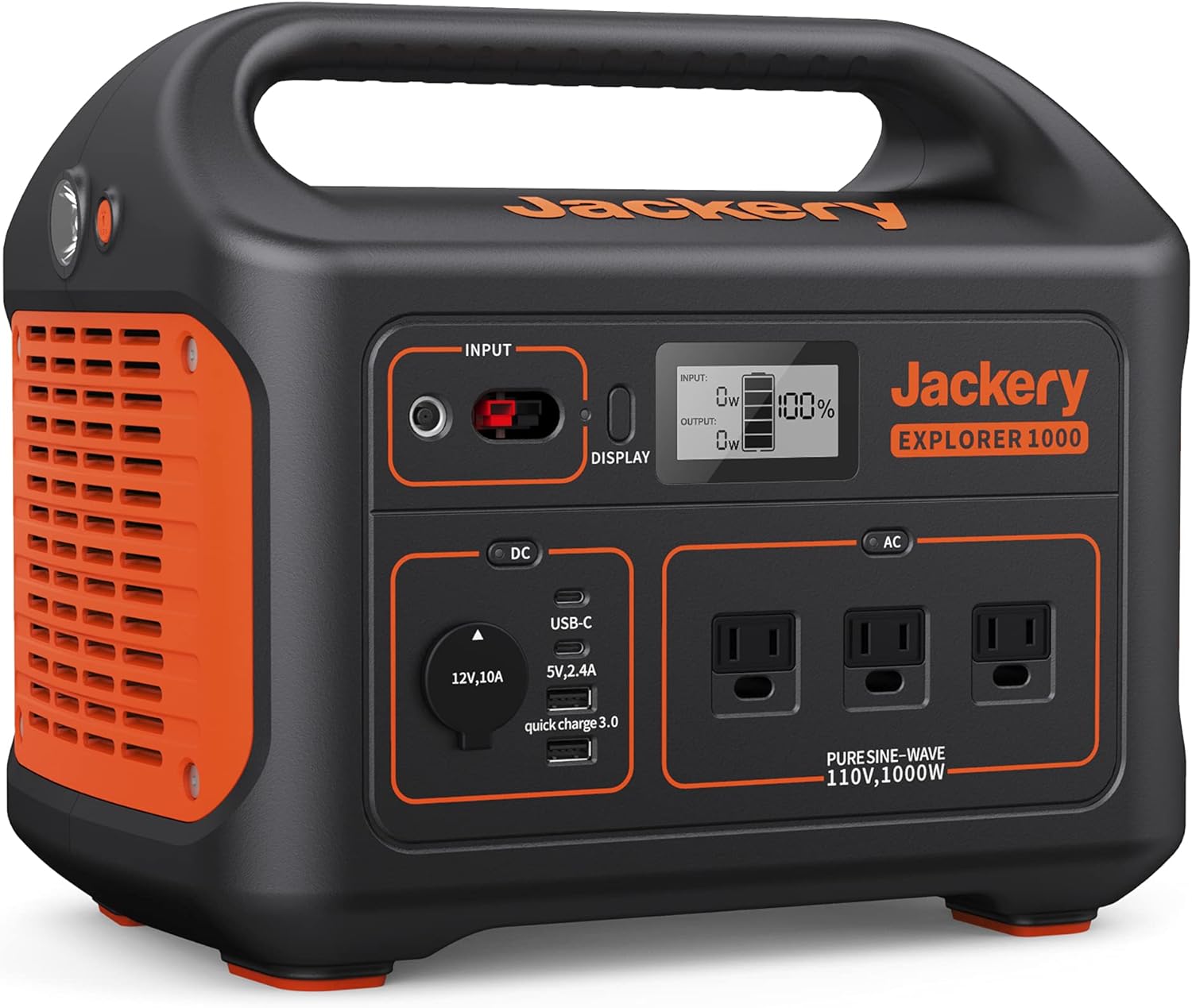
Prefer a simple, fixed-capacity unit with almost no learning curve? The Jackery Explorer 1000 is the go-to.
Check Price on AmazonCharging Speed: AC, Solar, and Car
Charging speed is arguably the single biggest usability difference between these three brands, and it’s also the spec that’s changed the fastest over the last few product generations. EcoFlow built its early reputation almost entirely on this one metric — its X-Stream fast-charging technology could take a Delta unit from empty to 80% in under an hour using AC power alone, at a time when comparable Bluetti and Jackery units needed several hours for the same charge level. That gap has narrowed since, but EcoFlow still tends to lead on raw AC charging speed across most of its current lineup.
Solar charging speed depends heavily on how many watts of solar input a given unit accepts, and this varies more by specific model than by brand. Bluetti’s larger units tend to accept very high solar input ceilings (several hundred to over a thousand watts on flagship models), which is a meaningful advantage if you’re trying to fully recharge off-grid in a single sunny afternoon rather than trickle-charging over two or three days.
- Fastest typical AC charging: EcoFlow, thanks to X-Stream technology
- Highest solar input ceiling on flagship units: Bluetti
- Most consistent, predictable charging curve: Jackery
Car charging (via a 12V outlet) is the slowest method across all three brands almost by definition — you’re limited by what a vehicle’s electrical system can safely supply, typically somewhere in the 8-10 amp range regardless of brand. None of the three has found a way around this physical limitation, so if fast recharging on the road matters to you, plan around AC or solar charging at a stop rather than relying on car-socket charging as your primary method.
One practical note: faster charging generally means more heat generation and, in some cases, more fan noise during the charge cycle. If you plan to charge a unit overnight in a bedroom or shared space, it’s worth checking the specific model’s charging noise levels rather than assuming “faster is strictly better” for your situation.
Dual charging — combining AC and solar input at the same time to speed things up further — is another area worth checking model by model rather than assuming brand consistency. EcoFlow’s higher-end units popularized combined AC-plus-solar charging as a way to hit very fast full-charge times, and Bluetti has adopted a similar approach on its larger flagship units, allowing solar and wall power to stack together rather than forcing you to pick one source at a time. Jackery supports simultaneous charging on many of its units too, though the combined wattage ceiling tends to be lower than what Bluetti or EcoFlow’s flagship-class units allow.
It’s also worth accounting for real-world solar conditions rather than the idealized numbers on a spec sheet. Manufacturer solar charging times are almost always measured under ideal, direct, cloudless sunlight with a panel angled perfectly toward the sun — conditions that are honestly pretty rare for the average camper or homeowner. In practical use, expect solar charging times across all three brands to run anywhere from 30% to 100% longer than the advertised figure once you factor in cloud cover, suboptimal panel angles, and morning or evening sun angles. This affects all three brands roughly equally, so it doesn’t change the relative ranking, but it’s an important expectation-setting detail regardless of which brand you choose.
Output Power & Surge Handling
Continuous output wattage tells you what a unit can run steadily; surge (or “peak”) wattage tells you whether it can handle the brief power spike that motors and compressors draw the instant they switch on. This second number is the one people underestimate most often, and it’s the reason a unit that looks powerful on paper can still trip and shut down the moment a refrigerator compressor or a power tool kicks on.
| Brand (flagship mid-size class) | Continuous output | Surge output |
|---|---|---|
| Bluetti AC200MAX | ~2,200W | ~4,800W |
| Jackery Explorer 1000 | ~1,000–1,500W | ~2,000–3,000W |
| EcoFlow Delta 2 | ~1,800W | ~2,700W |
Bluetti’s mid-size flagship tends to lead on both continuous and surge output in this comparison class, which is part of why it’s a popular pick among people planning to run higher-draw appliances — window AC units, power tools, space heaters — rather than just charging phones and running a mini-fridge. Jackery’s Explorer 1000-class units are plenty for lighter loads (laptops, lighting, small electronics, a CPAP machine) but can struggle with anything that has a hard motor start. EcoFlow’s Delta 2 sits comfortably in the middle, handling most common appliances without issue while falling short of Bluetti’s headroom for genuinely power-hungry equipment.
It helps to walk through a concrete example rather than just comparing numbers in the abstract. Say you’re planning to run a mini-fridge (roughly 100-150W continuous, with a startup spike that can briefly hit 600-800W), a string of LED lights (under 50W), and charge a couple of phones and a laptop overnight. All three brands’ mid-size units handle this comfortably with plenty of headroom to spare. Now swap the mini-fridge for a full-size residential refrigerator, add a window air conditioning unit, and suddenly the picture changes — that combination can easily demand 2,000W or more of surge capacity in the worst case, a load that only Bluetti’s higher-surge units in this comparison are realistically built to absorb without tripping a safety cutoff.
The practical takeaway: match the unit’s surge rating to your single highest-draw appliance’s start-up wattage, not its running wattage. A refrigerator that runs at 150W can still spike to 1,200W or more for a split second on startup, and that spike is what actually determines whether a given unit can handle it.
Many current units across all three brands also include some form of power-boosting or “X-Boost”-style technology, which allows the inverter to run appliances rated slightly above its normal continuous wattage ceiling by sacrificing pure sine wave purity for a short period. This can be genuinely useful for squeezing a few hundred extra watts out of a smaller unit in a pinch, but it’s not a substitute for buying appropriately sized capacity in the first place — sensitive electronics, in particular, don’t always play nicely with the modified waveform these boost modes produce, so it’s worth checking your specific appliance’s tolerance before relying on boost mode as a regular solution.
Total number and variety of output ports is another practical dimension of “output power” that’s easy to overlook. Bluetti’s larger units tend to ship with the widest port selection — multiple AC outlets, several USB-A and USB-C ports (often including higher-wattage USB-C PD ports for fast-charging laptops), a car-style 12V outlet, and in many cases a dedicated RV-style 30A port. Jackery and EcoFlow both cover the essentials well but sometimes ship with slightly fewer simultaneous AC outlets on their mid-size units, which is worth checking directly against your own device list if you plan to run several things at once from a single unit.

Want the fastest charging and the most polished app experience? The EcoFlow Delta 2 is the pick.
Check Price on AmazonPortability & Build Quality
Portability is a genuine trade-off against capacity and output for all three brands — there’s no way around the fact that more battery cells and a bigger inverter mean more weight. That said, each brand handles the ergonomics of that weight a little differently. Jackery has generally prioritized compact, lightweight designs even on its larger units, using a single top-mounted carry handle and a boxy, stackable shape that fits easily in a trunk or closet corner.
Bluetti’s larger expandable units lean into a more “appliance” aesthetic — bigger footprints, side handles or wheels on the largest models, and a design language that reads more like a piece of home equipment than a piece of camping gear. That’s a reasonable trade-off given that Bluetti’s target buyer is often planning to leave the unit in a garage or utility room rather than hauling it in and out of a car every weekend.
EcoFlow tends to land in between the two, with a rounded, more consumer-electronics-inspired design and a similar top-handle carry approach to Jackery, but with build quality and port layout aimed a bit more at the “this lives on my desk or in my RV permanently” crowd rather than the strictly grab-and-go camper.
- Best for backpacking or minimalist car camping: Jackery’s smaller Explorer units
- Best for a semi-permanent RV or van build: EcoFlow Delta series
- Best for a garage-based home backup setup: Bluetti’s AC200-class units
Fit and finish across all three brands has improved substantially over the last few product generations — buttons, screens, and port covers all feel noticeably more refined than they did on first-generation units from any of these companies. None of the three has a reputation for flimsy build quality at this point; the differences are more about design philosophy and intended use case than about one brand being meaningfully better-built than another.
Screen and control layout is a smaller but still meaningful part of the portability equation, since it affects how easy a unit is to read and operate in real conditions — bright midday sun, a dim tent at night, or gloved hands in cold weather. Jackery and EcoFlow both generally favor larger, higher-contrast LCD screens on their mid-size and larger units, making key stats like remaining capacity, input wattage, and output wattage easy to read at a glance. Bluetti’s screens are similarly clear on its flagship models, though some of its smaller or older units use a more basic display that shows less information simultaneously.
Carrying handles and drop resistance round out the portability picture. Jackery’s smaller units are specifically designed to survive the kind of casual bumps and drops that happen naturally around a campsite, with reinforced corners and a low center of gravity. Bluetti and EcoFlow’s larger units, given their size and weight, are less about drop resistance and more about controlled, deliberate movement — sliding into a vehicle trunk or rolling across a garage floor rather than being tossed into a backpack. If your unit is going to spend most of its life being carried rather than parked in one place, that weight-and-handling difference is worth weighing as heavily as any spec on a data sheet.
App Control & Smart Features
All three brands now offer a companion smartphone app, and all three apps do the basics well: monitoring charge level, toggling AC/DC outputs remotely, and checking for firmware updates. Where they diverge is in depth of features and polish.
EcoFlow’s app is generally considered the most feature-rich of the three, offering granular charge-speed control, scheduling, and — on models that support it — integration with home energy monitoring and time-of-use electricity rate optimization. It’s the app you’d reach for if you want to treat your power station as part of a broader smart-home energy setup rather than a standalone gadget.
Bluetti’s app has closed much of the gap in recent updates, offering similarly detailed monitoring and remote control, along with firmware update management for its more complex modular systems. Jackery’s app remains intentionally simpler — it covers the essentials (battery level, output toggles, basic settings) without trying to be a full energy-management dashboard, which lines up with Jackery’s broader “keep it simple” brand philosophy.
If you want deep app control
- EcoFlow — most mature ecosystem
- Bluetti — strong and improving fast
If you’d rather not think about an app
- Jackery — works great with zero app use
- All three function fully without the app
Worth noting: none of these apps are required for daily use. Every unit from all three brands has full physical controls on the device itself, so the app is a convenience layer rather than a dependency — a meaningful point if you’re buying this specifically as emergency backup and don’t want to rely on Wi-Fi or Bluetooth working during a power outage.
Firmware update behavior is another dimension worth understanding before you buy, since all three brands push periodic updates that can add features, improve charging efficiency, or occasionally change default behaviors. EcoFlow tends to ship updates most frequently, which is a double-edged sword — you get new features faster, but you’re also more likely to encounter the occasional update-related hiccup that needs a follow-up patch. Bluetti updates a bit less frequently but has a reputation for thoroughly testing updates before release, especially for its modular systems where a bad update could theoretically affect communication between the main unit and its battery add-ons. Jackery updates the least frequently of the three, consistent with its simpler feature set — there’s simply less to update when the app itself does less.
For buyers specifically interested in solar array monitoring or integrating a power station into a broader home energy setup, EcoFlow’s ecosystem currently offers the clearest path, with some models supporting integration into home energy management systems alongside EcoFlow’s own solar panels and smart plugs. Bluetti has been building out a similar ecosystem, particularly around its larger home-backup-focused units, while Jackery’s ecosystem remains more narrowly focused on portable, camping-oriented accessories rather than whole-home energy management.
Noise Levels
Fan noise is one of those specs that rarely shows up prominently on a product page but matters enormously in real use, especially if you’re running one of these units overnight in a tent, a bedroom, or a small camper. In general, noise correlates with two things: how hard the unit is working (higher loads and faster charging both spin fans up) and how aggressively each brand tunes its cooling system.
Jackery’s units tend to run quieter at idle and under light loads, which fits with their more casual, camping-first design brief. Bluetti’s larger expandable units, particularly when charging quickly or running a heavier load, can get noticeably louder — a reasonable trade-off given they’re also pushing more watts through the system. EcoFlow sits in the middle at idle but can spike in noise during its fastest X-Stream charging cycles, since that speed is achieved partly through more aggressive thermal management.
If overnight quiet is a priority — say, you’re powering a CPAP machine while camping — it’s worth checking decibel specs for the exact model you’re considering rather than assuming brand reputation alone will tell you what you need to know, since noise varies meaningfully even within a single brand’s lineup depending on the wattage class.
Fan behavior also tends to follow a predictable pattern across all three brands: near-silent or very quiet at low loads and low charge rates, ramping up noticeably once you either push output past roughly 50-60% of the unit’s continuous rating or engage a fast-charging mode. Ambient temperature plays a role too — a unit charging or discharging on a hot afternoon will run its fans harder than the same unit doing the same job in a cool garage, regardless of brand. If you’re testing a unit before a return window closes, it’s worth running it under a realistic load in the actual environment you plan to use it in, rather than judging noise purely from a quiet living room with the unit sitting idle.
For context, most idle or light-load noise levels across all three brands fall somewhere in the 40-50 decibel range — roughly comparable to a quiet conversation or a running refrigerator — while heavy-load or fast-charging noise can climb into the 55-65 decibel range on the louder end, comparable to a window air conditioner or a dishwasher running nearby. None of the three brands’ units are loud enough to be genuinely disruptive in most settings, but the difference between “barely noticeable” and “actively distracting” is real enough to matter if you’re light-sleeping in a small tent or camper van.
Warranty & Customer Support
Warranty length and customer support responsiveness matter more with these devices than with most consumer electronics, simply because a portable power station is the kind of purchase you might not touch for months and then suddenly need to work flawlessly during an actual emergency. All three brands have converged on broadly similar territory here, typically offering somewhere in the range of a two to five-year warranty depending on the specific model and whether you register the product or purchase an extended plan.
- Bluetti — Typically offers multi-year warranties on flagship units, with responsive email-based support and an active online community for troubleshooting.
- Jackery — Known for straightforward, no-hassle warranty claims and a support team that’s generally quick to respond, which fits its overall low-friction brand positioning.
- EcoFlow — Often extends warranty coverage through app registration and has a reputation for handling firmware-related issues quickly since so much of the unit’s behavior is software-controlled.
Across all three, the most common real-world support requests involve firmware updates, port or cable replacements, and occasional battery module pairing issues on the expandable systems — not catastrophic battery failures, which remain genuinely rare across all three brands’ current LFP-based lineups.
It’s worth reading the fine print on what, specifically, each warranty covers, since terms can vary by component. Some warranty policies distinguish between the main unit and included accessories like carrying cases or solar panels, sometimes covering the core power station for longer than bundled extras. Extended warranty options are available from all three brands at an additional cost, and given how central these devices can become to an emergency preparedness plan, that extra coverage is often a reasonable expense for buyers planning to rely on the unit for home backup rather than occasional recreational use.
Response time for support tickets is another practical factor that shows up consistently in owner feedback. All three brands generally respond within one to three business days for standard email support inquiries, with faster response times often available through in-app chat support on EcoFlow and Bluetti’s apps specifically. Phone support availability varies more by region than by brand, so it’s worth checking what’s actually available in your country before assuming a given support channel will be there when you need it during an actual emergency.
Pricing & Value for Money
Comparing raw sticker prices across brands is misleading unless you normalize for capacity and output, since a $600 unit and a $1,600 unit from the same brand aren’t competing products — they’re serving completely different use cases. The more useful comparison is cost-per-watt-hour, which strips out the size difference and tells you how efficiently each brand is pricing its battery capacity.
By that measure, Bluetti tends to offer some of the most competitive cost-per-Wh pricing in the category, especially once you factor in expansion batteries, which are usually priced more efficiently than buying an entirely separate new unit would be. Jackery generally sits at a slight premium per watt-hour, which buyers are effectively paying for in exchange for simplicity, brand recognition, and a slightly more polished out-of-box experience. EcoFlow lands in the middle-to-premium range, with pricing that reflects its faster charging hardware and more developed software ecosystem.
It’s also worth separating “expensive” from “overpriced,” since those aren’t the same thing. A more expensive unit that genuinely delivers faster charging, higher surge output, or a meaningfully better app experience isn’t overpriced — it’s priced for the extra capability it provides. The buyers who tend to feel disappointed after purchase are usually the ones who paid a premium for features they never actually use, like ultra-fast charging on a unit that mostly sits in a closet for months, or a heavily app-integrated system for someone who would honestly have been just as happy with physical buttons and a simple display. Being honest with yourself about which features you’ll actually use regularly is the single best way to avoid overpaying, regardless of which of the three brands you end up choosing.
Sale timing matters enormously with all three brands — list prices are frequently discounted 20-40% during major shopping events, and waiting for one of those windows can meaningfully change which brand offers the best value for a given capacity tier. If budget is the deciding factor, it’s almost always worth checking current pricing across all three before committing, since the “best value” answer shifts constantly with promotions.
Total cost of ownership extends beyond the initial purchase price, too. Expansion batteries, replacement solar panels, extended warranties, and brand-specific carrying cases or transport bags can add a meaningful amount on top of the base unit’s cost, and this is where Bluetti’s and EcoFlow’s modular approach can either save you money (compared to buying a whole second unit) or cost you more (compared to simply buying a bigger fixed-capacity Jackery unit upfront), depending entirely on how your power needs actually evolve over the following few years.
Resale value is a smaller but still relevant factor for buyers who tend to upgrade every few years. All three brands have healthy secondhand markets, with Jackery and EcoFlow units generally holding value slightly better than Bluetti’s larger units, likely due to higher overall sales volume and stronger brand recognition among casual secondhand buyers who are less familiar with Bluetti’s more specialized, backup-focused product line. If you expect to sell or trade in your unit down the line, this is worth a small amount of consideration alongside the upfront price comparison.
Best Use Cases: Which Brand Fits Your Situation
Rather than declaring one universal winner, it’s more useful to match brand strengths to specific real-world situations. Here’s how the three tend to sort themselves by use case:
Jackery
Lightweight, simple, and paired with a mature ecosystem of matching solar panels and cases built specifically for casual outdoor use.
Bluetti
Expandable capacity and higher surge output make it the strongest option for keeping essential appliances running through a multi-day outage.
EcoFlow
Fast charging and strong app-based monitoring suit a semi-permanent setup where you want quick top-ups between stops.
It’s also worth glancing outside this trio before you commit, since other brands do excel in specific niches. The Anker 767 PowerHouse is a strong alternative if you want Bluetti-style expandability with a slightly different port layout and design language, while the Goal Zero Yeti 1500X remains a favorite among buyers who prioritize rugged, outdoor-industry build quality over smart-home features. Neither dethrones Bluetti, Jackery, or EcoFlow outright, but both are worth a look if your use case sits right on the edge between two categories.
A few more specific scenarios worth calling out individually: for anyone building a dedicated off-grid cabin setup, Bluetti’s expandable ecosystem combined with its higher solar input ceiling tends to make it the most practical long-term foundation, since you can scale capacity as your off-grid systems mature without replacing the core unit. For emergency preparedness kits that need to sit unused in a closet for months at a time and then work flawlessly, Jackery’s simplicity is a genuine asset — there’s less that can go wrong, and less relearning needed if you haven’t touched the unit in a year. For content creators, remote workers, or anyone running sensitive electronics off-grid for extended stretches, EcoFlow’s combination of fast recharge and detailed app-based monitoring makes it easier to manage power budgets precisely rather than guessing.
Families with mixed use cases — say, camping several times a year but also wanting outage protection at home — often end up better served by thinking in terms of two smaller units rather than one large one. A smaller Jackery unit dedicated to camping trips, paired with a larger, expandable Bluetti or EcoFlow unit that lives at home, can end up being more practical and more cost-effective than trying to find one single unit that’s perfectly optimized for both jobs at once.
Weather-dependent use cases deserve a specific mention too. Buyers in regions with frequent hurricanes, wildfires, or ice storms tend to prioritize differently than buyers who just want backup for occasional brief outages. If you’re preparing for multi-day, multi-week grid instability, prioritize total expandable capacity and solar recharge speed over portability — you want a system that can be recharged entirely off-grid if the power stays out for an extended stretch, which points toward Bluetti’s higher solar input ceilings or EcoFlow’s fast dual-charging approach. If your typical outage is a few hours during a storm, any of the three brands’ mid-size units will comfortably cover your needs without requiring the largest, most expensive configuration available.
Off-grid work use cases — food trucks, mobile workshops, outdoor event vendors — represent a smaller but growing segment of buyers for all three brands. For this group, continuous output reliability under repeated daily cycling matters more than peak capacity, since these units are often charged and discharged multiple times per week rather than sitting mostly idle between occasional trips. All three brands’ LiFePO4-based units are well-suited to this kind of frequent cycling given their high rated cycle counts, though Bluetti’s higher continuous output ceiling gives it a practical edge for running commercial equipment like small blenders, espresso machines, or power tools throughout a working day.
Real-World Reliability & Long-Term Ownership
Spec sheets tell you what a unit is capable of on day one; long-term ownership tells you how it actually behaves after dozens of charge cycles, seasonal temperature swings, and the inevitable accidental drops and dust exposure that come with regular outdoor use. This is where brand reputation, built up over years of real customer feedback, becomes genuinely useful information rather than marketing copy.
Across all three brands, the most common long-term observations are remarkably consistent: LFP-based units from Bluetti, Jackery, and EcoFlow all tend to hold their rated capacity well past the one-year mark, with capacity fade typically staying under 10% even after a few hundred cycles of realistic, non-laboratory use. Reported issues tend to cluster around firmware quirks, occasional Bluetooth pairing frustrations with companion batteries, and — much less commonly — fan or port failures that are usually covered under warranty.
Our own long-term testing, documented in the EcoFlow Delta 2 long-term test, found charging speed and capacity holding remarkably steady across months of regular use, with the app’s firmware update process being the only recurring point of friction. That kind of pattern — strong hardware durability paired with occasional software rough edges — shows up across all three brands to varying degrees, which suggests the underlying LFP battery technology itself is the real hero here, more so than any single brand’s manufacturing process.
If reliability is your single biggest concern, buying from whichever brand has the most recent and most positive owner feedback for the specific model you’re considering will usually serve you better than picking a brand based on reputation alone, since quality control and firmware stability can shift meaningfully between product generations even within the same company.
Capacity retention over time deserves a closer look, since it’s ultimately the metric that determines whether your unit will still meet your needs three or five years down the line. In independent long-term testing across the category, units built on genuine LiFePO4 cells from all three brands typically show single-digit percentage capacity loss after a full year of regular use, with the rate of loss slowing further in subsequent years as the battery settles into its long-term degradation curve. This is a dramatic improvement over the older NMC-based units that some of these same brands sold years ago, which could lose noticeably more capacity over a comparable period.
Owner community sentiment is worth checking directly rather than relying solely on brand reputation summaries like this one. Searching recent owner discussions for the exact model you’re considering — not just the brand name — will surface the specific firmware versions, batches, or accessory pairings that have caused trouble for other buyers, which is far more actionable information than a general brand reputation score. This kind of model-specific research takes an extra ten or fifteen minutes but can save you from a genuinely frustrating ownership experience if a particular batch or firmware version has known issues that haven’t yet been resolved.
Environmental exposure is worth a final mention, since none of these three brands market their units as fully weatherproof, despite frequently being used outdoors. Dust ingress and light rain exposure are the most commonly reported environmental stressors across owner reviews for all three brands, and each recommends some form of cover or enclosure for extended outdoor use rather than leaving a unit directly exposed to the elements for days at a time. Bluetti and EcoFlow’s larger units, given their intended use in more permanent outdoor or semi-outdoor setups, generally include slightly better sealing around ports and vents than Jackery’s more grab-and-go oriented smaller units, though none of the three should be treated as fully weatherproof regardless of marketing language you might encounter.
Taken together, the reliability picture across Bluetti, Jackery, and EcoFlow is one of the more reassuring aspects of this entire comparison. Unlike categories where budget and premium options differ dramatically in build quality, all three of these established brands have converged on genuinely solid, LiFePO4-based hardware that holds up well over years of realistic use. The decision between them comes down far more to which specific feature set matches your situation than to any meaningful gap in fundamental product quality or safety.
Frequently Asked Questions
Which brand is best overall: Bluetti, Jackery, or EcoFlow?
There isn’t a single universal winner — Bluetti tends to be the strongest pick for expandable home backup, Jackery for simple and lightweight camping use, and EcoFlow for fast charging and smart-home style app control. The “best” brand depends entirely on which of those priorities matters most to you.
Is Bluetti more reliable than Jackery or EcoFlow?
All three brands use similar LiFePO4 battery chemistry and have comparable long-term reliability track records. Reported issues across all three tend to be minor and firmware-related rather than major hardware failures, so reliability differences are usually smaller than brand loyalty discussions suggest.
Which brand charges the fastest?
EcoFlow generally leads on raw AC charging speed thanks to its X-Stream fast-charging technology, though Bluetti’s larger units often accept a higher maximum solar input, which can make them faster to recharge in strong, direct sunlight.
Can I run a refrigerator on any of these three brands?
Yes, but capacity and surge output matter more than brand. You’ll want a unit with enough surge wattage to handle the compressor’s startup spike and enough total capacity to keep the fridge running for as long as you need. Bluetti’s higher-surge units tend to have the most headroom for this specific use case.
How long do these solar generators actually last?
Most current LiFePO4-based units from all three brands are rated for 3,000 to 4,000+ full charge cycles before dropping to 80% of original capacity, which typically translates to a decade or more of regular household use.
Do I need to buy the matching brand’s solar panels?
Not always, but it’s usually the path of least resistance. Each brand’s panels are guaranteed to match voltage and connector requirements, while third-party panels can work but sometimes need an adapter cable and a bit more care matching voltage specifications.
Which brand is quietest?
Jackery’s units generally run quieter at idle and under light loads. Bluetti and EcoFlow can both get louder during heavy loads or fast charging cycles, since more aggressive cooling is part of how that extra performance is achieved.
Is it worth paying more for an expandable system?
If you expect your power needs to grow — say, you’re building toward whole-home backup — an expandable Bluetti or EcoFlow system usually pays for itself compared to buying a second standalone unit later. If your needs are fixed and modest, a simpler Jackery unit can be the more cost-effective choice.
Which brand has the best app?
EcoFlow’s app is generally considered the most feature-rich, with detailed monitoring, scheduling, and energy-management tools. Bluetti’s app has improved significantly and offers similar depth. Jackery keeps its app deliberately simple, which some users actually prefer.
Are these solar generators safe to use indoors?
Yes — unlike fuel-powered generators, these units produce no exhaust fumes, so they’re safe to run indoors. The main indoor consideration is fan noise and heat output during heavy loads or fast charging, not air quality.
How do I know what size unit I need?
List the appliances you plan to run along with their wattage and how many hours you’d need them powered, then match that total against a unit’s capacity and continuous/surge output. Our detailed sizing guide breaks down exactly how to run that calculation.
Do these brands offer financing or payment plans?
Most retailers selling these brands, including major marketplaces, offer some form of installment payment option at checkout, though availability varies by region and by the specific retailer you’re purchasing through.
Final Verdict
After comparing battery chemistry, capacity, charging speed, output power, portability, app control, noise, warranty, and pricing, the honest conclusion is that Bluetti, Jackery, and EcoFlow are all excellent choices — they’ve just optimized for different priorities. Choose Bluetti if you want an expandable system built toward serious home backup. Choose Jackery if you want the simplest possible ownership experience for camping and light backup use. Choose EcoFlow if fast charging and a polished smart-home style app matter most to you.
Whichever direction you lean, matching the specific model’s capacity and surge output to your actual appliance list will matter more than the brand name on the case. Start with our sizing guide if you haven’t already, then compare current pricing on the specific units below.
Bluetti AC200MAX — expandable home backup
Check Price on Amazon
Jackery Explorer 1000 — simple and lightweight
Check Price on Amazon
EcoFlow Delta 2 — fastest charging, best app
Check Price on AmazonAs an Amazon Associate, we earn from qualifying purchases. Prices and availability are accurate as of the time of publishing and are subject to change.