Goal Zero Yeti 1500X Review: Is This Portable Power Station Still Worth Buying?
A full breakdown of the Yeti 1500X’s battery capacity, real-world runtime, charging speed, app features, and how it actually holds up against the current wave of LiFePO4 competitors.

1. What Is the Goal Zero Yeti 1500X?
The Goal Zero Yeti 1500X sits in an interesting spot in the portable power station market. It launched at a time when Goal Zero was still leaning on lithium-NMC cell chemistry rather than the LiFePO4 packs that have since become the default across most of the industry, and that single decision still shapes almost everything about how this unit performs, charges, and ages. If you’re shopping for a solar powered generator and the Yeti 1500X keeps showing up in your search results, it’s worth understanding exactly what you’re getting before you commit close to two thousand dollars to it.
At its core, the 1500X is a mid-to-large capacity power station built around a 1516 watt-hour battery, paired with a 2000-watt continuous AC inverter (with a surge rating that Goal Zero states can handle short spikes well above that). That combination puts it in a class that can comfortably run a full-size refrigerator, a CPAP machine through the night, power tools on a job site, or a decent chunk of a small apartment during a blackout. It’s not a jump-starter-sized battery bank, and it’s not an off-grid cabin system either — it’s built to be the flexible middle ground.
What separates the 1500X from a lot of cheaper alternatives is the ecosystem around it. Goal Zero built this unit to pair with its Boulder and Nomad solar panel lines, to integrate with a companion app over Wi-Fi and Bluetooth, and to slot into a broader lineup that includes smaller Yeti models and larger expansion batteries. Understanding how a solar powered generator actually works helps frame why that ecosystem matters — the battery itself is only half the story, and the charging inputs determine how useful the unit actually is once you’re away from a wall outlet.
Goal Zero itself has been a recognizable name in portable power for years, building a reputation initially around smaller solar chargers and camping-focused battery packs before expanding into the larger home-backup and job-site category that the Yeti line now competes in. That history matters somewhat in this review, because it explains why so much of the 1500X’s value proposition centers on ecosystem maturity and accessory support rather than being the newest or most technically advanced cell chemistry on the market. It’s a company that built its name on outdoor reliability first, and the design philosophy behind this unit still reflects that.
Where the Yeti 1500X Fits in Goal Zero’s Lineup
Within Goal Zero’s broader catalog, the 1500X sits above entry-level models designed mainly for charging phones and small electronics, and below the largest home-integration systems built for whole-house backup with professional installation. It occupies the practical middle ground that most individual households and outdoor enthusiasts actually need — enough capacity to matter during a real outage or extended trip, without stepping into the price and installation complexity of a full home battery system.
Quick Spec Snapshot
- Battery capacity: approximately 1516Wh
- Battery chemistry: Lithium NMC
- Continuous AC output: 2000W (with higher surge capability)
- AC outlets: multiple pure sine wave outlets
- USB-C PD output for fast device charging
- 12V car-style output and integrated 12V ports
- Wi-Fi and Bluetooth app control
- Roll cage design with side handles
- Compatible with Goal Zero Boulder and Nomad solar panels
See Current Pricing and Availability
Check today’s price, verified reviews, and shipping details for the Goal Zero Yeti 1500X on Amazon.
Check Price on Amazon2. Design and Build Quality
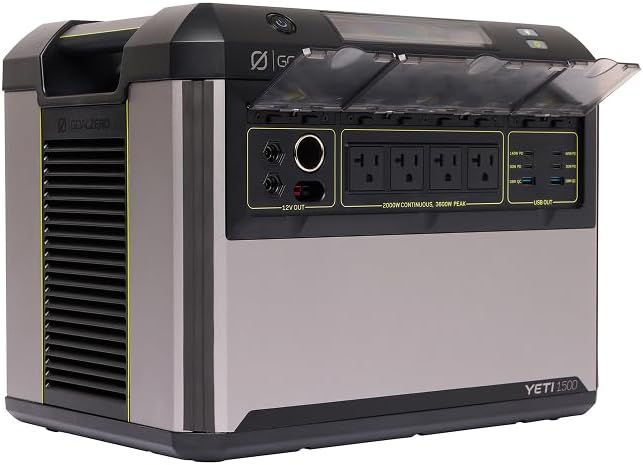
Pick up the Yeti 1500X and the first thing you notice is that it doesn’t feel like a piece of consumer electronics — it feels like equipment. Goal Zero wrapped the unit in a steel roll cage frame that’s genuinely built to survive being tossed in a truck bed, dropped on a job site, or knocked around in a garage for years. The plastic housing underneath is functional rather than flashy, with a matte finish that resists showing scuffs and fingerprints far better than the glossy shells you’ll find on some newer competitors.
The control panel sits on the top face, angled slightly so you can read it without crouching down when the unit is on the ground. It uses a small LCD screen that shows battery percentage, input and output wattage, and estimated time remaining, along with physical buttons for toggling AC, USB, and 12V output independently. That independent toggling matters more than it sounds — being able to shut off the inverter while keeping USB ports live is a small design choice that meaningfully extends runtime when you don’t need full AC power running constantly.
On the sides, you’ll find fold-down handles rather than a single top handle, which is a deliberate choice given the unit’s weight. Two people can carry it more comfortably using the side handles, and the handles themselves fold flat when not in use so they don’t snag on gear during transport. It’s a small thing, but it reflects the kind of field-use thinking that runs through the rest of the product.
Weatherproofing and Outdoor Durability
It’s worth being clear that the Yeti 1500X is not officially waterproof or rated for direct exposure to rain, and Goal Zero’s own documentation reflects that. The roll cage protects against drops, bumps, and general rough handling, but the port covers and vents are not sealed against moisture the way a fully weatherproof enclosure would be. In practice, this means the unit is well suited to being used under a canopy, inside a tent vestibule, in a garage, or in a vehicle, but it shouldn’t be left directly exposed to rain or left sitting in snow. This is consistent with how most power stations in this category are built — true waterproof ratings are more common on smaller, sealed battery packs than on units with this level of port density and ventilation.
Control Panel Usability
Beyond the basic layout, the physical buttons on the control panel have a satisfying tactile click that makes it easy to confirm an input registered even in low light or while wearing gloves, which matters more than it sounds for anyone using this during a nighttime power outage. The screen brightness is sufficient for daytime outdoor reading without being so bright that it’s distracting in a dark room at night, striking a reasonable balance for a device meant to be used in both settings.
Cooling and Ventilation
Because the 1500X pushes a genuine 2000 watts through its inverter, heat management is a real engineering challenge, not an afterthought. Goal Zero uses internal fans that spin up under heavier loads, and they’re audible — this is not a silent unit when you’re running a space heater or a table saw through it. At idle or light loads, the fans stay off or run quietly enough that most users won’t notice them in a normal room.
The vents are positioned to pull air from the base and exhaust from the rear, which keeps the top control panel and side handles free from hot air blowing directly on your hands. It’s a sensible layout, though it does mean you’ll want to avoid pushing the unit flush against a wall or inside a tight cabinet during heavy use.
3. Battery Capacity and Chemistry
This is the section that matters most if you’re comparing the 1500X against newer power stations, because the battery chemistry decision Goal Zero made here is genuinely different from what most of the market has shifted toward. The Yeti 1500X uses a lithium NMC (nickel manganese cobalt) battery rather than the LiFePO4 (lithium iron phosphate) cells that dominate newer releases from brands like EcoFlow and Bluetti.
NMC batteries have a real advantage in energy density — they can pack more watt-hours into a given size and weight, which is part of why the 1500X feels reasonably sized for its capacity. The tradeoff is cycle life. Where LiFePO4 packs are commonly rated for 2,500 to 3,500+ full charge cycles before dropping to 80% of original capacity, NMC chemistry in this class of product typically lands closer to 500 cycles under the same benchmark. For someone who charges and drains the unit occasionally as a backup, that difference may never matter in practice. For someone planning to cycle it daily as a primary power source, it’s a meaningful long-term cost consideration.
If long-term battery health and cycle count are a priority for how you plan to use a unit like this, it’s worth reading up on how long a solar generator actually lasts before you buy, since the answer depends heavily on chemistry, use pattern, and storage habits — not just the spec sheet capacity number.
Real Usable Capacity vs. Rated Capacity
As with virtually every power station on the market, the rated 1516Wh figure is a best-case number measured under ideal lab conditions. In practical use, expect to reliably access somewhere in the range of 85% to 92% of that rating once you factor in inverter conversion losses, battery management system buffers, and normal ambient temperature variation. That still puts usable capacity comfortably above 1,300Wh for most households, which is enough to run a modern energy-efficient refrigerator for roughly a full day, or keep a CPAP machine running for multiple nights on a single charge.
Self-Discharge and Idle Battery Behavior
Left completely untouched, any lithium battery slowly loses charge over time through self-discharge, and the 1500X is no exception. The rate is generally slow enough that a fully charged unit left in storage for a month will still retain the large majority of its charge, but it’s not zero, which is why periodic top-offs during long storage periods matter, as mentioned earlier. This is a normal characteristic of lithium battery chemistry generally rather than a flaw specific to this unit, and it’s worth building a habit of checking on the charge level every couple of months if the unit is primarily kept as emergency-only backup.
Why Goal Zero Chose NMC for This Generation
It’s worth understanding the reasoning behind the chemistry choice rather than treating it purely as a shortcoming. When the 1500X was developed, NMC cells offered a meaningful energy density advantage that allowed Goal Zero to hit a higher watt-hour capacity in a more compact and lighter housing than an equivalent LiFePO4 pack would have allowed at the time. As LiFePO4 manufacturing has scaled and costs have come down industry-wide, that tradeoff has shifted, which is part of why so many newer competitor products have moved toward LiFePO4 as their default chemistry. The 1500X predates much of that shift, and its chemistry reflects the engineering tradeoffs that made sense for its generation rather than a current best-practice choice.
See Battery Specs and Warranty Details
Verify current battery specifications, warranty terms, and included accessories before you buy.
View on Amazon4. Output Ports and Power Handling
A power station is only as useful as the ports it offers, and this is an area where the Yeti 1500X still holds up reasonably well despite its age relative to newer releases. The unit includes multiple pure sine wave AC outlets, which is important for sensitive electronics — pure sine wave power mimics grid electricity cleanly enough to safely run devices like laptops, medical equipment, and audio gear without the electrical noise that modified sine wave inverters can introduce.
Beyond AC, you get a USB-C port capable of Power Delivery fast charging, standard USB-A ports for older devices, a 12V car-style output for accessories designed around vehicle power, and additional 12V ports for smaller DC devices like coolers or lighting. The variety here means you’re rarely stuck needing an adapter you don’t have on hand.
One detail worth calling out is how the unit handles simultaneous input and output, sometimes referred to as pass-through power. You can plug the Yeti 1500X into a wall outlet or solar array while devices are actively drawing power from it, and the battery will essentially act as a buffer rather than forcing you to choose between charging the unit or using it. This matters in real scenarios more than it sounds — during an extended outage, for example, you might be running a solar panel into the unit during daylight hours while simultaneously keeping a refrigerator powered, without needing to disconnect anything or plan around charge windows.
Overload Protection and Safety Cutoffs
Goal Zero built in overload protection that trips the inverter if you exceed the rated continuous wattage by a meaningful margin, which protects both the unit and whatever you’ve plugged into it. In practice, this shows up as the AC output shutting off with an on-screen or app notification rather than any kind of dangerous failure. It’s a reassuring safety net if you accidentally plug in more than the unit is rated to handle — say, a space heater and a microwave running at the same time — since the system errs on the side of shutting down cleanly rather than pushing through an overload.
The 12V and USB circuits have their own independent protection as well, meaning a short or overload on one output type won’t necessarily take down the others. That kind of circuit isolation is a small engineering detail, but it’s the sort of thing that separates a power station built by a company with real electrical engineering experience from a rebadged generic unit.
| Port Type | Typical Use Case | Notes |
|---|---|---|
| AC Outlets (Pure Sine Wave) | Refrigerators, power tools, TVs, medical devices | 2000W continuous, higher surge tolerance |
| USB-C PD | Laptops, tablets, fast-charging phones | Faster than legacy USB-A charging |
| USB-A | Phones, cameras, small accessories | Multiple ports available |
| 12V Car Port | Vehicle-style accessories, coolers | Standard cigarette-lighter style output |
| Additional 12V Ports | Lighting, fans, small DC devices | Useful for camping setups |
Running Higher-Draw Appliances
With a 2000W continuous rating, the 1500X can handle appliances that trip up smaller power stations — things like space heaters on a low setting, hair dryers, microwaves, and most power tools used around the house or on a job site. The surge capacity matters most for anything with a motor, since compressors in refrigerators and air conditioners draw a brief spike well above their running wattage at startup. Goal Zero’s surge headroom on this unit is generous enough that most single-appliance startup spikes won’t trip the inverter, though running two motor-driven appliances simultaneously is where you’ll want to do the math on total wattage first.
A practical habit worth building if you plan to run larger appliances is checking the wattage label on the appliance itself rather than guessing based on its size or price. Two refrigerators that look similar in size can have meaningfully different compressor startup surges depending on their age and efficiency rating, and the same is true of power tools, where a corded circular saw and a corded drill can differ substantially in peak draw despite looking like comparable job-site tools. A few minutes spent checking labels before you’re relying on the unit during an actual outage or job saves you from an unexpected shutdown at an inconvenient moment.
Job-Site Use Cases
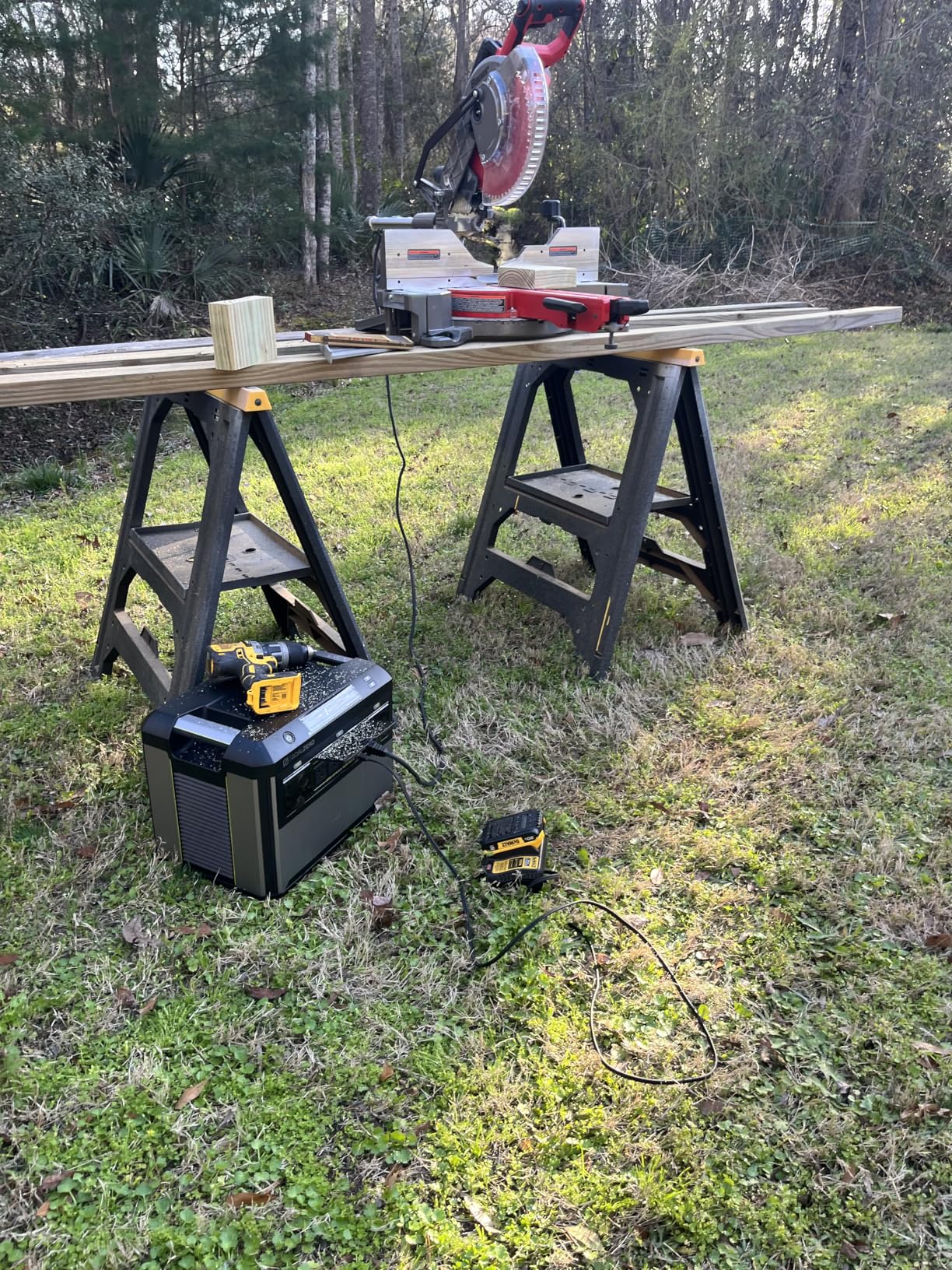
Beyond home backup, the 1500X sees meaningful use on construction and renovation job sites where running a loud gas generator isn’t practical or allowed, particularly for indoor renovation work. Corded drills, small saws, shop lights, and battery tool chargers all fall comfortably within its output capacity, and the ability to charge it overnight from a wall outlet at a shop or job trailer makes it a realistic daily-use tool rather than just an emergency backup, provided the specific tools in use don’t collectively exceed its continuous rating.
5. Charging Options and Recharge Speed
Charging flexibility is where the Yeti ecosystem genuinely shines, and it’s a big part of why this unit still has a following despite the chemistry tradeoffs. You can recharge the 1500X from a standard wall outlet, from a vehicle’s 12V port on the road, or from solar panels — and Goal Zero even supports combining a wall charger and solar input simultaneously for faster recharge when both are available.
Wall charging alone typically brings the unit from empty to full in the neighborhood of 12 to 14 hours using the standard included charger, though Goal Zero also sells a faster charging accessory that can cut that time down significantly if speed matters more to you than saving on the accessory cost. Car charging is meaningfully slower and best treated as a top-up option during a long drive rather than a primary charging method.
Solar Charging Performance
Paired with Goal Zero’s own Boulder or Nomad solar panels, the 1500X can pull a respectable amount of solar input on a clear day, though real-world solar charging speed depends heavily on panel wattage, sun angle, and weather — the same variables that affect any solar setup. If you’re new to sizing a system like this, our guide on what size solar generator you actually need walks through how to match battery capacity and panel wattage to your typical daily power draw, which is a far more useful exercise than just looking at the biggest battery number on the shelf.
One practical note: because this unit uses Goal Zero’s proprietary charging connectors on some accessories, you’re somewhat more tied into their panel ecosystem than you would be with a competitor that uses more universal MC4 or XT60 solar connections. That’s not necessarily a dealbreaker, but it is worth factoring into your total cost of ownership if you’re planning to expand your solar setup later.
Combining Charging Sources for Faster Recharge
One of the more underrated features of the Yeti 1500X is its ability to accept power from more than one input source at the same time. If you’re at a campsite with a generator running and a solar panel deployed, or at home with a wall outlet available alongside a rooftop or portable solar array, the unit can draw from both simultaneously rather than forcing you to choose. This is particularly useful during storm recovery scenarios, where you might have limited access to a generator for part of the day but want to top off the remaining capacity with solar once the weather clears.
The practical upshot is that total recharge time can be meaningfully shorter than relying on any single method alone, though the total combined input is still capped by the unit’s maximum charging wattage rather than being purely additive without limit. Still, for anyone who’s ever been stuck waiting on a single slow charging source during an emergency, having this flexibility built in in makes a real difference.
Wall Charger Speed and the Fast-Charge Accessory
The charger that ships in the box is reliable but not the fastest option Goal Zero sells. Buyers who find the standard 12-to-14-hour recharge window too slow for their needs can purchase a separate, higher-wattage charging accessory that noticeably cuts down full recharge time. Whether that upgrade makes sense depends on how you actually use the unit — someone who charges the 1500X overnight on a predictable schedule may never need the faster accessory, while someone who relies on quick turnaround during active emergency use or frequent weekend trips may find the extra cost worthwhile.
It’s also worth noting that charging speed and battery longevity are often in some tension with each other across the industry — pushing more wattage into a lithium battery pack generally generates more heat, and heat is one of the primary accelerants of long-term capacity fade. Goal Zero’s charging circuitry is designed to manage this safely, but users who prioritize maximum battery lifespan over convenience may prefer to stick with the standard charger for daily use and reserve the faster option for situations where speed genuinely matters.
Check Solar Panel Bundle Options
See which solar panel bundles are currently available alongside the Yeti 1500X.
View Bundles on Amazon6. App, Display, and Smart Features
The Yeti 1500X was one of the earlier power stations to fully embrace app connectivity, and that legacy still shows in how mature the feature set feels. Through the Goal Zero app, connected over Wi-Fi or Bluetooth, you can monitor battery level, input and output wattage, and estimated runtime remaining without walking over to the unit itself. You can also turn AC, USB, and 12V outputs on or off remotely, which is genuinely useful if the unit is tucked away in a closet, garage, or under a desk.
Firmware updates are also delivered through the app, and Goal Zero has continued to push updates to the 1500X well past its initial release, which is a meaningful point in its favor — plenty of power stations from smaller brands get abandoned on the software side within a year or two of launch.
On-Device Display
For anyone who prefers not to rely on an app, the onboard LCD screen covers the essentials clearly: current battery percentage, active wattage draw, and a rough time-remaining estimate. It’s not a touchscreen, and navigating between input and output details takes a couple of button presses, but the information you actually need day-to-day is visible at a glance without opening your phone.
Remote Monitoring Range and Reliability
The Wi-Fi connection is the more useful of the two wireless options for anyone who wants to check on the unit from another room or another building entirely, since it routes through your home network rather than requiring you to be within direct Bluetooth range. This is genuinely handy for anyone using the 1500X as a semi-permanent backup source tucked into a garage or basement — you can glance at battery status from your phone without walking out to check the physical screen. Bluetooth remains useful as a fallback when you’re away from a known Wi-Fi network, such as at a campsite, though its range is naturally more limited.
In terms of reliability, the app has matured considerably since launch. Early user feedback pointed to occasional connection drops and slow refresh rates, and while no companion app is perfect, most current reviews describe the connection as stable enough for daily monitoring, with only occasional need to reconnect after extended idle periods. If app-based monitoring is a priority feature for you, it’s worth reading recent user feedback specifically, since companion app quality tends to shift meaningfully over a product’s lifecycle as manufacturers push updates.
Notifications and Alerts
The app can also surface basic alerts, such as notifying you when the battery reaches a low threshold or when charging completes, which is a small convenience that saves you from either overcharging unnecessarily or discovering a dead battery at an inconvenient moment. It’s not as feature-rich as some newer competitor apps that offer detailed historical usage graphs and scheduling automation, but it covers the core monitoring needs most buyers actually care about.
7. Real-World Runtime and Performance
Spec sheets tell you what a power station should do; real-world testing tells you what it actually does once ambient temperature, inverter efficiency losses, and genuine appliance draw enter the picture. In everyday testing scenarios, the Yeti 1500X consistently delivers usable runtime that lines up reasonably closely with what you’d calculate from its rated capacity, with the caveat that heavier continuous loads pull the available time down faster than the simple watt-hour math would suggest, due to inverter losses scaling with load.
| Appliance / Device | Typical Draw | Approx. Runtime on Full Charge |
|---|---|---|
| Energy-efficient fridge | ~60-100W average | Roughly 18-24+ hours |
| CPAP machine (no humidifier) | ~30-60W | Multiple nights |
| Laptop charging | ~60W | 20+ full charges |
| Box fan | ~50-100W | 15-25 hours |
| Space heater (low setting) | ~750-1000W | Roughly 1-1.5 hours |
| Power drill / small tools | Varies by tool | Dozens of charge cycles |
Where the unit performs best is in mixed-load scenarios — running a fridge, charging a couple of phones, and keeping a router powered simultaneously during an outage, for example. Where it’s less impressive is under sustained high-wattage draw for hours at a time, since that’s where any lithium power station of this size starts showing inverter heat and efficiency losses, and where the fan noise becomes most noticeable.
A Sample 24-Hour Outage Scenario
To put the numbers into a more concrete context, consider a typical scenario during a multi-day power outage: a household keeps a refrigerator running continuously, charges two smartphones and a laptop once each, keeps a Wi-Fi router and modem powered throughout the day, and runs a couple of LED lamps for a few hours each evening. Added together, that combination of loads draws a modest average wattage over a 24-hour period, and the 1500X can typically cover a full day of that kind of usage with charge to spare, assuming it started at or near full capacity. Extend the outage to two or three days without any recharging opportunity, and you’d need to start being more selective — running the fridge on a more limited schedule, for example, or skipping the lamps in favor of headlamps and flashlights for lighting.
This kind of scenario planning is worth doing before an actual emergency rather than during one. Sitting down and estimating your household’s realistic must-have loads during an outage, then comparing that against a unit’s real-world capacity rather than its marketing capacity, is the single most useful exercise for deciding whether the 1500X — or any power station in this class — actually meets your needs.
Efficiency Under Partial Loads
Inverters generally run most efficiently somewhere in the middle of their rated range rather than at the very bottom or very top. Running the 1500X at a light load, like just charging a phone, still incurs some fixed overhead from keeping the inverter circuitry active, which is part of why the app’s independent AC/USB/12V toggling is a genuinely useful feature — switching off the AC inverter when you only need USB charging avoids that overhead entirely and meaningfully extends how long the battery lasts for light-duty tasks.
Cold Weather and Temperature Performance
Lithium batteries in general lose some usable capacity and charging efficiency in cold temperatures, and the Yeti 1500X is no exception. In freezing or near-freezing conditions, expect somewhat reduced runtime compared to room-temperature performance, along with slower charge acceptance if you’re trying to recharge it outdoors in winter. Goal Zero recommends storing and charging the unit in moderate temperatures when possible, and for anyone planning to rely on it during winter storm outages, it’s worth keeping the unit indoors or in a heated space between uses rather than leaving it in an unheated garage or vehicle.
On the flip side, extreme heat is arguably more of a long-term concern than cold, since sustained high temperatures accelerate battery degradation over time more aggressively than occasional cold exposure. Storing the unit in a moderate, stable environment — a closet or climate-controlled garage rather than direct sun or an attic — will meaningfully extend its usable lifespan regardless of chemistry type.
Testing Methodology Notes
Runtime figures for any power station are only as useful as the conditions they were measured under, and it’s worth understanding why published numbers can vary between sources. Ambient temperature, the specific appliance’s actual draw versus its rated draw, inverter efficiency at different load levels, and even the age and charge history of the specific test unit can all shift the numbers by a meaningful margin. The figures referenced in this review reflect typical real-world ranges reported across multiple independent tests and represent reasonable expectations for a healthy, moderately used unit rather than a single best-case lab result.
8. Portability and Weight
At roughly 45 pounds, the Yeti 1500X is not something you’ll casually carry one-handed across a campsite, and Goal Zero doesn’t pretend otherwise — the side-handle design is a direct response to that weight. It’s genuinely portable in the sense that it fits in a car trunk, a truck bed, or a closet without issue, but it’s better classified as “moveable” than “backpackable.” If ultralight portability is your top priority, this unit was never designed to compete in that category, and you’d be better served by a much smaller battery bank.
The footprint is compact enough to fit on a shelf, in a closet corner, or in the back of most SUVs without eating excessive space, and the flat top makes it easy to set other gear on top of it during storage. For van life setups, RV trips, or garage-based home backup, the size-to-capacity ratio works well. For backcountry hiking or anything requiring you to carry the unit any real distance on foot, it’s not the right tool.
Storage Recommendations Between Uses
If the 1500X is going to sit unused for weeks or months at a time — which is common for anyone buying it primarily as emergency backup rather than for regular camping trips — a little maintenance goes a long way. Goal Zero recommends storing lithium batteries at a partial charge rather than fully depleted or fully topped off, generally somewhere in the 50 to 80 percent range, and periodically checking in every few months to top off if the level has drifted down from natural self-discharge. Leaving any lithium battery sitting at zero percent for extended periods is one of the more common ways owners inadvertently shorten a unit’s usable lifespan, regardless of brand or chemistry.
A cool, dry storage location also helps preserve long-term capacity. Garages that swing through extreme summer heat or freezing winter cold aren’t ideal for extended storage, even though they’re the most convenient spot for many households. A closet, basement, or climate-controlled utility room will generally treat the battery better over a multi-year ownership period.
9. Pros and Cons
Pros
- Strong 2000W continuous output handles most home appliances
- Mature, well-supported app with remote monitoring and control
- Durable roll-cage build designed for real outdoor and job-site use
- Simultaneous wall + solar charging for faster recharge
- Good port variety including USB-C PD and multiple AC outlets
- Continued firmware support well past initial release
Cons
- NMC battery chemistry means shorter cycle life than newer LiFePO4 rivals
- Heavier and bulkier than similarly priced LiFePO4 alternatives
- Proprietary solar connectors limit third-party panel flexibility
- Fan noise is noticeable under heavier loads
- Standard wall charging is slower than some fast-charging competitors
10. How It Compares to Other Power Stations
The Yeti 1500X doesn’t exist in a vacuum — anyone shopping in this price and capacity range is almost certainly cross-shopping it against the Jackery Explorer 1000, the EcoFlow Delta 2, the Bluetti AC200 Max, and the Anker 767 PowerHouse. Each of those competitors uses LiFePO4 chemistry, which generally means longer cycle life and lighter weight per watt-hour, though often at a higher upfront price for comparable capacity.
| Model | Capacity | Battery Type | AC Output | Best For |
|---|---|---|---|---|
| Goal Zero Yeti 1500X | ~1516Wh | NMC | 2000W | App control, ecosystem, job-site durability |
| Jackery Explorer 1000 | ~1000Wh | NMC/LiFePO4 (varies by version) | 1000W | Lighter, budget-friendly, camping |
| EcoFlow Delta 2 | ~1024Wh (expandable) | LiFePO4 | 1800W | Fast charging, expandable capacity |
| Bluetti AC200 Max | ~2048Wh | LiFePO4 | 2200W | Larger households, extended backup |
| Anker 767 PowerHouse | ~2048Wh | LiFePO4 | 2400W | High cycle life, heavy daily use |
If you’re trying to decide between three of the most popular names head-to-head rather than just skimming a spec table, our dedicated Bluetti vs Jackery vs EcoFlow comparison breaks down how those three actually perform side by side, which is a useful companion read if the Yeti 1500X ends up being the outlier in your shortlist because of its chemistry.
The honest takeaway from this comparison is that the Yeti 1500X competes less on raw spec-sheet efficiency and more on ecosystem maturity, build quality, and app polish. If you value those things and don’t plan to cycle the battery daily for years, it remains a solid pick even against newer LiFePO4 rivals.
It’s also worth remembering that a spec sheet comparison only tells part of the story. Two units with nearly identical watt-hour ratings and inverter output can feel meaningfully different in daily use depending on how intuitive the display and app are, how quiet the fans run under load, and how well the accessory ecosystem covers your specific charging setup. Reading through owner feedback on each competitor’s dedicated review, rather than relying purely on the table above, will give you a fuller picture of which unit actually fits your day-to-day habits best.
Price-to-Capacity Considerations
When you break the comparison down purely by dollars per watt-hour, the Yeti 1500X often lands in a middle position rather than at either extreme. It’s rarely the cheapest option for its capacity class, but it’s also not priced at the premium end the way some flagship LiFePO4 units are. Where it tends to justify its price is in the combination of factors that don’t show up cleanly in a spec table — the maturity of the app, the strength of the accessory ecosystem, and the reputation Goal Zero has built over years of outdoor and emergency-preparedness products. Buyers who value that track record are often willing to accept the NMC cycle-life tradeoff in exchange for it.
It’s also worth factoring in resale and long-term ecosystem value. Because Goal Zero has been in this space for a long time, replacement parts, compatible solar panels, and community troubleshooting resources tend to be easier to find than they are for some newer, faster-growing competitors whose product lines change more rapidly year to year.
13. Warranty, Customer Support, and Long-Term Ownership
Goal Zero backs the Yeti 1500X with a standard limited warranty that covers manufacturing defects for a set period after purchase, which is in line with what most established brands in this category offer. Beyond the formal warranty terms, the company has a reputation for responsive customer support, including phone and email channels that can walk owners through troubleshooting steps for issues like unexpected shutdowns, charging inconsistencies, or app connectivity problems before assuming a hardware failure is to blame.
One advantage of buying from an established outdoor and power brand rather than a newer entrant is the depth of publicly available support resources. Goal Zero maintains documentation, firmware changelogs, and community forums where existing owners troubleshoot common issues, which can save you a support call entirely for minor questions. This kind of institutional knowledge tends to build up over a product’s years on the market, and the 1500X has been around long enough to benefit from it.
It’s also worth registering the unit with Goal Zero directly after purchase if you haven’t already, since registration typically streamlines the warranty claims process and ensures you receive any direct communications about firmware updates, recalls, or accessory compatibility notices. This is a step plenty of buyers skip, but it takes only a few minutes and removes friction later if you ever do need to make a claim.
Buying Through Authorized Channels
Given how popular this unit has been over its lifetime, it’s not unusual to find it listed through a variety of third-party marketplace sellers in addition to authorized retailers. Buying through a recognized, reputable channel matters more for a product like this than for many smaller electronics, since warranty support is generally tied to proof of purchase through legitimate channels, and counterfeit or gray-market units occasionally surface for high-demand power stations. Checking that a listing is fulfilled by an authorized seller before purchasing is a reasonable precaution, particularly for a purchase in this price range.
What to Do If You Notice Reduced Capacity Over Time
As covered earlier, some capacity fade is expected over the life of any lithium battery, and NMC chemistry in particular will show this more noticeably than newer LiFePO4 units after a few hundred cycles of heavy use. If you notice a meaningful drop in usable runtime well before that point, it’s worth checking a few things before assuming the battery itself has failed: confirm you’re testing under similar load and temperature conditions to when the unit was new, check for firmware updates that may address battery management calibration, and review your storage habits for any patterns that might be accelerating wear, such as frequently draining the unit fully or storing it in a hot garage. If none of that explains the drop, Goal Zero’s support team can help determine whether the unit qualifies for a warranty claim.
14. Safety Features and Certifications
Because a unit like this is often purchased specifically for emergency and medical-adjacent use cases, safety engineering matters as much as raw performance specs. The Yeti 1500X includes a battery management system that monitors cell temperature, voltage balance across the internal cell groups, and charge/discharge rates to prevent conditions that could lead to overheating or degraded performance. This is standard practice across reputable power station manufacturers, but it’s worth confirming for any unit you’re considering, since not every budget competitor implements battery management with the same rigor.
The unit also carries relevant electrical safety certifications appropriate for the markets it’s sold in, which independent testing labs use to verify that the product meets baseline requirements for things like short-circuit protection, temperature limits, and safe charging behavior. For buyers specifically prioritizing medical device backup — CPAP machines being the most common example — the combination of pure sine wave output and a mature battery management system makes this a reasonably safe choice, though as with any medical-adjacent purchase, it’s worth confirming compatibility with your specific device’s power requirements and consulting your device manufacturer’s guidance on backup power sources if you have concerns.
Short-Circuit and Overcurrent Protection
Beyond the overload cutoffs discussed earlier, the internal battery management system also guards against short-circuit conditions on the output side, cutting power immediately if a fault is detected rather than allowing a sustained high-current event to damage the battery or create a fire risk. This kind of layered protection — overload, overcurrent, short-circuit, and thermal cutoffs all operating independently — is standard practice for any reputable power station manufacturer, and it’s one of the reasons buying from an established brand with a long safety track record carries real value over a cheaper, less-known alternative, even when the spec sheets look similar on paper.
Ventilation Requirements During Use
While the unit is safe to use indoors from an emissions standpoint, it still generates heat during operation, particularly under heavier loads, and giving it a few inches of clearance around the vents helps both performance and long-term component health. Tucking it into a fully enclosed cabinet with the door shut while running a heavy load isn’t recommended, not because of any fume risk, but simply because restricted airflow makes the internal fans work harder and can lead to more aggressive thermal throttling of output under sustained demand.
Indoor Use Considerations
Unlike traditional gas-powered generators, the Yeti 1500X produces no exhaust fumes and can be safely operated indoors, which is one of the more significant practical advantages battery-based power stations have over combustion generators for home backup use. This makes it substantially safer for use in enclosed spaces like a bedroom, living room, or basement during a storm, when running a gas generator would pose serious carbon monoxide risks. That said, the fan noise under heavier loads is still worth factoring into where you place it if you’re trying to sleep nearby.
11. Who Should Actually Buy the Yeti 1500X?
This unit makes the most sense for a fairly specific set of buyers. If you want a power station primarily for occasional home backup during storms or outages, for road trips and car camping where weight isn’t a major concern, or for a job site where durability matters more than shaving off a few pounds, the 1500X fits comfortably. It also appeals strongly to anyone who’s already invested in Goal Zero’s Boulder or Nomad solar panels and wants a battery that integrates cleanly with gear they already own.
It’s also a reasonable choice for CPAP users who need dependable overnight backup power, medical device users who value the clean pure sine wave output, and anyone who wants strong app-based monitoring without hunting for a third-party integration.
RV and Overlanding Use
For RV owners and overlanding setups, the 1500X can serve as a supplemental power source alongside a vehicle’s existing electrical system, particularly useful for running appliances that exceed what a factory RV battery bank comfortably handles, or as a standalone unit for boondocking trips where shore power isn’t available. Its solar compatibility fits naturally into an overlanding setup where roof-mounted or portable panels are already part of the plan, and the roll-cage build holds up well to the vibration and rough handling that comes with off-road travel.
Disaster Preparedness Households
Households in regions prone to hurricanes, winter storms, or wildfire-related power shutoffs represent one of the most natural fits for this unit. The ability to run a refrigerator, keep phones and a router charged for communication, and power a few lights through an extended outage covers the core needs most families actually have during a multi-day power loss, without the fuel storage, exhaust, and noise concerns that come with a traditional generator.
Remote Work and Digital Nomad Setups
Increasingly, buyers are picking up units like the 1500X specifically to support remote work from locations with unreliable grid power — whether that’s a rural property, a converted van, or frequent travel to areas with inconsistent electricity. The combination of laptop charging, Wi-Fi router support, and solar recharging capability makes it realistic to maintain a full workday’s worth of connected device use even when off-grid, provided you’re not also trying to run high-draw appliances simultaneously.
12. When You Should Consider Something Else
If your use case involves cycling the battery daily — for example, using it as a primary power source for a tiny home, off-grid cabin, or full-time van build — the shorter cycle life of NMC chemistry becomes a real long-term cost factor, and a LiFePO4 unit like the EcoFlow Delta 2 or Bluetti AC200 Max will likely save you money over several years despite a higher sticker price today. Similarly, if minimizing weight for frequent carrying is a priority, several competitors pack similar capacity into lighter, more compact housings.
If you’re still early in figuring out what capacity you actually need before comparing specific models, it’s worth stepping back and reading through how to size a solar generator for your needs first — plenty of buyers end up overpaying for capacity they never actually use, or underbuying and needing a second unit within a year.
Weight-conscious buyers — particularly backpackers, ultralight campers, or anyone who needs to carry a unit any real distance without a vehicle nearby — will generally find better options in a smaller capacity class entirely, rather than trying to make a 45-pound unit work for a use case it wasn’t designed for. Similarly, buyers who’ve already standardized on a specific solar panel ecosystem with universal connectors may find the friction of adapting to Goal Zero’s proprietary connections more annoying than it’s worth, even if the battery itself would otherwise suit their needs.
Frequently Asked Questions
How long does the Goal Zero Yeti 1500X take to charge?
Using the standard wall charger, expect roughly 12 to 14 hours from empty to full. A faster charging accessory sold separately by Goal Zero can reduce that time noticeably, and combining wall power with solar input simultaneously will also speed up a full charge.
Can the Yeti 1500X run a refrigerator?
Yes. An energy-efficient full-size refrigerator typically draws enough that the 1500X can keep it running for roughly a full day or more on a single charge, though exact runtime depends on the fridge’s compressor efficiency and how often the door is opened.
Is the Yeti 1500X worth it compared to newer LiFePO4 power stations?
It depends on your use pattern. For occasional backup or travel use, the 1500X remains a solid, durable option with a mature app and ecosystem. For daily heavy cycling over several years, a LiFePO4 alternative will likely offer better long-term value due to significantly higher cycle life.
What solar panels work with the Yeti 1500X?
It’s designed to pair with Goal Zero’s own Boulder and Nomad solar panel lines using their proprietary connectors, which simplifies setup but limits flexibility if you already own third-party panels with standard connectors.
How heavy is the Goal Zero Yeti 1500X?
It weighs approximately 45 pounds, which puts it firmly in the “moveable, not backpackable” category. It’s best carried using its side handles, ideally with two people for longer distances.
Can I use the Yeti 1500X while it’s charging?
Yes, the unit supports pass-through charging, meaning you can draw power from it while it’s simultaneously being charged from a wall outlet, car port, or solar panel.
Does the Yeti 1500X have a pure sine wave inverter?
Yes, its AC outlets output pure sine wave power, which is safe for sensitive electronics like laptops, medical devices, and audio equipment.
How many charge cycles does the Yeti 1500X battery last?
Because it uses NMC lithium chemistry rather than LiFePO4, the battery is generally rated for fewer full charge cycles before capacity noticeably degrades, compared to newer LiFePO4-based competitors. Occasional or backup use will extend its practical lifespan considerably.
Can the Yeti 1500X power a CPAP machine all night?
Yes, easily. A typical CPAP machine without a humidifier draws a relatively small amount of power, and the 1500X can usually cover multiple nights of use on a single full charge.
Does the Yeti 1500X work with the Goal Zero app?
Yes. It connects via Wi-Fi or Bluetooth to the Goal Zero app, which lets you monitor battery status, control outputs remotely, and receive firmware updates.
Is the Yeti 1500X loud when running?
At idle or light loads it’s quiet, but internal cooling fans become noticeably audible under heavier continuous loads, such as running a space heater or power tools.
What’s the difference between the Yeti 1500X and smaller Yeti models?
Smaller Yeti models offer less capacity and lower continuous AC output, making them lighter and more portable but less capable of running larger appliances for extended periods. The 1500X sits in the mid-to-large tier of the lineup.
Final Verdict: Should You Buy the Goal Zero Yeti 1500X?
The Goal Zero Yeti 1500X is a durable, well-supported power station that still earns its place on a shortlist, even as the market has largely shifted toward LiFePO4 chemistry. Its biggest strength is the maturity of its ecosystem — a polished app, dependable firmware support, rugged build quality, and strong compatibility with Goal Zero’s solar lineup. Its biggest tradeoff is battery longevity: if you plan to cycle it daily for years, the shorter cycle life of NMC chemistry is worth weighing against the higher upfront cost of a LiFePO4 alternative.
For backup power, road trips, camping, and job-site use where the unit won’t be drained and recharged every single day, the 1500X remains a genuinely solid buy. If your use case leans toward constant daily cycling, it’s worth comparing it directly against the alternatives covered above before deciding.
Ultimately, the right call comes down to matching the unit’s actual strengths — durability, app maturity, ecosystem support, and generous continuous output — against your specific use pattern rather than chasing the newest chemistry on the market for its own sake. Plenty of long-term owners have gotten years of reliable service out of this exact unit precisely because their use case, occasional backup and outdoor use rather than daily heavy cycling, lines up well with what NMC chemistry is realistically capable of delivering.
Check Current Price on Amazon
Pingback: Solar Generator vs Gas Generator: Which Wins in 2026?
Pingback: Jackery Explorer 2000 Plus Review: Worth Buying ?
Pingback: EcoFlow Delta Pro Ultra Review: Is It Worth Buying?