Jackery Explorer 2000 Plus Review: Is This Modular Power Station Worth Buying?
A deep, no-fluff breakdown of performance, expandability, charging speed, and real-world value.

Table of Contents
What Is the Jackery Explorer 2000 Plus?
The Jackery Explorer 2000 Plus sits in an unusual spot in the portable power market. It isn’t just another sealed power station you charge, drain, and eventually replace. Instead, Jackery built it around a modular battery philosophy — a base unit that can be paired with additional expansion packs to scale capacity from roughly 2 kWh all the way up into the double-digit kilowatt-hour range. That single design decision changes how you should think about this unit. It’s less “big power bank” and more “starter node in a home backup system.”
For anyone who has shopped for solar generators before, the appeal is obvious. Most units force you to pick a capacity up front and live with it. Underestimate your needs, and you’re stuck. Overestimate, and you’ve paid for capacity you’ll never use during three-day camping trips. The Explorer 2000 Plus tries to solve that by letting the battery grow with your needs, which is especially relevant if you’re comparing it against fixed-capacity competitors like the EcoFlow Delta 2 or the Bluetti AC200 Max.
Before diving into every spec sheet number, it’s worth setting expectations. This is not a lightweight, grab-and-go unit for a weekend hiking trip. It’s a home-backup-first, camping-second device. If your primary use case is powering a fridge, a CPAP machine, a few lights, and a laptop through a multi-hour outage, this device is built exactly for that job. If you want something you sling into a backpack, look elsewhere in Jackery’s lineup or at competitors like the Anker 767 PowerHouse.
It’s also worth understanding the broader context that makes this category of product relevant in the first place. Grid reliability has become an increasingly common talking point across many regions, whether the cause is aging infrastructure, extreme weather events, or planned utility maintenance during high-demand periods. Homeowners who once viewed backup power as a luxury reserved for rural properties or hurricane-prone coastlines are now treating it as standard household preparedness, the same way a fire extinguisher or a first-aid kit became non-negotiable decades ago. The Explorer 2000 Plus fits neatly into that shift because it doesn’t require the permitting, installation costs, or fuel storage headaches associated with a traditional standby generator.
There’s also a quieter, less obvious use case worth mentioning: peace of mind for remote workers and small business owners who simply cannot afford downtime. A freelance video editor rendering a client deliverable, a small e-commerce operator who needs their point-of-sale system running, or a household with a family member on medical equipment all have very different risk tolerances than someone who just wants the porch light to stay on. The Explorer 2000 Plus, especially in an expanded configuration, is powerful enough to bridge these more serious continuity needs, not just casual convenience.
Throughout this review, we’ll evaluate the unit not just on isolated spec sheet numbers, but on how those numbers translate into real decisions: what appliances you can safely run together, how long you can expect the battery to last under realistic (not laboratory) conditions, and where the unit’s limitations might push you toward a different product entirely. That’s the only way a review like this is actually useful — numbers on their own tell you very little until they’re translated into “can I keep my refrigerator cold for two days” or “can I run my CPAP machine safely through the night.”
One more contextual point before moving into design: portable power stations broadly split into two philosophies. The first prioritizes portability and treats capacity as secondary — think of it as a power bank on steroids. The second prioritizes capacity and expandability, treating portability as a secondary concern. The Explorer 2000 Plus is unmistakably in the second camp, and understanding that framing early will help you interpret every subsequent section of this review correctly.
Check current pricing and availability for the Jackery Explorer 2000 Plus.
Check Price on AmazonDesign & Build Quality
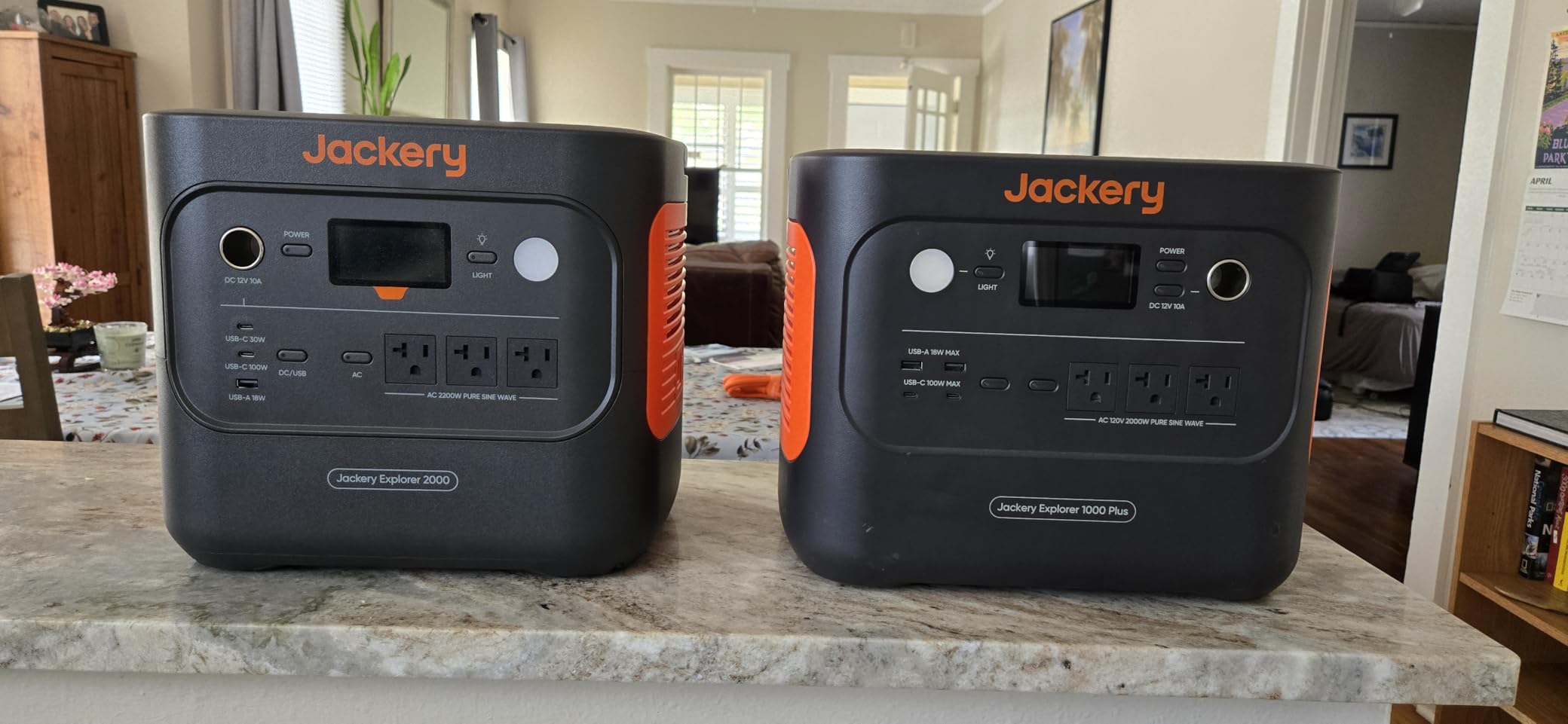
Pick up the Explorer 2000 Plus and the first thing you notice is the heft. At roughly 43 pounds for the base unit alone, this isn’t a device you casually toss into a trunk one-handed. Jackery clearly prioritized internal component density and thermal management over portability here, and that trade-off shows in the housing. The shell is a rugged, matte-finish polymer that resists scuffing far better than the glossy plastics found on some rival units, and the corners are reinforced to survive the inevitable drops that happen when you’re loading gear into a vehicle in the dark.
The carrying handles deserve a specific mention. Rather than a single top handle, Jackery uses a dual side-handle design that distributes weight more evenly across two hands, or lets two people carry it together, which genuinely matters once you’re loading it into a camper or hauling it up basement stairs during a power outage. The control panel sits on the front face, angled slightly upward so it’s readable even when the unit is on the ground next to your feet.
The LCD display is bright, high-contrast, and easy to read even in direct sunlight, which is a small detail that a surprising number of competitors get wrong. It shows input wattage, output wattage, remaining battery percentage, and estimated time remaining at the current draw — all information you actually need in the moment, not buried three menus deep in an app.
| Build Attribute | Details |
|---|---|
| Housing Material | Reinforced matte polymer |
| Weight (base unit) | ~43 lbs |
| Dimensions | Compact tower form factor |
| Display | High-contrast LCD, sunlight readable |
| Handles | Dual side-mounted |
It’s worth spending a moment on thermal management, because it’s one of those unglamorous engineering details that has an outsized impact on real-world reliability. Under sustained heavy loads — say, running a space heater or an air conditioner continuously — internal components generate meaningful heat, and how a manufacturer handles that heat determines whether the unit throttles output, shuts down unexpectedly, or simply keeps working. The Explorer 2000 Plus uses active cooling fans positioned to draw air through the chassis in a predictable path, venting warm air out the rear rather than the sides, which keeps the intake and exhaust separated and reduces the chance of the unit simply recirculating its own heat in a poorly ventilated closet or garage corner.
The fans themselves are not silent, and you’ll notice them spin up audibly once output climbs past a few hundred watts. That’s a reasonable trade-off; a completely passive cooling system at this power density would either need to be enormous or would risk overheating under sustained load. In practice, most users report the fan noise as comparable to a laptop under heavy load — noticeable in a quiet room but easily ignored in a kitchen, garage, or campsite with any ambient noise.
The button layout on the control panel follows a logical left-to-right flow: power toggle, AC output toggle, DC output toggle, and a dedicated button for the display backlight, which is a small but appreciated touch for anyone using the unit at night without wanting to blind themselves with a bright screen. Each button provides tactile feedback with a satisfying click rather than a mushy membrane press, which again points to Jackery treating this as a durable, semi-permanent household fixture rather than a disposable accessory.
Ventilation grilles are covered with a fine mesh that keeps dust and small debris out while still allowing adequate airflow — a detail that matters if you plan to store the unit in a garage, shed, or basement where dust accumulation over months of storage is a realistic concern. Combined with the reinforced corners and rugged base, the overall build quality signals a product designed for years of occasional-to-regular use rather than a single-season purchase.
Finally, the aesthetic itself deserves a brief mention. Jackery’s industrial design language across this product line favors clean lines, a restrained color palette, and minimal branding, which means the unit doesn’t look out of place sitting in a living room during an extended outage, unlike some competitors that lean into an aggressive “tactical gear” look. For households that might store this unit somewhere visible rather than tucked away, that’s a small but real quality-of-life consideration.
Capacity & Expandability: The Real Selling Point
The base capacity of roughly 2042Wh already puts the Explorer 2000 Plus in a competitive spot against similarly priced units. But the real story is what happens when you add expansion battery packs. Each add-on pack roughly doubles usable capacity, and Jackery’s architecture allows multiple packs to be daisy-chained, which means a household with genuine backup power needs can scale this system well beyond what a single fixed-capacity unit could ever offer.
This matters enormously if you’re trying to decide between this and something like the Jackery Explorer 1000. The 1000 is cheaper and lighter, but it’s a ceiling — what you buy is what you get, forever. The 2000 Plus is a foundation. You can start with just the base unit for smaller needs and expand later without replacing anything, which spreads the cost over time and reduces the risk of buying something that becomes inadequate in a year.
| Configuration | Approx. Capacity | Best For |
|---|---|---|
| Base unit only | ~2042Wh | Weekend camping, small outages |
| Base + 1 expansion pack | ~4000Wh | Multi-day outages, larger appliances |
| Base + 2 expansion packs | ~6000Wh+ | Whole-room backup, extended off-grid stays |
Not sure how much capacity you actually need? Our solar generator sizing guide walks through the math based on the appliances you want to run.
It’s worth digging a bit deeper into what “capacity” actually means in practice, because the number on the spec sheet is a theoretical maximum, not a guaranteed real-world figure. Battery capacity is typically measured in watt-hours (Wh), which represents the total energy stored when fully charged. To translate that into something useful, you divide the capacity by the wattage of whatever you’re running. A device drawing 100W continuously from a 2042Wh battery would, in a perfect world with zero conversion losses, run for just over 20 hours. In the real world, inverter inefficiency, battery management system overhead, and temperature effects typically reduce that usable runtime by roughly 10-15%, so a more realistic estimate for that same scenario would land closer to 17-18 hours.
This matters because marketing materials across the entire industry — not just Jackery — tend to present capacity numbers in their most favorable light. Understanding the gap between theoretical and realistic runtime helps you set expectations correctly rather than feeling disappointed when the unit doesn’t hit the exact number implied by simple division.
The expansion battery ecosystem also introduces an interesting strategic question: should you buy the full expanded configuration upfront, or start small and grow into it? There’s a reasonable argument for both approaches. Buying everything at once often comes with bundle discounts and ensures you have adequate capacity from day one, which matters if you’re purchasing specifically in anticipation of hurricane season or winter storm risk and don’t have the luxury of gradually scaling up. On the other hand, starting with just the base unit lets you validate that this product category actually solves your problem before committing further capital, and many households discover that their real-world needs are smaller than they initially assumed once they’ve lived through an actual outage with the base unit alone.
Battery chemistry is another factor worth understanding, since it affects both safety and longevity. Units built around lithium iron phosphate (LFP) chemistry — which is the direction the broader home battery industry has been moving — tend to offer significantly higher cycle life than older lithium-ion nickel-manganese-cobalt (NMC) chemistries, often rated for several thousand charge cycles before capacity degrades to 80% of original. Practically speaking, that means a unit used for a full charge-discharge cycle roughly once a week could realistically last well over a decade before meaningful capacity loss becomes noticeable. This is a meaningful upgrade over earlier-generation portable power stations that used less stable chemistries with shorter practical lifespans.
| Household Load Scenario | Approx. Runtime (Base Unit) |
|---|---|
| Refrigerator only (~150W avg) | ~12-14 hours |
| Refrigerator + lights + router | ~9-11 hours |
| Refrigerator + laptop charging + phone charging | ~10-12 hours |
| Space heater (low setting, ~750W) | ~2-2.5 hours |
| Window AC unit (~900W) | ~1.8-2 hours |
Those numbers roughly double or triple with each expansion battery added, which is why so many reviewers — including us — keep returning to expandability as the defining characteristic of this product rather than treating it as just another line item on the spec sheet.

See current expansion battery bundle pricing.
View on AmazonPower Output & Ports: What Can You Actually Run?
With 2200W of continuous output and a surge capacity that comfortably handles motor-driven appliance startups, the Explorer 2000 Plus can run the overwhelming majority of household devices without hesitation. That includes refrigerators, window AC units, space heaters (on lower settings), power tools, and even some induction cooktops, provided you’re mindful of overall load.
- 3x AC outlets — standard household plugs, pure sine wave output
- USB-A and USB-C ports — including high-speed PD charging for laptops and phones
- 12V DC car outlet — for automotive accessories and coolers
- Dedicated solar input — separate from AC charging input
Pure sine wave output is worth calling out specifically. Cheaper generators use modified sine wave inverters that can cause sensitive electronics — think CPAP machines, medical devices, or certain audio equipment — to run inefficiently or even sustain damage over time. Jackery’s decision to use pure sine wave across this unit means you can plug in nearly anything without worrying about compatibility.

Let’s talk through a realistic load-stacking scenario, since that’s usually the actual question people have rather than “what’s the max wattage.” Imagine a moderate power outage scenario: a refrigerator cycling on and off (averaging around 150W but spiking to 800-1200W briefly on compressor startup), a modem and router (combined under 30W), three or four phone chargers (negligible individual draw), a laptop charging via USB-C PD (60-100W), and a couple of LED lamps (10-15W each). Add all of that together and you’re looking at a sustained draw well under 500W in most moments, with brief spikes when the fridge compressor kicks on. The Explorer 2000 Plus handles this kind of layered, intermittent load without breaking a sweat, and its 2200W continuous rating means you have enormous headroom before you’d need to start making trade-offs about what stays plugged in.
Where things get more interesting is when you start adding higher-draw single appliances into the mix. A microwave, for instance, might draw 900-1200W on its own. Combine that with a running refrigerator’s background draw and you can approach 1500-1800W in a worst-case overlapping moment — still within the unit’s continuous rating, but worth being mindful of if you’re also running a space heater or window AC simultaneously, since those alone can consume 750-1500W depending on the unit and setting.
The surge/peak rating (separate from the continuous rating) is what allows the unit to handle the brief current spike that occurs when a motor-driven appliance — a refrigerator compressor, a well pump, a power tool — first turns on. This spike can be two to three times the appliance’s steady-state wattage for a fraction of a second, and it’s a common point of confusion for first-time power station buyers who see an appliance’s wattage rating, compare it against a unit’s continuous output, and assume compatibility without accounting for startup surge. Jackery’s surge handling on this unit is generous enough that most common household motor-driven appliances start without issue.
On the DC and USB side, the inclusion of high-wattage USB-C PD ports deserves particular praise. Many portable power stations still ship with underpowered USB-C ports better suited to charging phones than laptops, forcing you to rely on the AC inverter (and its associated conversion losses) just to charge a MacBook or similar device. The Explorer 2000 Plus’s PD-capable ports can charge most modern laptops directly over USB-C, which is both faster and more energy-efficient than routing power through the AC inverter unnecessarily.
Charging Speed: Wall, Car, and Solar
This is one of the areas where the Explorer 2000 Plus genuinely separates itself from older-generation power stations. Plugged into a standard wall outlet, it can reach roughly 80% charge in under two hours thanks to Jackery’s fast-charging architecture — a dramatic improvement over stations that take six-plus hours for a full charge.
Car charging via the 12V outlet is, predictably, much slower and best treated as a supplemental trickle-charge option rather than a primary method — useful for topping off during a long drive, not for a full recharge from empty.
| Charging Method | Approx. Time to Full |
|---|---|
| AC Wall Outlet | ~2–2.5 hours |
| Solar (optimal conditions) | ~3–4 hours |
| Car 12V Outlet | Several hours (supplemental) |
| Combined AC + Solar | Fastest option available |
The ability to combine AC and solar charging simultaneously is a feature that’s easy to overlook on a spec sheet but genuinely valuable in emergency scenarios. Imagine a situation where a storm is approaching and you want to top off the battery as fast as physically possible before grid power potentially goes out — being able to plug into the wall while also having a solar panel connected and contributing extra wattage shaves meaningful time off the charging window compared to relying on either method alone.
It’s also worth understanding what “80% in under two hours” actually implies about charging behavior across the full cycle. Like nearly all lithium battery systems, charging speed isn’t linear from 0% to 100%. The fastest charging happens in the lower-to-middle state-of-charge range, while the final stretch from roughly 80% to 100% slows down deliberately as part of the battery management system’s strategy to protect long-term cell health and prevent overcharging stress. This is standard practice across the industry — the same behavior you’ll notice charging a modern smartphone — and it’s a feature, not a flaw, even though it can feel counterintuitive if you’re staring at a countdown timer waiting for that last 20%.
For households that experience frequent short outages rather than extended multi-day events, this fast-charge behavior in the 0-80% range is arguably more practically relevant than the theoretical maximum capacity. If your outages typically run two to four hours and you have grid power in between, you’ll rarely be charging from empty; more often you’re topping off a partially depleted battery, and the fast-charge curve works strongly in your favor in that scenario.
One practical tip worth mentioning: if you’re charging via AC and plan to immediately use the unit under heavy load, be aware that simultaneous charging and heavy discharge (pass-through operation) generates more internal heat than either operation alone, which is part of why the cooling fans can get noticeably louder during storm-charging periods when you’re also running appliances off the unit at the same time. This is normal, expected behavior and not a sign of a fault.
Solar Compatibility & Off-Grid Performance
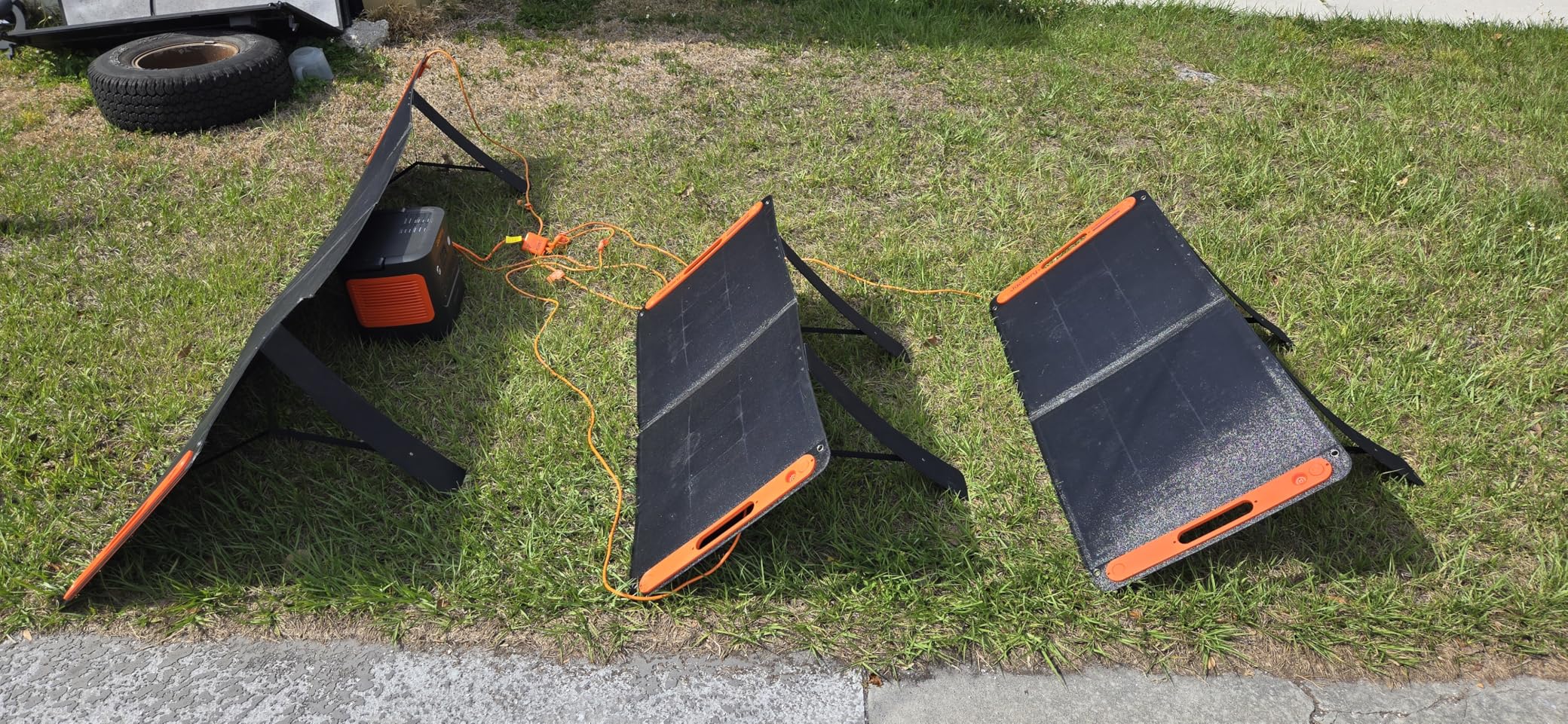
The Explorer 2000 Plus accepts high-wattage solar input, meaning that under good sun conditions with the right panel setup, it’s genuinely possible to recharge the unit in a single afternoon rather than waiting overnight. This makes it a legitimate off-grid companion, not just a battery you charge once at home and drain until it’s dead.
If you’re new to how these systems actually work, our explainer on how solar generators work covers the relationship between panel wattage, sun hours, and realistic charge times in more depth. In short: the more panel wattage you feed into the unit’s input ceiling, the faster you recharge, up to the unit’s maximum accepted input.

Solar charging performance is one of the most variable aspects of this entire product category, and it’s worth setting realistic expectations rather than relying purely on manufacturer-quoted best-case numbers. Panel output is affected by several compounding factors: the angle of the panel relative to the sun, cloud cover, ambient temperature (counterintuitively, panels become slightly less efficient in extreme heat), dust or debris accumulation on the panel surface, and simple geographic latitude and season, which determine how many effective peak sun hours you get per day.
A rough rule of thumb that experienced off-grid users apply: take the panel’s rated wattage and multiply by roughly 0.7-0.8 to estimate realistic average output under good but non-ideal conditions (partial cloud, imperfect angle, morning or late afternoon sun). Multiply that adjusted number by your region’s average peak sun hours (commonly 4-6 hours in most temperate regions during non-winter months) to get a realistic daily energy harvest estimate. This calculation consistently produces more accurate expectations than simply assuming full rated wattage for a full day.
For off-grid or extended camping use, panel angle adjustment throughout the day can meaningfully increase harvest — tilting panels to track the sun’s position rather than leaving them flat can improve output by a meaningful margin, particularly in morning and late afternoon hours when the sun sits at a lower angle. This is more effort than most casual campers will want to invest, but for anyone treating solar charging as a primary power source during an extended off-grid stay rather than a backup measure, it’s a worthwhile habit.
It’s also worth noting that the Explorer 2000 Plus’s solar input is a separate physical port from its AC input, which is a deliberate design choice that allows genuinely simultaneous solar and grid charging when both are available, rather than forcing you to choose one source at a time. This distinction matters more than it might initially seem: some competing designs share circuitry in ways that limit combined charging speed, while a dedicated solar MPPT (maximum power point tracking) input, which this unit uses, extracts the maximum available wattage from connected panels regardless of what’s happening on the AC side.
See bundle options with solar panels included.
Check Bundle PricingApp & Smart Features
Jackery’s companion app lets you monitor charge level, input/output wattage, and control the unit remotely via Bluetooth or Wi-Fi, depending on model connectivity. It’s a genuinely useful addition for a device that often sits in a garage or basement — you can check status without physically walking over to it, and some users appreciate the ability to schedule charging windows to take advantage of off-peak electricity rates.
The app isn’t going to win design awards, but it’s stable, doesn’t require constant firmware nagging, and does the core job it’s meant to do: give you visibility and control without needing to touch the unit itself.
Beyond basic monitoring, the app’s ability to toggle AC and DC output remotely is genuinely useful in specific scenarios — for instance, if the unit is charging devices in a garage or storage area overnight and you want to shut off output without walking outside in bad weather, or if you’re using it to power an outdoor security camera setup and want to check status without physically inspecting the unit during a storm. It’s a small convenience, but it’s the kind of feature that quietly earns its keep over months and years of ownership rather than impressing anyone during an initial unboxing.
Firmware update handling through the app is also relatively painless compared to some competitors that require convoluted multi-step processes involving SD cards or direct cable connections to a computer. Updates typically download and install over Bluetooth or Wi-Fi with a straightforward progress indicator, and Jackery has a reasonable track record of pushing updates that improve charging algorithms and fix minor bugs rather than introducing new problems — though as with any connected device, it’s wise to only update when you’re not relying on the unit for critical power in the immediate future, just in case an update process needs a restart.
One area where the app experience could improve is historical data and analytics. Some competing ecosystems offer detailed charge/discharge history graphs, cycle count tracking, and more granular energy usage breakdowns over time. Jackery’s app covers the fundamentals well but doesn’t go as deep into long-term data visualization, which may matter to more data-driven users who want to track battery health trends over years of ownership.
Real-World Use Cases
Home Backup Power
This is where the Explorer 2000 Plus shines brightest. During a multi-hour or even multi-day outage, it can keep a refrigerator running, charge phones and laptops, power a modem and router so you stay connected, and run lighting throughout the house. Pair it with an expansion battery and you’re looking at genuinely extended backup capability rather than a stopgap.
Camping & RV Trips
For car camping or RV use where weight isn’t a major constraint, the unit provides enough capacity to run a portable fridge, charge devices, and power small appliances like an electric kettle or induction burner for days at a time, especially when paired with a solar panel setup during daylight hours.
Remote Work & Off-Grid Living
Digital nomads and remote workers living off-grid or in areas with unreliable grid power increasingly use setups like this to keep laptops, monitors, and networking equipment running reliably, independent of utility power.

Emergency Preparedness & Storm Season
For households in regions prone to hurricanes, ice storms, or wildfire-related grid shutoffs, the Explorer 2000 Plus fits neatly into a broader emergency preparedness plan. Unlike a gas generator, it requires no fuel stockpiling (a genuine safety concern for households storing gasoline near living spaces), produces no carbon monoxide, and can be safely operated indoors, which matters enormously during severe weather when running equipment outdoors isn’t practical or safe. Pre-charging the unit ahead of a forecasted storm and keeping it topped off via the app’s remote monitoring gives households a real safety net without the logistical overhead of traditional backup generators.
A common preparedness strategy involves keeping the unit charged to a moderate level (not necessarily 100%, since lithium batteries generally prefer not sitting at full charge for extended periods) during elevated-risk seasons, then topping off to full only when a specific weather event is imminent. This approach balances long-term battery health with responsiveness to actual risk.
Small Business & Event Use
Food truck operators, market vendors, photographers doing outdoor shoots, and small event organizers increasingly use mid-to-large capacity power stations like this as a quiet, fume-free alternative to small gas generators. The lack of exhaust fumes and dramatically reduced noise output make it far more suitable for use in proximity to customers or event attendees, and the fast AC recharge means it can be topped off between events or overnight without requiring a full day of downtime.
For point-of-sale systems, small lighting rigs, laptop-based workflows, or running a portable speaker system for a few hours, the base unit alone is typically more than sufficient, and the option to add expansion capacity exists for vendors who scale up to longer events or higher-draw equipment over time.
Medical Equipment Backup
Households with a family member dependent on medical equipment — CPAP machines, oxygen concentrators, nebulizers, or similar devices — represent one of the highest-stakes use cases for this category of product. The pure sine wave output discussed earlier isn’t just a nice-to-have in this context; it’s often a genuine requirement, since many medical device manufacturers explicitly recommend against modified sine wave power sources due to potential equipment strain or malfunction. For these households, the Explorer 2000 Plus’s reliable, clean power output combined with expandable capacity for multi-day outages can be a meaningfully important safety investment rather than a discretionary purchase. That said, anyone relying on this kind of setup for life-sustaining medical equipment should consult with their equipment manufacturer and possibly a medical professional about appropriate backup power redundancy, since no single device should be treated as an infallible sole safety net for critical medical needs.
How It Compares to Competitors
The portable power station market is crowded, and the Explorer 2000 Plus doesn’t exist in a vacuum. Here’s how it stacks up against some of the most commonly cross-shopped alternatives.
| Model | Capacity | Expandable | Output |
|---|---|---|---|
| Jackery Explorer 2000 Plus | ~2042Wh (scalable) | Yes | 2200W |
| EcoFlow Delta 2 | ~1024Wh (expandable) | Yes | 1800W |
| Bluetti AC200 Max | ~2048Wh (expandable) | Yes | 2200W |
| Anker 767 PowerHouse | ~2048Wh | Limited | 2400W |
| Goal Zero Yeti 1500X | ~1516Wh | No | 2000W |
For a full head-to-head breakdown across brands, our Bluetti vs Jackery vs EcoFlow comparison goes much deeper into build quality, warranty terms, and long-term battery chemistry differences.
Against the EcoFlow Delta 2, the comparison largely comes down to base capacity versus expansion cost efficiency. The Delta 2’s base unit is smaller, which means a lower upfront cost of entry, but reaching a comparable total capacity to the Explorer 2000 Plus through EcoFlow’s own expansion batteries can end up costing a similar amount overall, depending on current pricing and bundle promotions. EcoFlow’s charging speed on the base Delta 2 is also very competitive, so the decision here often comes down to brand ecosystem preference and specific port configurations rather than a clear-cut technical winner.
The Bluetti AC200 Max is arguably the closest direct competitor in terms of raw specifications — similar base capacity, similar continuous output, and its own expansion battery ecosystem. Where the two diverge is largely in interface design and app polish, where Jackery generally edges ahead, and in some specific port configurations where Bluetti offers a few additional specialty outputs that niche users (particularly those integrating with existing solar setups or RV electrical systems) might find valuable. For most general household backup use cases, the practical difference between these two units is smaller than either brand’s marketing suggests.
The Anker 767 PowerHouse trades expandability for a higher raw continuous output rating and, in Anker’s case, a strong reputation built from its consumer electronics background particularly around charging speed and port design. If your priority is squeezing out every possible watt for a single high-draw appliance and you don’t anticipate needing to scale capacity over time, the Anker’s fixed but slightly higher output ceiling might appeal. But for households that value the ability to grow their system over multiple years, the lack of a robust expansion ecosystem is a meaningful long-term limitation.
The Goal Zero Yeti 1500X represents an older design philosophy relative to the other units in this comparison — solid, reliable, and backed by a long-established brand in the outdoor and off-grid space, but without the modular expansion capability that defines the newer generation of products including the Explorer 2000 Plus. It remains a reasonable choice for users who specifically want a fixed-capacity unit and value Goal Zero’s ecosystem of accessories and long-standing reputation in the outdoor recreation space, but it’s increasingly looking like the previous generation of thinking in this product category.
Stepping back from individual model comparisons, the broader trend across the entire portable power station industry is clearly moving toward modular, expandable architectures. Manufacturers have recognized that forcing customers to guess their exact capacity needs upfront creates friction and buyer’s remorse, and the Explorer 2000 Plus’s design reflects Jackery’s clear bet that expandability, not just raw capacity or portability, is what will define the next generation of category leaders. For a buyer evaluating options today, that broader industry direction is itself a useful signal about where to place your money for the best long-term value.
Pros & Cons
No product is perfect, and it’s worth being upfront about where the Explorer 2000 Plus genuinely excels versus where it asks for compromise. The strengths here are concentrated almost entirely around the core value proposition — capacity, expandability, and charging speed — while the weaknesses tend to cluster around portability and secondary software polish rather than anything that undermines the unit’s primary function.
Pros
- Genuinely modular, scalable capacity
- Fast AC recharge (~2 hours to 80%)
- Pure sine wave output
- Strong solar input ceiling
- Sturdy, well-built housing
Cons
- Heavy — not ideal for backpacking
- Expansion packs add significant cost
- App design feels dated
- Premium price point
Ready to see full specs and current pricing?
View Latest PriceWho Should Buy the Jackery Explorer 2000 Plus?
This unit makes the most sense for homeowners who want serious backup power without committing to a whole-house generator installation, RV owners who want a quiet, fume-free alternative to gas generators, and off-grid or remote-living households that need dependable daily power. If you camp occasionally and want something ultra-portable for a single backpack trip, this isn’t your unit — look at lighter, smaller-capacity options instead.
Let’s break this down into more specific buyer profiles, since “who should buy this” is rarely a single answer for a product with this broad a range of applications. First, consider the storm-season prepper: someone living in a region with predictable seasonal outage risk who wants a reliable, no-fuss backup solution they can charge, store, and forget about until needed. For this buyer, the base unit alone is often sufficient, with an expansion battery as a reasonable upgrade if their household includes higher-draw needs like medical equipment or a larger refrigerator.
Second, consider the RV or van-life traveler who wants dependable power without the noise, fumes, and maintenance burden of a traditional gas generator. For this buyer, the trade-off is weight and space — the Explorer 2000 Plus is heavier and bulkier than some dedicated RV power solutions, but it offers far more flexibility since it isn’t permanently installed and can be removed, recharged via shore power at a campground, or supplemented with portable solar panels during scenic stops.
Third, consider the off-grid homesteader or remote property owner who needs consistent daily power rather than occasional emergency backup. This buyer benefits most from the expansion battery ecosystem, since their use case involves sustained daily cycling rather than occasional deep discharge during isolated events. For this group, investing in solar panels alongside the unit from day one, rather than treating solar as an afterthought, delivers the best long-term value and reduces dependency on grid charging entirely.
Finally, consider the cautious first-time buyer who isn’t entirely sure how much backup power capacity they’ll actually need. This is perhaps the buyer profile that benefits most distinctly from the Explorer 2000 Plus’s expandable architecture specifically, since it removes the pressure to make a perfect capacity decision on day one. Starting with the base unit, living through a season or two of real-world use, and then deciding whether to expand based on actual experience rather than theoretical estimation is a genuinely sound strategy that this product uniquely enables compared to fixed-capacity alternatives.
On the other side of the equation, buyers who should look elsewhere include ultra-light backpackers and thru-hikers (weight is simply prohibitive), budget-conscious buyers who only need to charge phones and small electronics occasionally (a much smaller and cheaper power bank or mini power station would serve just as well at a fraction of the cost), and buyers whose primary need is truly whole-house backup during extended multi-week outages, for whom a properly installed standby generator system, despite its higher upfront cost and installation complexity, remains the more appropriate solution.
Final Verdict
The Jackery Explorer 2000 Plus earns its place among the best solar generators currently available, largely because of its expandability. It’s not the cheapest option, and it’s certainly not the lightest, but for households that want a power system that can grow alongside their needs, it’s one of the smartest long-term investments in this category. If you’re still comparing options at a category level, our best solar powered generator roundup is a good next stop.
Zooming out, it’s worth acknowledging that no single portable power station is a perfect fit for every household, and a fair review has to be honest about that reality rather than pretending one product solves every scenario. What the Explorer 2000 Plus does exceptionally well is remove the anxiety of committing to a fixed capacity decision, which for many buyers is the single biggest source of hesitation when shopping in this category. Being able to start modestly and scale as needs, budget, or risk tolerance change over time is a genuinely different buying experience than the traditional all-or-nothing approach that has defined this market for years.
The build quality, charging speed, and pure sine wave output collectively suggest a product built by a team that understands the difference between headline spec numbers and genuine day-to-day usability. The areas of compromise — weight, price, and a slightly dated app experience — are real, but none of them undermine the unit’s core function in a way that should be disqualifying for the buyer profiles discussed throughout this review.
If you’re weighing this purchase against the backdrop of unpredictable grid reliability, increasingly severe weather patterns, or simply a desire for more energy independence in daily life, the Explorer 2000 Plus represents a mature, well-engineered answer to that need — one that’s likely to remain relevant and useful for many years rather than becoming an obsolete purchase within a single season.
Frequently Asked Questions
How long does the Jackery Explorer 2000 Plus last on a full charge?
Runtime depends entirely on what you’re powering. A refrigerator alone might run for a day or more, while running multiple high-draw appliances simultaneously will drain it in a few hours.
Can I add expansion batteries later instead of buying them upfront?
Yes. One of the biggest advantages of this system is that you can start with the base unit and add expansion packs whenever your budget or needs change.
Is it safe to run a CPAP machine overnight?
Yes, thanks to the pure sine wave output, which is compatible with sensitive medical electronics.
How long does it take to fully recharge via solar panels?
Under optimal sun conditions with sufficiently rated panels, a full recharge can happen in roughly half a day.
Can this power a full-size refrigerator?
Yes, most standard refrigerators fall well within the 2200W continuous output capacity.
Is the unit loud when running or charging?
It uses internal cooling fans that spin up under heavier loads, but overall noise levels stay well below that of a gas generator.
Does it work well in cold weather?
Lithium batteries generally lose some efficiency in freezing conditions, so performance may dip slightly in very cold environments.
What’s the warranty coverage like?
Jackery typically offers a multi-year limited warranty on this unit, though exact terms can vary by region and retailer.
Can I charge it while simultaneously powering devices?
Yes, the unit supports pass-through charging, meaning you can charge it and draw power from it at the same time.
How does it compare to a traditional gas generator?
It’s quieter, produces no fumes, requires no fuel storage, and can be used indoors safely, though it has a finite capacity compared to a gas generator’s continuous fuel supply.
Is this overkill for casual weekend camping?
For minimal needs like charging phones and running small lights, yes — a smaller, lighter unit would suffice and be easier to carry.
Can multiple expansion batteries be connected at once?
Yes, the system is designed to support multiple expansion packs for significantly increased total capacity.
Is it safe to leave the unit charging unattended overnight?
Yes, it includes built-in battery management protections against overcharging, overheating, and short circuits, making unattended charging reasonably safe under normal conditions.
How should I store it long-term between uses?
Store it at a moderate charge level (not empty or completely full) in a cool, dry location, and check the charge level every few months to top it off if needed.
Can it power a well pump or sump pump?
In many cases yes, provided the pump’s running and starting wattage fall within the unit’s continuous and surge output ratings — check your specific pump’s spec plate before relying on it for this purpose.
Does altitude or extreme heat affect performance?
Very high heat can reduce charging efficiency slightly and trigger more aggressive cooling fan activity, but the unit is generally designed to operate reliably across a wide range of typical outdoor and indoor conditions.
Ready to Upgrade Your Backup Power Setup?
The Jackery Explorer 2000 Plus combines fast charging, strong output, and true expandability in one of the most flexible power stations available today.
Check Latest Price on Amazon