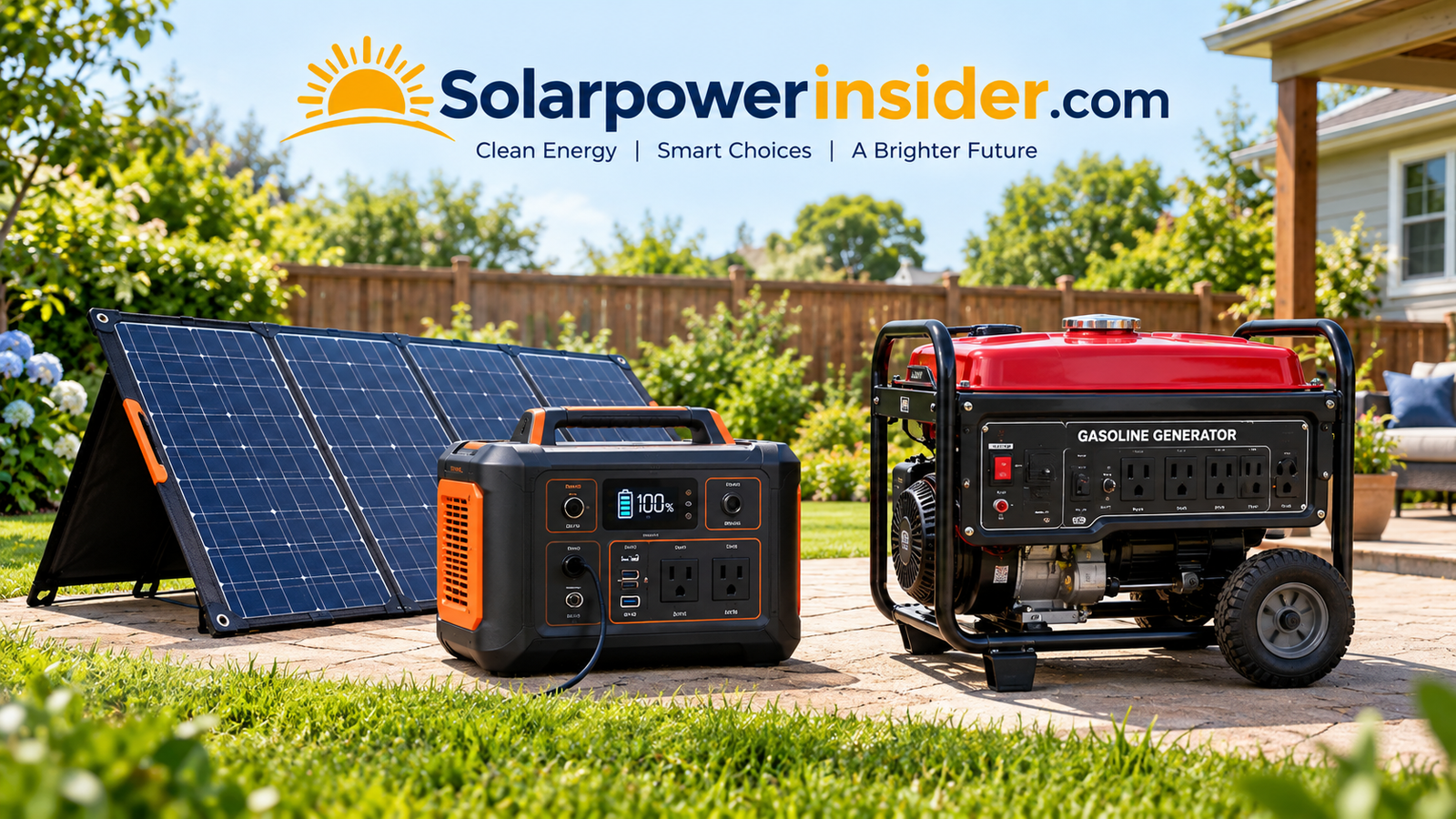
Solar Generator vs Gas Generator: Which One Actually Deserves a Spot in Your Garage?
A detailed, real-world comparison of solar-powered and gas-powered generators — covering cost, noise, maintenance, power output, safety, and which one wins for different situations, from weekend camping trips to multi-day blackouts.

If you’ve ever stood in the generator aisle of a hardware store, or scrolled through a hundred open tabs comparing power stations, you already know the dilemma: solar generator vs gas generator is one of the most common — and most confusing — decisions in emergency preparedness and off-grid living. Both promise to keep your lights on, your fridge running, and your phone charged when the grid goes down. But they get there in completely different ways, with completely different trade-offs.
This guide breaks the decision down piece by piece — power, cost, noise, safety, maintenance, and real-world use cases — so you can figure out which category actually fits your life, rather than which one has the flashiest marketing.
It’s worth saying upfront that this isn’t really a competition with a single winner. Solar generators and gas generators were built to solve different problems, and the “best” choice genuinely depends on where you live, how often the power actually goes out, what you need to keep running, and how much hands-on maintenance you’re willing to take on. A rural homeowner on well water facing week-long ice storm outages has a very different set of needs than an apartment-dweller who occasionally loses power for a few hours during a summer thunderstorm — and the right generator for one of those situations can be the wrong generator for the other.
What makes this comparison especially tricky is that both categories have improved a lot in a short window of time. Gas generators have gotten quieter thanks to inverter technology, and solar generators have gotten more powerful thanks to better battery chemistry and faster charging. That means a lot of the old assumptions — “solar generators are just toys” or “gas generators are always loud and dirty” — are increasingly out of date. This guide reflects where the technology actually stands today, section by section, so you can make a decision based on facts rather than outdated stereotypes.

1. How Each Type Actually Works
Before comparing specs, it helps to understand what’s actually happening inside each device — because the underlying technology is the root cause of nearly every difference you’ll read about below.
Gas Generators: Combustion in a Box
A traditional gas generator is, at its core, a small internal combustion engine bolted to an alternator. You pour gasoline (or in some models, propane or diesel) into a tank, the engine burns that fuel to spin a rotor inside the alternator, and the spinning rotor produces alternating current electricity. It’s the same basic principle that’s powered vehicles for over a century, scaled down into a portable box with outlets on the front.
Solar Generators: Batteries Dressed Up With a Nicer Name
A “solar generator” is a bit of a marketing misnomer — it doesn’t generate anything on its own. It’s actually a battery power station (usually lithium iron phosphate, or LiFePO4) that can be charged from solar panels, a wall outlet, or a car’s 12V port. The battery stores DC energy, and an internal inverter converts that stored energy into usable AC power for your appliances. The “solar” part refers to the charging method, not the power source itself — the unit works identically whether it was charged by sunlight or by a wall socket.
| Aspect | Solar Generator | Gas Generator |
|---|---|---|
| Power source | Stored battery energy (charged via solar, wall, or car) | Combustion of gasoline/propane/diesel |
| Runs out when | Battery is depleted | Fuel tank is empty |
| Can refill on the go? | Only with sunlight or another power source | Yes, with a fuel can |
| Core technology | Lithium battery + inverter | Combustion engine + alternator |
Why the Naming Confuses People
Part of the confusion around this comparison starts with the name itself. “Solar generator” suggests something that continuously converts sunlight into electricity, similar to rooftop solar panels feeding a home. In reality, the unit sitting in the box is a battery and an inverter — nothing more. The solar panels, if you buy them, are a separate accessory that charges the battery. This distinction matters because it means a “solar generator” is really only as green, or as reliable, as the charging method you pair it with. Charge it from a coal-heavy grid outlet, and it’s no more “solar” than any other battery pack. Charge it from a 200-watt folding panel array, and it genuinely becomes a self-sufficient, renewable power source.
What Happens Inside During a Power Draw
When you plug an appliance into a solar generator, the stored DC energy in the battery pack is routed through a pure sine wave inverter, which converts it into standard 120V AC household current. Pure sine wave output is important because it closely mimics grid power, making it safe for sensitive electronics like laptops, CPAP machines, and modern appliances with digital control boards. Cheaper modified sine wave inverters exist but can cause issues — humming noises, reduced efficiency, or even damage — in some sensitive devices. On the gas generator side, the alternator’s raw output is typically less clean unless the unit is specifically an “inverter generator,” a category built around producing steadier, cleaner power through electronic conditioning rather than a raw mechanical alternator feed.
The Role of the Battery Management System
Every reputable solar generator includes a battery management system (BMS), a small onboard computer that constantly monitors cell voltage, temperature, and charge/discharge rates. The BMS is what prevents overcharging, deep discharge damage, short circuits, and thermal runaway — the rare but serious failure mode associated with poorly made lithium batteries. This is one of the most important, and least visible, differences between a well-engineered solar generator and a cheap knockoff: the quality of the BMS directly determines how safely and how long the unit will perform.
Inverter Generators vs Conventional Gas Generators
It’s worth drawing a distinction within the gas generator category itself, since “gas generator” isn’t a single monolithic technology. Conventional gas generators run the engine at a constant speed regardless of load, which is simple and cheap but noisy and less fuel-efficient. Inverter gas generators, a newer and increasingly popular subcategory, vary engine speed based on actual demand and run the output through electronic conditioning to produce cleaner, quieter power — closing some of the gap with solar generators on noise and efficiency, though still nowhere near silent, and still dependent on combustion and fuel.
Hybrid Systems: The Best of Both Worlds?
A newer category worth knowing about is the hybrid or dual-input system — a battery power station designed to accept charging input from both solar panels and a small gas-powered charging module simultaneously. These systems aim to combine the quiet, indoor-safe operation of a battery bank with the virtually unlimited runtime of fuel-based charging, essentially using a small generator purely to recharge the battery rather than to power appliances directly. While still a smaller niche compared to standalone solar or gas units, this category is growing quickly among buyers who want the reliability of fuel with the flexibility of battery storage.
2. Power Output & Capacity Compared
This is where the two categories diverge the most sharply, and where a lot of buyers get caught off guard.
Gas Generators: Built for Sustained High Output
Gas generators are rated in continuous running watts, typically ranging from around 2,000W for small portable units up to 10,000W+ for whole-home standby models. As long as there’s fuel in the tank, a gas generator can run large loads — well pumps, central air conditioners, electric ranges — indefinitely, refueling every several hours.
Solar Generators: Limited by Battery Capacity
Solar generators are rated two ways: watt-hours (Wh), which describes total stored energy, and output watts, which describes how much can be drawn at once. A mid-size unit might store 1,000–2,000Wh and output 1,500–3,000W continuously. That’s plenty for lights, a laptop, a CPAP machine, or a mini-fridge, but running a table saw or a window AC unit for hours will drain even a large unit quickly.
| Capability | Solar Generator (mid-size) | Gas Generator (mid-size) |
|---|---|---|
| Continuous output | 1,500–3,000W | 3,000–7,500W |
| Total available energy | Fixed by battery (e.g. 2,000Wh) | Effectively unlimited (refuel) |
| Runtime on full load | 1–3 hours before recharge needed | 8–12 hours per tank |
| Best for heavy appliances | Limited | Excellent |
Solar Generator Strengths
- Instant, silent power for electronics and small appliances
- No power degradation as it discharges (steady voltage)
- Can be recharged indefinitely without buying fuel
Solar Generator Limits
- Fixed energy reserve — once it’s out, it’s out until recharged
- Recharging via solar panels alone can take many hours
- Not well suited to high-draw appliances for extended periods
Understanding Starting Watts vs Running Watts
Gas generator spec sheets typically list two numbers: running (or rated) watts and starting (or surge) watts. Running watts describe what the unit can sustain continuously, while starting watts describe the brief surge many motor-driven appliances need the instant they switch on — refrigerator compressors, well pumps, and power tools are common examples, and their startup surge can be two to three times their running wattage. Solar generators handle this differently: because the inverter can respond almost instantly, surge handling is usually built into the stated peak output rating, but that peak is still capped by the battery’s maximum discharge rate, so it’s worth checking a specific model’s surge rating before assuming it can handle a compressor-driven appliance.
Stacking and Expandable Battery Systems
A growing number of solar generator models now offer expandable capacity — additional battery modules that connect to the main unit to increase total watt-hours without adding a second inverter. This lets buyers start with a smaller, more affordable unit and scale up capacity later as budget allows, something gas generators simply can’t replicate; a gas unit’s capacity is fixed the day it’s manufactured, and the only way to get more power is to buy a second, separate generator or a larger one outright.
Real-World Runtime Examples
To make the numbers concrete: a 2,000Wh solar generator can typically run a modern energy-efficient refrigerator for roughly 20–30 hours, keep a handful of LED lights on for well over 100 hours, or charge a laptop more than 40 times. A mid-size 3,500W gas generator, by contrast, could power that same refrigerator continuously for days on end, as long as fuel keeps getting added every 8–12 hours. The gap becomes obvious the moment you’re trying to power something continuously for more than a day without recharging or refueling — which is exactly where gas generators still hold a structural advantage.
Read: What Size Solar Generator Do I Need?
3. Upfront Cost vs Long-Term Cost
Sticker price only tells half the story. The real cost comparison has to include fuel, maintenance, and how long each unit is likely to last.
Upfront Price
Entry-level gas generators (2,000–3,500W) typically cost less upfront than a comparably capable solar generator, since battery cells — especially LiFePO4 — remain relatively expensive per watt-hour of storage. A basic gas unit might run a few hundred dollars, while a solar generator with similar peak output but far less total capacity can cost noticeably more.
Ongoing Costs
This is where solar starts clawing back ground. A gas generator needs a continuous supply of fuel, plus regular oil changes, spark plugs, air filters, and occasional carburetor cleaning. Over several years of intermittent use, fuel and maintenance costs add up. A solar generator, once purchased (and paired with solar panels if you want sun-charging), has essentially no recurring cost beyond the electricity used to charge it from the wall, which is negligible.
| Cost Factor | Solar Generator | Gas Generator |
|---|---|---|
| Typical upfront cost (mid-tier) | Higher | Lower |
| Fuel cost over 5 years | $0 (or solar panel cost, one-time) | Ongoing, scales with usage |
| Routine maintenance cost | Minimal | Moderate, recurring |
| Replacement parts | Rare (battery degrades slowly) | Common (engine wear parts) |
Buyers who use a generator only a handful of times a year for short outages often find the math favors gas upfront; buyers expecting frequent or long-term use tend to break even on solar within a few years of avoided fuel costs.
Hidden Costs Buyers Often Miss
The comparison gets more nuanced once you factor in costs that don’t show up on the price tag. Gas generators typically require a dedicated fuel storage plan — gas cans, a stabilizer, and a safe outdoor storage spot — plus occasional costs for oil, filters, and spark plugs that add up to perhaps $50–150 per year for moderate use. Solar generators carry a hidden cost of their own if you want true off-grid recharging: solar panels aren’t cheap, and a panel array capable of fully recharging a large unit in a reasonable timeframe can cost nearly as much as the power station itself. Buyers who assume the panels are included, or who buy an undersized panel, are often disappointed by how long a full recharge actually takes.
Depreciation and Resale Value
Gas generators tend to hold resale value reasonably well as long as the engine has been maintained, since the used generator market is large and buyers understand what they’re getting. Solar generators depreciate somewhat faster on the resale market, partly because battery health is harder for a buyer to verify secondhand, and partly because newer models with better battery chemistry and faster charging tend to make older units feel outdated more quickly.
Financing the Purchase
Because solar generators sit at a higher price point, many retailers now offer installment financing, and buyers frequently combine a base unit purchase with a smaller initial panel setup, expanding capacity over time as budget allows. This staged approach can make the higher upfront solar cost easier to absorb than paying for a large gas generator and years of fuel all at once.
A Sample Five-Year Cost Comparison
To put rough numbers to the comparison: imagine a household using backup power for roughly 60 hours a year across a handful of outages. Over five years, a mid-size gas generator might involve the initial purchase, several oil changes, a set of spark plugs, an air filter or two, and enough gasoline to cover 300 cumulative hours of runtime — together landing somewhere in the low-to-mid hundreds of dollars in ongoing costs on top of the purchase price. A comparably capable solar generator, purchased with a modest panel array, would involve essentially no further spending over that same five years beyond the wall electricity used for occasional top-up charging, which is close to negligible. The gas generator likely still costs less in total over this particular five-year window given its lower purchase price, but the gap narrows considerably compared to the upfront price difference alone, and it continues narrowing the longer both units stay in service.
Comparing Cost Per Watt-Hour
One useful way to compare pricing across brands and sizes is cost per watt-hour of usable capacity — dividing the price by the battery’s rated Wh. This metric tends to improve (get cheaper) as capacity increases, meaning larger solar generators are often a better value per watt-hour than smaller ones, even though their total price tag is higher. It’s a similar principle to buying in bulk: the fixed costs of the inverter, casing, and electronics get spread across more stored energy in bigger units.
Rebates, Incentives, and Tax Credits
Depending on where you live, solar generators and accompanying solar panels may qualify for local rebates or incentives aimed at encouraging renewable energy adoption, particularly if the panels are also usable for other home solar applications. Gas generators occasionally qualify for state-level disaster-preparedness tax credits in certain regions, though these programs vary widely and change often, so it’s worth checking current local programs before assuming either option comes with built-in savings.
Insurance and Homeowner Considerations
Some homeowners insurance policies ask about fuel storage on the property, which can occasionally affect premiums if large quantities of gasoline are kept on-site. Solar generators don’t typically raise the same flags, since there’s no flammable fuel being stored in bulk. This is a minor factor for most buyers, but it’s worth a quick call to an insurance provider if fuel storage plans are extensive.
4. Noise Levels: Whisper vs Roar
Noise is one of the most frequently underestimated differences between these two categories — and for many buyers, it ends up being the deciding factor.
Gas Generators Are Loud by Design
A running combustion engine produces mechanical noise, exhaust noise, and vibration. Even “quiet” inverter-style gas generators typically run in the 50–65 dB range at a distance, which is comparable to a normal conversation to a vacuum cleaner. Many campgrounds and some residential neighborhoods have specific rules or quiet hours around gas generator use because of this.
Solar Generators Are Nearly Silent
Because there’s no combustion and no moving engine parts, a solar generator produces virtually no operating noise — at most a barely audible fan hum on high loads. This makes them popular for camping in noise-sensitive areas, running CPAP machines overnight, or powering equipment in shared living spaces.
Gas Generator
~55–70 dB at 20 feet, comparable to a lawn mower running continuously.
Solar Generator
Near-silent, typically under 30 dB — quieter than a refrigerator hum.
Why Decibels Don’t Tell the Whole Story
Decibel ratings only capture volume, not the character of the sound, and engine noise tends to be far more fatiguing over time than the numbers suggest. A gas generator’s noise includes a steady mechanical drone plus intermittent surges as the engine load changes, which is more noticeable and more irritating over a multi-hour period than a comparable steady tone. This is a big part of why campground and RV park rules single out generators specifically, rather than any noise source of similar volume — engine noise carries and annoys in a way flat white noise doesn’t.
Neighborhood and HOA Restrictions
Beyond campgrounds, a growing number of homeowners’ associations and municipal noise ordinances place explicit restrictions on gas generator operation, particularly overnight. Some jurisdictions cap generator noise at specific decibel limits measured from the property line, and violations can result in fines. Solar generators, producing no meaningful operating noise, sidestep this issue entirely, which is part of why they’ve become popular for backup power in dense suburban and multi-family housing settings where a loud generator simply isn’t a realistic option.
Noise During Sleep
For anyone relying on backup power to run a CPAP machine, medical equipment, or simply to sleep through an outage, the noise difference is not a minor comfort issue — it’s often the deciding factor. A gas generator running outside a bedroom window at 60 dB overnight can meaningfully disrupt sleep, while a solar generator can often sit in the same room as the sleeper without any audible disturbance at all.
Measuring Noise the Way Manufacturers Do
Manufacturer decibel ratings are typically measured at a standard distance, often 23 feet (7 meters), under a specific load percentage, usually 25–50% of rated output. Real-world noise at full load, or measured closer to the unit, is often noticeably higher than the advertised figure, which is worth keeping in mind when comparing spec sheets between models — the quietest-looking number on paper doesn’t always reflect how the unit sounds in typical use.
Layering Noise Reduction for Gas Generators
For buyers committed to a gas generator who still want to minimize noise impact, a few strategies help: choosing an inverter model over a conventional one, positioning the unit as far from living and sleeping areas as safely possible, using a generator-specific sound-dampening enclosure designed to allow proper ventilation, and pointing the exhaust away from reflective surfaces like fences or walls that can bounce sound back toward the house. None of these fully closes the gap with a solar generator’s near-silence, but they can meaningfully soften the impact.
5. Fuel, Refueling & Recharging
How you keep each unit running day-to-day is one of the most practical differences to plan around.
Gas Generator Refueling
Refueling a gas generator is quick — a few minutes with a gas can — but requires you to have fuel stockpiled or available to purchase, which becomes a real challenge during widespread outages or natural disasters when gas stations may be closed or have long lines. Stored gasoline also degrades over time unless treated with a stabilizer.
Solar Generator Recharging
A solar generator can be recharged three main ways: solar panels (slowest, weather-dependent, typically 4–8+ hours for a full charge in good sun), a wall outlet (fastest, often 1–3 hours), or a car’s 12V outlet while driving. This flexibility means you’re never fully dependent on finding fuel — but full solar recharging is genuinely slow and weather-dependent, which matters a lot during multi-day cloudy stretches.
| Recharge/Refuel Method | Solar Generator | Gas Generator |
|---|---|---|
| Fastest method | Wall outlet (1–3 hrs) | Refuel by hand (minutes) |
| Off-grid method | Solar panels (4–8+ hrs, weather dependent) | Stockpiled fuel canisters |
| Dependent on external supply chain? | No (with panels) | Yes (fuel stations) |
Planning Fuel Storage Safely
Fuel safety deserves its own consideration. Gasoline should be stored in approved, sealed containers, away from living spaces, ideally in a detached shed or garage, and rotated every few months to prevent degradation — old gas can gum up a carburetor and cause hard starting or engine damage. Propane, an alternative fuel some dual-fuel generators accept, stores indefinitely without degrading, which is one reason many preparedness-focused buyers choose dual-fuel gas generators specifically for the storage flexibility.
Charging Speed Trade-Offs
It’s worth understanding the trade-off curve on solar generator charging: wall-outlet charging is fast but requires grid power, defeating part of the purpose during an actual blackout. Car charging is moderate speed and requires burning gasoline in your vehicle, which somewhat undercuts the “no fuel needed” appeal. True solar panel charging is the slowest option but the only one that’s genuinely fuel-free and grid-independent, which is why serious off-grid or emergency-focused buyers generally view solar panels as a necessary companion purchase rather than an optional extra.
Multi-Day Outage Planning
For outages lasting more than a day or two, the recharging method becomes the single most important planning variable. A solar generator with a strong panel array in sunny conditions can, in principle, be recharged every day indefinitely, giving it a form of unlimited runtime similar to a gas generator’s refuel cycle — just spread across daylight hours instead of minutes. In prolonged cloudy weather, however, that same setup can struggle to keep pace with daily consumption, which is exactly the scenario where a gas generator’s fuel-can refueling remains the more dependable option.

Solar Panel Wattage and Sizing
Choosing the right solar panel wattage to pair with a power station involves matching panel output to battery capacity and how quickly you want a full recharge. As a rough rule of thumb, a panel array’s total wattage divided into the battery’s Wh capacity gives an estimate of ideal sun-hours needed for a full charge under good conditions — a 200W panel paired with a 2,000Wh battery would need roughly 10 hours of strong, direct sun for a complete charge, though real-world efficiency losses typically push that figure somewhat higher. Buyers who want same-day full recharges generally need to oversize their panel array well beyond the bare minimum.
Fuel Types Beyond Gasoline
Gas generators aren’t limited to gasoline alone. Many modern units are “dual-fuel,” able to run on either gasoline or propane, and some larger standby models run on natural gas piped directly from a home’s gas line. Propane offers the advantage of indefinite shelf life without degradation, while natural gas offers essentially unlimited runtime for homes with a piped connection, though at the cost of losing portability entirely since the generator becomes a fixed installation.
Read: How Does a Solar-Powered Generator Work?
6. Maintenance Requirements
Maintenance is where the “set it and forget it” appeal of solar generators really shows.
Solar Generator Maintenance
- No oil changes, spark plugs, or filters
- Occasional firmware updates on smart models
- Store at 50–80% charge and top up every few months
Gas Generator Maintenance
- Regular oil changes (often every 50–100 hours of use)
- Spark plug replacement and air filter cleaning
- Fuel stabilizer needed for long-term storage; carburetor issues if fuel sits too long
None of the gas generator maintenance tasks are difficult, but they do require attention, tools, and consumable parts — something to factor in if the generator is meant to sit in storage for months at a time and work flawlessly the moment it’s needed.
The “Exercise Run” Requirement
Small engines are notorious for developing starting problems after long periods of disuse — stale fuel, dried-out gaskets, or a battery that’s lost its charge can all leave a gas generator refusing to start exactly when it’s needed most. Most manufacturers recommend running a gas generator under load for 20–30 minutes every month or so to keep the engine, carburetor, and battery in working order. Skipping this step is one of the most common reasons people discover, mid-blackout, that their “backup” generator won’t start.
Solar Generator Long-Term Storage
Lithium batteries have their own storage best practices, though they’re considerably simpler to follow. Manufacturers generally recommend storing a solar generator at roughly 50–80% charge rather than fully charged or fully depleted, and topping off the charge every three to six months if it’s sitting unused. Unlike a gas engine, there’s no risk of the unit “forgetting how to start” — a solar generator that’s been sitting for a year will simply power on and work exactly as it did the day it was put away, provided the battery hasn’t been allowed to sit fully depleted for an extended period, which can permanently damage cell capacity.
Warranty and Service Support
Warranty terms also differ meaningfully between categories. Gas generator warranties typically run one to three years and often distinguish between the engine (sometimes covered separately by the engine manufacturer) and the generator housing/electronics. Solar generator warranties frequently run two to five years on the full unit, reflecting manufacturer confidence in the simpler, more static nature of battery and inverter technology compared to a mechanical engine with dozens of moving parts.
Tools and Skills Required
Maintaining a gas generator properly does require a modest toolkit — a wrench for the spark plug, an oil drain pan, funnels, and basic mechanical comfort with small engines. None of it is difficult, and countless online guides walk through the process step by step, but it is a skill set, and one that some buyers simply don’t want to acquire or keep up with. Solar generator maintenance, by contrast, requires essentially no tools and no mechanical knowledge — the most involved task most owners will ever perform is plugging the unit in every few months to top off the charge.
Troubleshooting Common Problems
When something goes wrong, the troubleshooting experience differs sharply between the two categories. A gas generator that won’t start could involve any number of culprits — bad fuel, a fouled spark plug, a clogged carburetor, a dead battery on electric-start models, or a tripped circuit breaker — often requiring some diagnostic work to isolate the cause. A solar generator that won’t power on typically has a much narrower set of possible issues: a depleted battery, a tripped internal protection circuit (often reset with a specific button combination), or in rare cases a BMS fault requiring manufacturer service. The simpler troubleshooting tree is itself a meaningful convenience for owners who aren’t mechanically inclined.
Cold Weather Maintenance Differences
Cold weather affects both technologies, but in different ways. Gas engines can be harder to start in freezing temperatures, sometimes requiring fuel additives or engine warmers in very cold climates, and oil viscosity needs to be matched to the season. Lithium batteries lose some usable capacity in cold temperatures and, more importantly, most lithium chemistries should not be charged below freezing, since doing so can permanently damage the cells — meaning a solar generator left in an unheated garage during winter may need to be brought inside to warm up before it can be safely recharged, even though it can typically still discharge (power devices) in the cold without the same restriction.
Hot Climate Considerations
On the other end of the temperature spectrum, gas generators generally tolerate heat well, provided oil levels and cooling airflow are properly maintained, though very high ambient temperatures can slightly reduce engine efficiency. Lithium batteries are more sensitive to sustained heat, with prolonged exposure to high temperatures accelerating capacity degradation over time — something worth considering for buyers in hot, sunny climates who might be tempted to leave a solar generator sitting in direct sun or a hot vehicle for extended periods, ironically the exact environment where it’s also being recharged.
7. Safety Considerations
Safety is arguably the single most important category, since generator misuse causes real, well-documented harm every year.
Gas Generator Risks
Gas generators produce carbon monoxide, a colorless, odorless gas that is deadly in enclosed spaces. They must always be run outdoors, far from windows and doors, and ideally paired with a CO detector nearby. They also involve storing flammable fuel and pose burn risks from hot engine components.
Solar Generator Risks
Solar generators produce no exhaust and can safely be used indoors, which is a major safety advantage — especially during winter storms when running a gas generator outdoors in freezing temperatures is both dangerous and unpleasant. The main risks are battery-related: overheating, damage from extreme temperatures, or using a low-quality unit without proper battery management systems (BMS).
Placement Rules for Gas Generators
Manufacturers and safety organizations generally recommend placing a gas generator at least 20 feet from the home, with the exhaust pointed away from windows, doors, and vents. Wind direction matters too — even an outdoor generator can push carbon monoxide back into a home if it’s placed on the wrong side of a prevailing breeze. A battery-powered carbon monoxide detector, positioned inside the home, adds a critical layer of protection that costs very little relative to the risk it mitigates.
Electrical Safety and Backfeeding
Both generator types carry electrical risks if connected improperly to a home’s wiring. “Backfeeding” — plugging a generator directly into a wall outlet to power household circuits — is extremely dangerous, both to the generator operator and to utility workers who may be working on what they believe is a de-energized line. Proper setups use a transfer switch or simply run extension cords directly to individual appliances, a rule that applies equally whether the backup power source is gas or solar.
Weatherproofing Concerns
Neither generator type is typically designed to run fully exposed to rain. Gas generators need dry conditions to avoid engine and electrical issues, and most solar generators are not rated for direct rain exposure either, despite sometimes being marketed for outdoor use. Both benefit from a generator tent, canopy, or covered porch area during storm use — running either type in open rain is a common and avoidable safety mistake.
Fire Risk Comparison
Both technologies carry fire risk, though the nature of that risk differs. Gasoline is highly flammable, and improper fuel storage or refueling a hot engine are common causes of generator-related fires. Lithium batteries carry a smaller but more severe risk: thermal runaway, a rare failure mode where a damaged or defective cell overheats uncontrollably, sometimes triggered by physical damage, manufacturing defects, or charging outside the safe temperature range. Reputable solar generator brands invest heavily in BMS protections and cell-quality control specifically to minimize this risk, which is one of the strongest arguments for buying from an established manufacturer rather than an unknown budget brand.
Child and Pet Safety
Running gas generators reach high external temperatures and have exposed moving parts, both of which pose burn and injury risks around curious children or pets. Solar generators run cool to the touch and have no moving parts on the exterior, making them meaningfully safer to have running in a home with young kids or animals nearby, though basic caution around any powered electrical device is still warranted.
Emergency Preparedness Checklists
Whichever type you choose, a few safety habits apply universally: test the unit before an emergency actually arrives, keep a fire extinguisher rated for electrical or fuel fires nearby, never leave a running generator unattended for extended periods, and make sure every household member knows how to safely operate it. A generator that’s never been test-run is a gamble at exactly the moment you can least afford one.
8. Portability & Weight
Weight and size affect how practically usable each option is for camping, road trips, or simply moving it around the house.
| Category | Solar Generator (mid-size) | Gas Generator (mid-size) |
|---|---|---|
| Typical weight | 20–45 lbs | 50–110 lbs |
| Handles/wheels | Usually built-in handle, some with wheels on large units | Wheel kits common on larger models |
| Carry-on friendly? | Smaller units, yes | No |
| Fits in a car trunk easily? | Yes, most models | Larger models are bulky |
For car camping, van life, tailgating, or apartment-dwellers who don’t have a garage to store a gas can, the lighter weight and cleaner handling of a solar generator is a genuine quality-of-life upgrade.
Setup Time and Ease of Use
Beyond raw weight, setup complexity differs too. A gas generator requires checking oil level, filling the fuel tank, choking and starting the engine, and letting it warm up before drawing a full load — a process that takes several minutes even for an experienced user, longer in cold weather. A solar generator is genuinely as simple as pressing a single power button; there’s no warm-up period, no choke, and no risk of flooding the engine on a failed start attempt.
Air Travel and Transport Restrictions
It’s worth noting that gasoline itself cannot be transported by air under any circumstances, and even an empty gas generator can raise questions at airport security due to residual fuel vapors. Solar generators, by contrast, are essentially large lithium battery packs, and many smaller and mid-size units fall within airline watt-hour limits for carry-on baggage, making them a practical choice for travelers who want backup power without checking complicated equipment.
Storage Footprint at Home
Beyond travel, day-to-day storage footprint matters too. A gas generator typically needs to live in a garage or shed, away from living space, due to fuel fumes and fire risk, and it needs to be accompanied by properly stored fuel cans. A solar generator can be stored virtually anywhere — a closet shelf, under a bed, in an apartment — since there’s no fuel, no fumes, and no fire code concerns around indoor storage. For apartment or condo dwellers without garage access, this alone can be the deciding factor.
Moving It Around During Use
Once in use, the difference in day-to-day handling continues. Gas generators are usually meant to be positioned once, outdoors, and left running in place for the duration of an outage, since repositioning a running engine is impractical and unsafe. Solar generators, being lighter and producing no fumes, can be moved from room to room as needed — powering the kitchen during meal prep, then wheeled to the bedroom to run a CPAP machine overnight — offering a flexibility that a stationary, fume-producing engine simply can’t match.
Handles, Wheels, and Ergonomics
Larger solar generators, particularly those in the 2,000Wh-plus range, increasingly ship with retractable handles and built-in wheels similar to rolling luggage, acknowledging that even a “portable” battery pack in this size range can weigh 40 pounds or more. Gas generators in similar output classes almost universally ship with wheel kits as standard, since their weight has always necessitated it — a reminder that “portable” is a relative term in both categories once you move up to higher-capacity units.
Vehicle and RV Integration
For RV owners and van-lifers, solar generators integrate especially well with existing rooftop solar setups, often accepting direct input from permanently mounted panels in addition to portable ones. Gas generators can also be mounted or carried in RV storage compartments, but building codes and RV park rules frequently restrict where and when they can be run, adding a layer of logistical complexity that solar setups simply don’t encounter.
9. Environmental Impact
For buyers weighing sustainability, the comparison isn’t close in terms of operating emissions — though it’s worth looking at the full picture.
Gas generators burn fossil fuel and emit carbon dioxide, carbon monoxide, and other pollutants every time they run. Solar generators produce zero emissions during operation, and when charged via solar panels, the electricity used is effectively free and renewable. The trade-off is in manufacturing: lithium battery production has its own environmental footprint, and batteries eventually need recycling or disposal at end of life. Even accounting for that, most lifecycle analyses favor solar generators for buyers who use backup power regularly over several years.
Air Quality Impact
Beyond global carbon emissions, gas generators also affect local air quality in the immediate area where they’re running, releasing carbon monoxide, nitrogen oxides, and particulate matter. This matters most in dense residential areas or during widespread outages, when dozens of neighboring households may all be running gas generators simultaneously, measurably degrading local air quality for the duration of the event. Solar generators have no such local impact regardless of how many are running nearby.
End-of-Life Disposal
Disposal considerations differ between the two as well. A gas generator’s engine, mostly metal, is relatively straightforward to recycle through standard scrap metal channels once it reaches the end of its life. Lithium batteries require specialized recycling to safely recover valuable materials and prevent fire risk, and while battery recycling infrastructure has expanded significantly, it’s not yet as universally accessible as metal recycling — something to be aware of if a solar generator’s battery eventually needs replacing or the unit is retired after many years of service.
Carbon Footprint Over a Typical Ownership Period
Looking at total emissions over a typical five-to-ten-year ownership period, the gap between the two options widens considerably in favor of solar. A gas generator used for even moderate backup duty — say, 100 hours a year during outages — burns through a meaningful amount of gasoline annually, each gallon of which releases roughly 19–20 pounds of carbon dioxide when burned. A solar generator charged primarily from rooftop or portable solar panels produces close to zero operating emissions over that same period, with its only carbon footprint tied to the one-time manufacturing process rather than ongoing use.
Community and Grid Impact
During widespread regional outages, the cumulative effect of many households running gas generators simultaneously can create noticeable local air quality dips, something public health officials have flagged after major storms in dense population centers. Solar generators, drawing only stored battery power, place no such burden on either local air quality or the broader fuel supply chain during exactly the moments when fuel supplies are often most strained.
Manufacturing Footprint Considerations
To be fair to gas generators, it’s worth acknowledging that manufacturing a lithium battery pack is more resource- and energy-intensive than manufacturing a comparable combustion engine, involving mining for lithium, cobalt, and other materials. However, because a solar generator produces no ongoing emissions during years of use, most full lifecycle assessments still show a net environmental advantage for solar generators over any ownership period longer than a couple of years — the upfront manufacturing footprint is paid back many times over by the avoided fuel emissions.
Choosing a More Sustainable Gas Option
For buyers who need a gas generator’s power output but still want to minimize environmental impact, propane burns somewhat cleaner than gasoline, and newer EPA-compliant engines are meaningfully more efficient than older models. Pairing a gas generator with genuinely necessary, load-appropriate sizing — rather than buying more generator than needed “just in case” — also reduces unnecessary fuel consumption over the unit’s lifetime.
10. Best Use Cases for Each
Neither option is universally “better” — the right choice depends heavily on how and where you plan to use it.
Choose Solar If…
You need quiet, indoor-safe backup for electronics, medical devices, or short outages, or you camp in noise-restricted areas.
Choose Gas If…
You need to run high-draw appliances (well pumps, AC units) for extended periods and want the lowest upfront cost.
Choose Solar If…
You want zero maintenance and don’t want to store flammable fuel at home.
Choose Gas If…
You expect multi-day cloudy outages and need guaranteed, fast-refuel power regardless of weather.
Solar Generators Shine For…
Weekend campers who want to charge phones, run string lights, or power a portable fridge without disturbing neighboring campsites; homeowners in areas with frequent short outages who mainly need to keep routers, lamps, and small electronics running; anyone using medical devices that require quiet, indoor-safe, uninterrupted power; and RV or van-life travelers who want a lightweight, low-maintenance power solution that doesn’t require carrying fuel cans.
Gas Generators Shine For…
Rural homeowners on well water who need to keep a pump running continuously during multi-day outages; construction and job sites needing to run power tools for hours at a stretch; anyone who needs to power a central air conditioner or electric range during a summer storm outage; and buyers on a tight budget who need maximum watts for the lowest possible upfront cost.
Case Study: The Weekend Camper
Consider a family that camps a handful of weekends each summer, mostly at sites with quiet-hour rules and no hookups. Their power needs are modest — phone charging, a string of camp lights, maybe a portable fridge for a cooler upgrade — and noise matters a lot, both for their own experience and out of courtesy to neighboring campers. This is close to the ideal solar generator scenario: light, silent, rechargeable via a folding panel during the day, and more than capable of the modest loads involved.
Case Study: The Rural Homeowner
Now consider a homeowner on well water in a region prone to multi-day ice storm outages. Their well pump alone can draw several thousand watts at startup, and they also want to keep a chest freezer, some lighting, and a space heater running for days at a time if needed. This is a much better match for a gas generator, ideally a larger dual-fuel model — the sustained wattage and fast refueling are simply better suited to a multi-day, high-draw scenario than any reasonably priced solar setup could match.
Case Study: The Urban Apartment Dweller
Finally, picture someone in a city apartment with no outdoor space, no garage, and strict building rules against fuel storage or generator use. For this person, a gas generator may not even be a legal or practical option. A solar generator, safe to store and even operate indoors in a pinch, is really the only realistic backup power solution — illustrating how living situation alone can eliminate one category entirely before cost or power output even enter the conversation.
Read: Is a Solar Generator Worth It?11. Lifespan & Durability
Longevity is another area where the two technologies age very differently.
A well-maintained gas generator engine can last 1,000–2,000+ hours of run time, which for occasional backup use can translate to well over a decade, provided maintenance is kept up. A solar generator’s lifespan is largely determined by its battery chemistry — LiFePO4 batteries, now standard in most quality solar generators, are typically rated for 2,000–3,500+ charge cycles before capacity noticeably degrades, which for typical intermittent use can also mean a decade or more of useful life.
| Durability Factor | Solar Generator | Gas Generator |
|---|---|---|
| Expected lifespan (typical use) | 8–15 years | 10–20 years (with maintenance) |
| Degrades from disuse? | Slight battery self-discharge over months | Fuel degrades, engine seals can dry out |
| Weather resistance | Varies by model; most are not fully weatherproof | Generally more weather-tolerant when running |
What Actually Degrades a Lithium Battery Faster
A handful of habits can noticeably shorten a solar generator’s usable lifespan: routinely running the battery down to 0% before recharging, exposing the unit to extreme heat (leaving it in a hot car trunk, for example), or storing it fully charged for long stretches. Buyers who avoid these habits — keeping the unit in a moderate temperature range and avoiding full discharge cycles when possible — can often extend a battery’s usable life well beyond its rated cycle count.
What Actually Shortens a Gas Engine’s Life
Similarly, a handful of habits shorten a gas generator’s lifespan: running it consistently near or above its rated capacity, skipping oil changes, using old or contaminated fuel, and failing to run it periodically when in storage. A gas generator that’s properly maintained — oil changed on schedule, fuel treated and rotated, and exercised monthly — can easily outlast one that’s neglected by a factor of two or three in total usable years.
Signs a Unit Is Nearing the End of Its Useful Life
For gas generators, warning signs of a declining engine include harder starting, noticeably rougher idling, increased oil consumption, and declining output under load — all signals that a rebuild or replacement may be approaching. For solar generators, the key warning sign is reduced runtime relative to when the unit was new; a battery that once ran a laptop for eight hours but now manages only five or six is showing the natural capacity fade that comes with cycle aging, and while this is normal, a sudden or dramatic drop can indicate a battery or BMS problem worth having checked.
Extending Usable Life With Good Habits
In both cases, moderate, consistent use paired with proper storage practices does more to extend lifespan than any single maintenance task. A generator that’s occasionally exercised, stored correctly, and not routinely pushed to its absolute maximum rated output will, in either category, reliably outlast one that’s either neglected in storage or consistently run at the edge of its capacity.
Read: How Long Does a Solar Generator Last?12. Which One Should You Buy?
If you’re still torn, it often comes down to a few honest questions: How long do you expect outages to last where you live? Do you need to run heavy appliances, or just keep essentials running? Does noise or indoor safety matter to you? And how much ongoing maintenance are you actually willing to do?
Many well-prepared households end up landing on a hybrid approach — a solar generator for daily convenience, quiet nights, and indoor-safe emergency backup, paired with a gas generator (or a larger dual-fuel unit) reserved for extended outages or high-draw needs. That combination covers nearly every scenario without over-investing in either category alone.
A Simple Decision Framework
If you had to boil the entire decision down to three questions, they’d be these: First, how long do outages typically last in your area — hours, or multiple days? Second, do you need to power heavy, continuous loads like a well pump or central air, or mostly lights, electronics, and small appliances? Third, does noise, indoor safety, or fuel storage present a real constraint in your living situation? Answering those three questions honestly will point most buyers toward the right category far more reliably than comparing spec sheets alone.
Starting Small and Scaling Up
For buyers who aren’t sure yet, starting with a smaller, more affordable solar generator is a low-risk way to get comfortable with battery-based backup power before committing to a larger investment — and if heavier loads turn out to be a real need, a gas or dual-fuel generator can always be added later as a complementary second layer of protection rather than a replacement.
Questions to Ask Before You Buy
Before finalizing a purchase in either category, it helps to walk through a short mental checklist: What’s the single heaviest appliance I might need to run, and what’s its starting wattage? How many hours, realistically, do I need to run things before I can recharge or refuel? Where will I store this unit day-to-day, and does that space allow for fuel storage or fumes? Is noise a real constraint given my neighbors, campground rules, or need for indoor use? And finally, how much ongoing maintenance am I genuinely willing to keep up with over the years I plan to own it? Working through these questions honestly, rather than starting from a specific model or brand, tends to produce a far better-fitted final decision than shopping by price or wattage alone.
Buying New vs Used
The used market treats these two categories differently as well. A used gas generator can be a reasonable value if it’s been well maintained and starts reliably on inspection, since the core mechanical technology is well understood and easy to evaluate secondhand. A used solar generator is harder to evaluate, since battery health isn’t visible from the outside — a unit that looks pristine could have significantly degraded capacity from age or poor storage, making it generally safer to buy solar generators new or from a seller who can demonstrate actual runtime performance.
Bringing It All Together
At the end of the day, the solar-versus-gas decision isn’t really about which technology is objectively “better” — it’s about matching a tool to a job. A generator that sits unused in a closet because it’s too loud, too much hassle to maintain, or too limited in capacity for your actual needs isn’t doing its job, no matter how good it looked on paper. Take stock of your real-world outage patterns, your power needs, your living situation, and your tolerance for maintenance, and let those specifics — not marketing claims — drive the final decision.
| If your priority is… | Best choice |
|---|---|
| Lowest upfront cost | Gas generator |
| Quiet, indoor-safe operation | Solar generator |
| Running heavy appliances for days | Gas generator |
| Zero ongoing maintenance | Solar generator |
| Camping/backpacking in quiet areas | Solar generator |
| Whole-home backup during storms | Gas (or hybrid) generator |

Frequently Asked Questions
Is a solar generator as powerful as a gas generator?
Can a solar generator run a refrigerator?
Are solar generators safe to use indoors?
How long does it take to charge a solar generator from solar panels?
Do solar generators work at night or on cloudy days?
Which is cheaper long term, solar or gas?
Can I use a solar generator without solar panels?
How loud is a typical gas generator?
What size solar generator do I need for a power outage?
Do gas generators need to be stored with fuel stabilizer?
Can a solar generator power a whole house?
Is it worth buying both a solar and a gas generator?
Final Verdict
There’s no single “winner” between solar and gas generators — only the option that better matches your situation. If you want quiet, low-maintenance, indoor-safe backup power for everyday essentials, a solar generator is hard to beat. If you need serious, sustained wattage for heavy appliances during extended outages and want the lowest upfront cost, a gas generator remains the more practical choice. Many households ultimately find that owning both — or a hybrid setup — offers the most complete protection.
Shop Top-Rated Solar Generators