Can a Solar Generator Run a Refrigerator? The Complete Power Breakdown
Everything you need to know about wattage, runtime, battery capacity, and which portable power stations actually keep your fridge cold — whether you’re off-grid, camping, or riding out a blackout.
1. Short Answer: Yes, a Solar Generator Can Run a Refrigerator
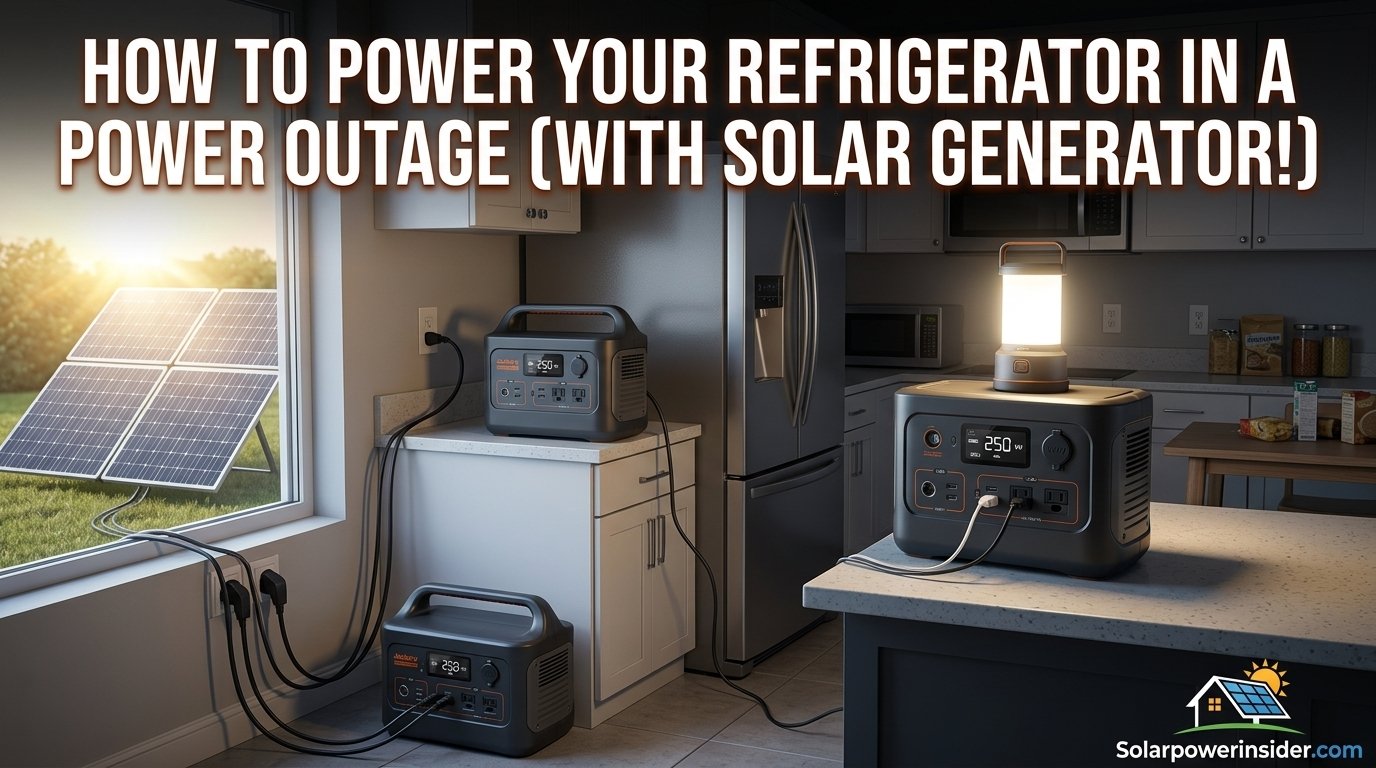
If you’ve landed here wondering whether a solar generator can genuinely keep your refrigerator cold through a blackout, a camping trip, or an off-grid weekend, the short answer is yes — with the right size battery and the right expectations. Most modern portable power stations, from compact 300Wh units to massive 3000Wh+ systems, can absolutely run a refrigerator. The real question isn’t whether it’s possible, it’s for how long, how efficiently, and which unit actually makes sense for your specific fridge and your specific use case.
Refrigerators are deceptively tricky loads. Unlike a laptop charger or a string of lights, a fridge doesn’t draw a flat, predictable wattage all day. It cycles on and off, spikes when the compressor kicks in, and its real-world power draw varies wildly based on age, size, ambient temperature, and how often the door gets opened. That’s why two people with what looks like the “same” 500W fridge can get completely different runtimes out of the same solar generator.
Throughout this guide we’ll break down exactly how to calculate what you need, which units on the market actually deliver on their marketing claims, and how to avoid the handful of mistakes that trip up almost everyone the first time they try to run a fridge off battery power.

Check Price on Amazon
2. How Refrigerator Power Draw Actually Works
To understand whether your solar generator can handle a fridge, you first need to understand that a refrigerator isn’t “on” all the time in the way a light bulb is. The compressor — the component that actually does the cooling — cycles on and off throughout the day. When it’s off, the fridge is drawing almost nothing, just enough to run the internal light and control board. When the compressor kicks on, draw spikes significantly, then settles into a steady running wattage until the target temperature is reached and the compressor shuts off again.
This cycling behavior means that a refrigerator’s average power draw over 24 hours is usually far lower than its rated or “running” wattage on the nameplate. A fridge might have a running wattage of 150W but only actually run the compressor about 30-40% of the time in a typical day, giving you an average draw closer to 50-60W across 24 hours. This is the number that actually matters for calculating your solar generator’s realistic runtime.
2.1 Nameplate Wattage Is Not Real-World Wattage
Most people make their first mistake right here: they look at the sticker on the back of the fridge, see a number like “6.5 amps,” multiply by 120V, and assume that’s what the appliance draws constantly. In reality, that number usually reflects a worst-case or maximum draw, not typical operation. Real-world energy monitoring almost always shows lower average consumption.
2.2 Compressor Cycling and Duty Cycle
The percentage of time a compressor actually runs during a given period is called its duty cycle. A duty cycle of 40% means the compressor is actively running 40% of the time and idle the other 60%. Duty cycle is affected by ambient room temperature, how full the fridge is, how often the door opens, the age and efficiency of the compressor, and the target internal temperature setting.

Find a Watt Meter on Amazon
3. Starting Watts vs Running Watts Explained
This is the single most important concept for anyone shopping for a solar generator to run a refrigerator. Every compressor-based appliance — refrigerators, freezers, air conditioners, well pumps — requires a brief surge of extra power the instant the motor starts. This is called the surge, startup, or locked-rotor wattage, and it can be two to seven times higher than the running wattage.
A refrigerator rated at 150W running might briefly draw 600-900W for a fraction of a second when the compressor kicks on. If your solar generator’s inverter can’t supply that surge, the unit won’t be able to start the fridge at all, even if its “continuous” wattage rating looks more than sufficient on paper.
3.1 Why This Trips Up First-Time Buyers
Many entry-level or budget power stations advertise a continuous output rating prominently while burying the surge/peak rating in the fine print. A 300W continuous unit might only handle a 600W surge — enough for a small mini-fridge but nowhere near enough for a full-size kitchen refrigerator that might surge to 1200W or more.
3.2 How to Find Your Fridge’s Surge Requirement
The most reliable way is to check the compressor’s locked-rotor amps (LRA) rating, often found on the compressor data plate or in the fridge’s technical manual. Multiply LRA by voltage to estimate peak surge wattage. If you can’t find this, a safe rule of thumb is to plan for 3x the running wattage as your minimum surge capacity requirement.
| Fridge Type | Typical Running Watts | Typical Surge Watts |
|---|---|---|
| Compact/Mini Fridge (1.7-4.5 cu ft) | 60-100W | 150-300W |
| Standard Top-Freezer (18-20 cu ft) | 100-200W | 400-800W |
| Side-by-Side / French Door (22-26 cu ft) | 150-400W | 800-1500W |
| RV/12V Compressor Fridge | 40-80W | 100-200W |
| Chest Freezer (7-15 cu ft) | 100-300W | 500-1000W |
4. How Much Battery Capacity You Actually Need
Once you know your fridge’s average watt-hour consumption per day, calculating battery capacity becomes straightforward math — with a buffer built in for real-world inefficiency. Portable power stations lose some energy to inverter conversion, meaning you never get 100% of the rated Wh capacity out as usable AC power. A reasonable efficiency assumption is 85%.
4.1 The Basic Formula
Daily watt-hours needed ÷ 0.85 (efficiency factor) = minimum battery Wh capacity required for one full day of runtime. If your fridge averages 50W over 24 hours, that’s 1,200Wh of raw consumption. Divided by 0.85, you’d want a power station rated at roughly 1,400Wh to comfortably cover a full day without solar input.
4.2 Building In a Safety Margin
Most experienced off-gridders recommend sizing for 1.5-2 days of autonomy if you don’t have reliable solar recharging, and at least 1.2x your calculated daily need even if you do have panels, to account for cloudy days and panel efficiency losses.
Pros of Oversizing Your Battery
- Buffer for cloudy days or reduced solar input
- Headroom to run other appliances simultaneously
- Longer battery lifespan from shallower discharge cycles
- Peace of mind during extended outages
Cons of Oversizing Your Battery
- Significantly higher upfront cost
- Heavier and less portable units
- Longer full recharge times
- Diminishing returns past a certain capacity for single-appliance use

See Current Price
5. Solar Generator Sizing by Fridge Type
Not every refrigerator situation is the same, and the right power station really does depend on which category your appliance falls into. Below is a practical sizing breakdown based on the most common fridge categories people are trying to power.
5.1 Mini Fridges and Dorm-Style Units
For compact fridges under 4.5 cubic feet, a power station in the 300-600Wh range is often enough for a full day of intermittent use, especially paired with a small solar panel for daytime top-ups.
5.2 Standard Kitchen Refrigerators
Full-size top-freezer or bottom-freezer units typically need at least 1000-1500Wh of capacity for a full day of autonomous runtime, with a pure sine wave inverter rated for at least 1000W continuous and 2000W+ surge.
5.3 Side-by-Side and French Door Refrigerators
These larger, feature-heavy units (often with ice makers and dual compressors) draw the most power and benefit from 2000Wh+ systems, ideally with expandable battery packs for multi-day resilience.

View on Amazon
6. Best Solar Generators for Refrigerators
Based on continuous wattage, surge handling, battery capacity, and real-world fridge-runtime testing, a handful of units consistently stand out as genuinely capable of running refrigerators reliably rather than just claiming to on paper.
6.1 Jackery Explorer 2000 Plus
A strong all-rounder with expandable battery modules, making it easy to scale capacity up as your needs grow, ideal for full-size fridges during extended outages.
6.2 EcoFlow Delta 2
Notable for extremely fast recharge times via wall outlet or solar, which matters a lot if you’re cycling the unit daily to keep a fridge running indefinitely.
6.3 Bluetti EB3A
A smaller, budget-friendly option well suited to mini fridges or as a backup for short outages rather than full-size, multi-day fridge duty.
6.4 Bluetti AC500
A higher-end modular system capable of essentially whole-kitchen backup, including a refrigerator alongside other essential loads simultaneously.
6.5 Goal Zero Yeti 1500X
Known for a polished app experience and reliable pure sine wave output, a solid mid-to-large option for standard refrigerators.

Check Availability
7. Solar Panel Requirements for Continuous Fridge Use
If your goal is indefinite, off-grid refrigerator operation rather than just backup power for a few days, you’ll need solar panels capable of fully replenishing your daily consumption, not just topping it off.
7.1 Calculating Required Panel Wattage
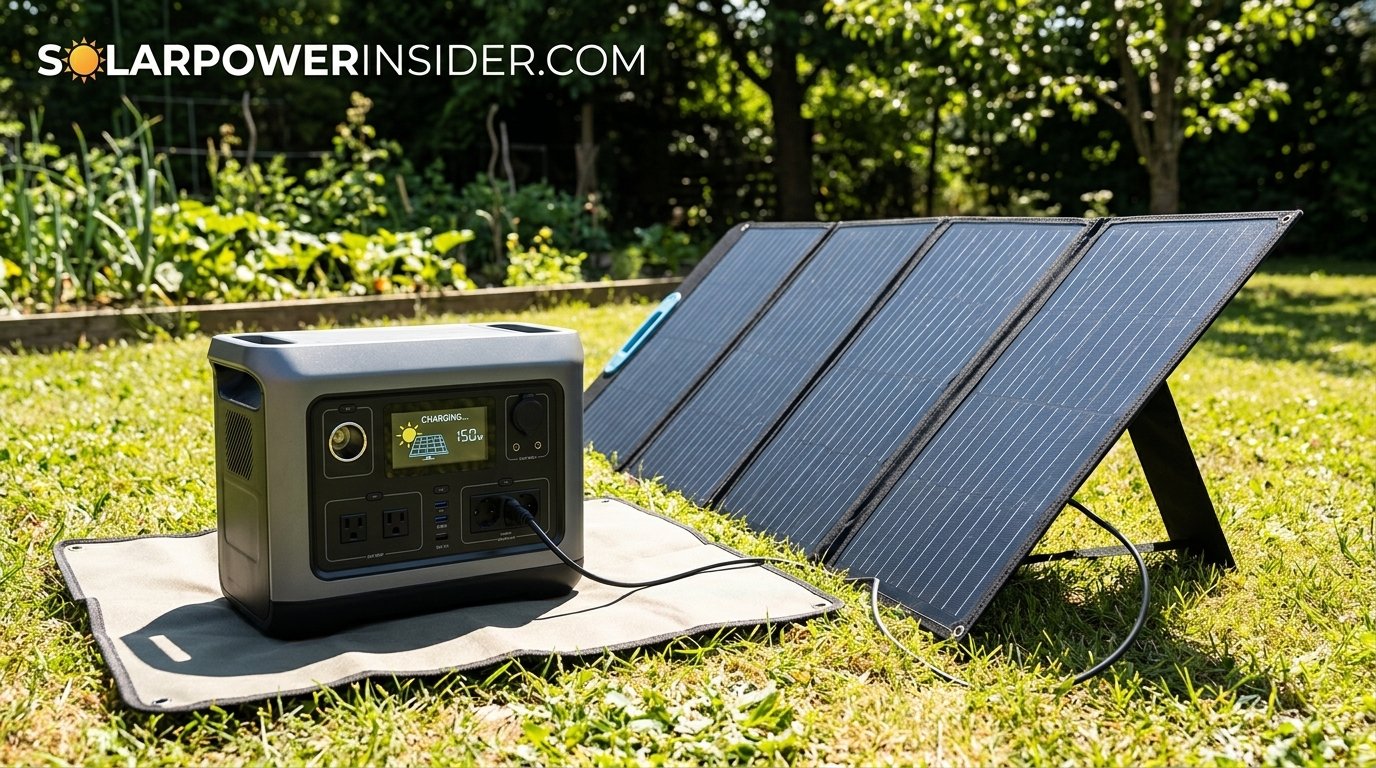
A rough rule of thumb: to replace 1,200Wh of daily consumption, you’d want approximately 300-400W of solar panel capacity, assuming 4-5 peak sun hours and typical real-world derating for angle, temperature, and dust losses.
7.2 Panel Placement and Seasonal Variation
Panel output varies significantly with season, latitude, and weather. Sizing your system for worst-case winter sun hours, rather than ideal summer conditions, prevents unpleasant surprises when you need reliability most.
Read the Sizing Guide
8. Mini Fridges, Chest Freezers & RV Fridges
Different appliance categories bring different quirks worth knowing before you commit to a power station.
8.1 Mini Fridges
Generally the easiest category to power, mini fridges are forgiving of smaller power stations and modest solar arrays, making them a great entry point for anyone new to off-grid power.
8.2 Chest Freezers
Chest freezers are actually more energy-efficient than upright models due to better insulation and less cold air spilling out when opened, often making them easier to sustain long-term than a comparable upright fridge.
8.3 RV and 12V Compressor Fridges
These are often the most efficient category, purpose-built for battery operation and typically drawing far less than a household refrigerator, making them ideal candidates for smaller power stations.
9. Real-World Runtime Tests
Manufacturer runtime estimates are useful starting points, but real-world testing under actual household conditions consistently paints a more accurate picture, since duty cycle assumptions baked into marketing materials tend to be optimistic.
9.1 What Real Testing Typically Shows
Independent reviewers who test power stations with actual refrigerators generally find real-world runtimes land somewhat below advertised figures, primarily due to inverter efficiency losses and higher-than-assumed compressor duty cycles in warmer environments.
9.2 Why Ambient Temperature Matters So Much
A fridge working to maintain temperature in a hot garage or during summer will cycle far more frequently than the same unit in a cool, climate-controlled kitchen, sometimes doubling actual energy consumption.
10. Common Mistakes That Kill Runtime
Most disappointing experiences with solar generators and refrigerators trace back to a handful of avoidable mistakes.
10.1 Undersizing for Surge, Not Just Running Watts
As covered earlier, this is the number one reason a fridge simply won’t start on an underpowered unit.
10.2 Ignoring Inverter Efficiency Losses
Assuming you’ll get 100% of rated Wh as usable output leads to consistently overestimating runtime by 10-20%.
10.3 Not Accounting for Ambient Temperature
Sizing based on a cool spring day’s duty cycle, then relying on the system through a hot summer, is a common and avoidable planning error.
10.4 Running Other Loads Simultaneously
Adding lights, phone chargers, or a router to the same power station without recalculating capacity needs eats into runtime faster than expected.

Check Price
11. Comparison Table: Top Units for Fridge Duty
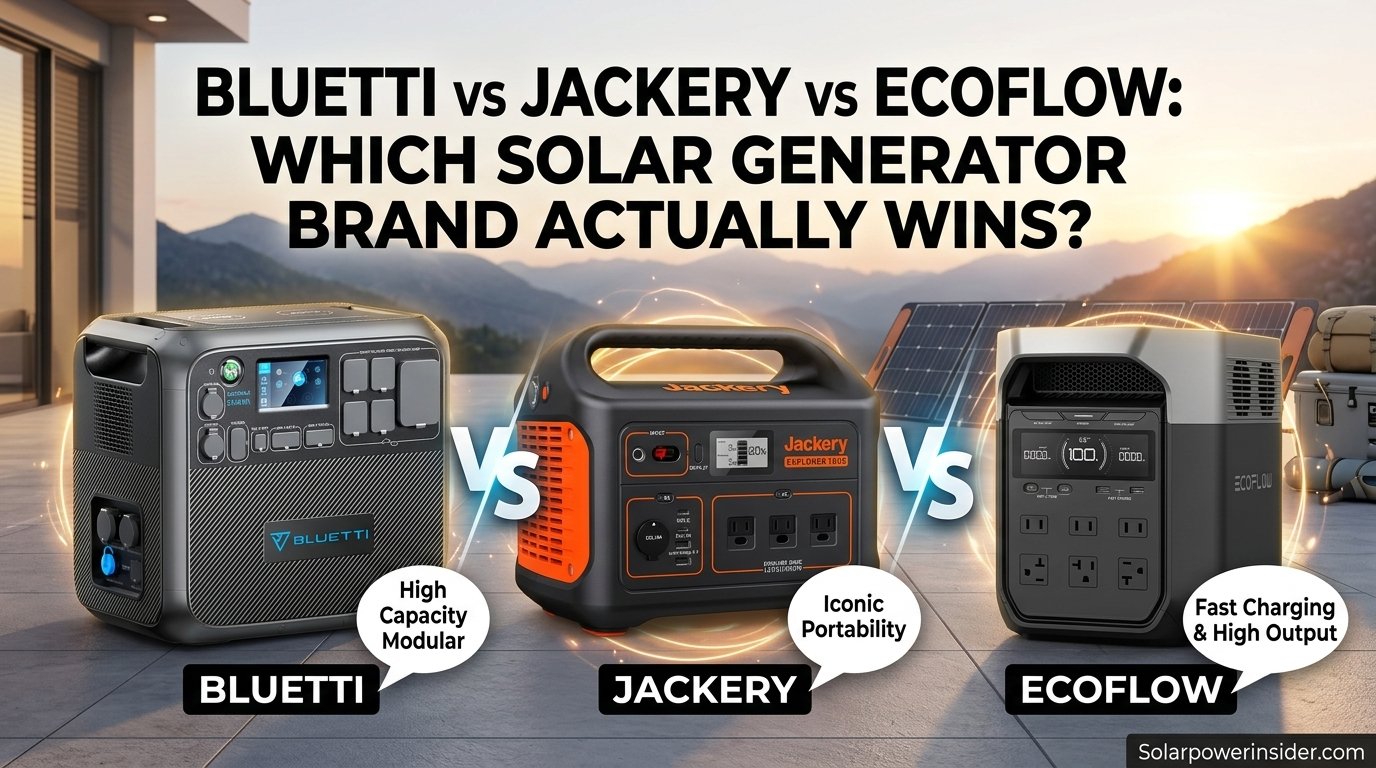
| Model | Capacity | Continuous Output | Best For |
|---|---|---|---|
| Bluetti EB3A | ~268Wh | 600W | Mini fridges, short outages |
| Jackery Explorer 1000 | ~1002Wh | 1000W | Standard fridges, weekend camping |
| EcoFlow Delta 2 | ~1024Wh | 1200W | Fast-recharge daily cycling |
| Jackery Explorer 2000 Plus | ~2042Wh (expandable) | 2200W | Full-size fridges, multi-day backup |
| Anker 767 Powerhouse | ~2048Wh | 2400W | Large fridges + additional loads |
| Bluetti AC200 Max | ~2048Wh (expandable) | 2200W | Whole-kitchen backup |
| Bluetti AC500 | Modular, 3072Wh+ | 5000W | Whole-home style refrigerator + AC backup |
| Goal Zero Yeti 1500X | ~1516Wh | 2000W | Mid-size fridges, app monitoring |
Read the Full Comparison
12. Setup Tips & Safety Considerations
Getting a solar generator safely connected to a refrigerator involves a few practical steps worth getting right from day one.
12.1 Placement and Ventilation
Keep the power station in a well-ventilated, dry location away from direct heat sources, and never enclose it in an airtight space during operation.
12.2 Cord Management
Use a properly rated extension cord if the fridge is far from the unit, and avoid running cords under rugs or through doorways where they could be damaged.
12.3 Monitoring Battery Health Long-Term
For extended off-grid use, periodically letting the battery run through a fuller discharge/recharge cycle can help maintain accurate capacity readings on the unit’s display.
12.4 Backup Planning
Consider a secondary, smaller power bank for phones and essential electronics so the main unit’s capacity stays dedicated to the refrigerator during critical outages.
13. Solar Generator vs Gas Generator for Refrigerators
When the power goes out and your refrigerator is at stake, most people face a fundamental decision: do you go solar or go gas? Both approaches can keep a fridge running, but they differ dramatically in how they work, what they cost over time, how loud they are, and whether you can safely use them indoors. Understanding these differences is critical for making the right choice for your household, especially if you live in an area prone to extended outages from hurricanes, ice storms, or wildfire-related grid shutoffs.
13.1 How Gas Generators Handle Refrigerator Loads
A traditional portable gas generator — typically powered by gasoline, propane, or dual-fuel capability — produces AC electricity through a combustion engine turning an alternator. These units have been the go-to emergency power solution for decades, and they excel at one thing: producing large amounts of continuous power for as long as you can keep fuel flowing. A mid-range 3,500W gas generator can comfortably start and run even large side-by-side refrigerators without breaking a sweat, and with a steady fuel supply, it can do so indefinitely.
However, the trade-offs are significant. Gas generators produce carbon monoxide and must be operated outdoors, at least 20 feet from any window, door, or vent. They are loud — typically 65 to 80 decibels at rated load, which is comparable to a vacuum cleaner or a busy restaurant. They require regular maintenance: oil changes, fuel stabilizer, carburetor cleaning, and periodic test runs to keep everything in working order. And in a real emergency, gasoline itself can become scarce, as was dramatically demonstrated during hurricanes Harvey, Irma, and Maria when gas stations ran dry across entire regions for days.
13.2 Where Solar Generators Win
Solar generators are silent during operation. They produce zero emissions at the point of use, meaning they can sit safely right next to your refrigerator in the kitchen, living room, or even a bedroom. There is no fuel to store, no fuel to go stale, and no fuel to compete with neighbors for during a regional emergency. Once you own the system and have solar panels deployed, your “fuel” arrives every morning for free.
The maintenance burden is also essentially nonexistent compared to a gas generator. There are no oil changes, no spark plugs, no pull cords to wrestle with, and no carburetors to gum up from old gasoline. Modern LiFePO4-based power stations are rated for 3,000+ charge cycles with minimal capacity degradation, which translates to roughly a decade of regular use before you’d notice meaningful battery capacity loss.
13.3 Where Gas Generators Still Win
For sheer sustained power output, gas generators remain hard to beat. A $500 gas generator can produce 3,500-7,500 watts continuously — enough to run a refrigerator, a space heater, several lights, and a microwave simultaneously. Achieving the same output from a solar generator requires a significantly more expensive system, typically in the $2,000-$5,000 range. Gas generators also recharge instantly: pour in more fuel and keep going. Solar generators, even with fast AC recharging, take one to two hours to fully replenish from empty, and solar panel recharging depends entirely on weather and daylight conditions.
13.4 Hybrid Approach: The Best of Both Worlds
Many preparedness-minded households are now adopting a hybrid strategy. A solar generator handles the refrigerator and essential electronics indoors — silently and safely, even overnight — while a gas generator sits outside as a backup recharge source or handles heavier loads like well pumps, electric water heaters, or power tools that exceed the solar generator’s output capacity. This approach limits gas generator runtime (reducing noise and fuel consumption) while leveraging the silent, emission-free advantages of solar for the continuous, always-on load that a refrigerator represents. It is arguably the most resilient setup for areas with frequent extended outages.
Solar Generator Advantages
- Silent operation — no noise day or night
- Zero emissions, safe for indoor use
- No fuel storage, no fuel cost after purchase
- Minimal maintenance over lifespan
- Free energy from sunlight indefinitely
Gas Generator Advantages
- Higher continuous power output per dollar spent
- Instant refueling for indefinite runtime
- Not weather-dependent for refueling
- Lower upfront cost for equivalent wattage
- Proven technology with decades of reliability data
Check Price on Amazon
14. LiFePO4 vs Lithium-Ion: Which Battery Chemistry Wins for Fridge Use
The battery inside your solar generator is its single most important component, and not all batteries are created equal. The two dominant chemistries in the portable power station market today are lithium-ion (specifically NMC — nickel manganese cobalt) and lithium iron phosphate (LiFePO4 or LFP). Understanding how these two chemistries differ is essential when the load you’re powering is a refrigerator that needs to run reliably for days, not just hours.
14.1 Cycle Life: The Long Game
This is where LiFePO4 has a decisive advantage. A typical NMC lithium-ion battery is rated for 500 to 800 charge cycles before its capacity drops to 80% of its original rating. LiFePO4 cells, by contrast, are commonly rated for 3,000 to 6,000 cycles under similar conditions. If you’re planning to use your solar generator as a regular backup — charging and discharging it several times a month during outages or off-grid weekends — that difference is enormous. An NMC unit cycled twice a week might start showing noticeable capacity loss within two to three years. A LiFePO4 unit under the same usage pattern could last a decade or more before reaching the same degradation threshold.
14.2 Thermal Stability and Safety
LiFePO4 chemistry is inherently more thermally stable than NMC. It has a higher thermal runaway temperature — the point at which a battery enters an uncontrollable self-heating state — by a significant margin. In practical terms, LiFePO4 batteries are far less likely to catch fire or vent gases even under abuse conditions like overcharging, puncture, or exposure to high ambient temperatures. For a device that may sit in your kitchen running a refrigerator during a sweltering summer power outage, this safety advantage is not trivial.
14.3 Energy Density and Weight
NMC batteries have a higher energy density per kilogram, meaning that for the same capacity, an NMC-based power station will generally weigh less than a LiFePO4 equivalent. This matters most for units you plan to carry regularly — camping trips, tailgating, or moving the unit between locations. For a stationary home backup that sits in one spot next to your fridge, the extra weight of LiFePO4 is essentially irrelevant. Many of the latest power stations in the 1,000-2,000Wh class have shifted to LiFePO4 specifically because the cycle-life advantage outweighs the weight penalty for the majority of use cases.
14.4 Depth of Discharge
LiFePO4 batteries can routinely be discharged to 0-10% of their rated capacity without significant damage, while NMC batteries are more sensitive to deep discharges and degrade faster when regularly drained below 20%. For refrigerator duty, where you may need every last watt-hour during a long outage, the ability to safely use nearly the full rated capacity of a LiFePO4 battery gives you effectively more usable runtime from the same rated watt-hour specification.
14.5 The Bottom Line for Refrigerator Use
If your primary goal is reliable, long-term refrigerator backup — something you’ll use repeatedly over many years — LiFePO4 is the superior choice by nearly every metric that matters. The only scenario where NMC still makes more sense is if portability and minimum weight are your top priority, such as a backpacker or someone who flies to remote locations with their power station. For everyone else, the LiFePO4 units in the market today represent the best value proposition for fridge duty.
| Feature | NMC (Lithium-Ion) | LiFePO4 |
|---|---|---|
| Cycle Life (to 80% capacity) | 500-800 cycles | 3,000-6,000 cycles |
| Thermal Runaway Temp | ~150°C | ~270°C |
| Energy Density | Higher (lighter per Wh) | Lower (heavier per Wh) |
| Safe Discharge Depth | ~80% (keep 20% reserve) | ~95-100% (nearly full drain) |
| Calendar Life (shelf) | 3-5 years typical | 8-12 years typical |
| Cost Per Cycle | Higher over time | Lower over time |
| Best For | Ultralight portability | Long-term backup & daily use |
Check Price on Amazon
15. Step-by-Step: Calculate the Exact Runtime for Your Fridge
Guessing leads to disappointment. If you want to know precisely how long a specific solar generator will run your specific refrigerator, you need to walk through a calculation grounded in real numbers, not marketing estimates. Here is the exact process that experienced off-grid users and professional installers follow.
15.1 Step One: Measure Your Fridge’s Actual Daily Consumption
Plug a kill-a-watt style energy monitor between your fridge’s power cord and the wall outlet. Let it log for at least 48 hours — ideally a full week — to capture variations from different ambient temperatures, door-opening patterns, and grocery-loading cycles. At the end of the monitoring period, note the total kilowatt-hours consumed. Divide by the number of days monitored to get your daily average. A typical modern 18-cubic-foot top-freezer refrigerator in a climate-controlled kitchen will usually log between 1.0 and 1.5 kWh per day, though older or larger units can easily reach 2.0 kWh or more.
15.2 Step Two: Convert to Watt-Hours
Multiply your daily kWh figure by 1,000 to convert to watt-hours. If your fridge consumed 1.2 kWh over 24 hours, that equals 1,200Wh per day. This is your target energy budget.
15.3 Step Three: Apply the Inverter Efficiency Factor
No DC-to-AC inverter is 100% efficient. Some energy is lost as heat during the conversion process. Most quality portable power stations operate at around 85-90% inverter efficiency under typical loads. To account for this, divide your daily Wh need by your expected efficiency. Using 85%: 1,200Wh ÷ 0.85 = 1,412Wh. This is the minimum battery capacity you need to cover one full day of refrigerator operation.
15.4 Step Four: Factor in Your Battery Depth of Discharge
If you’re using an NMC unit, plan to use only about 80% of the rated capacity to preserve battery health. If you’re using LiFePO4, you can safely use 90-95%. Divide your one-day need by the usable percentage to get the rated capacity you should shop for. For an NMC unit: 1,412Wh ÷ 0.80 = 1,765Wh minimum rated capacity. For a LiFePO4 unit: 1,412Wh ÷ 0.95 = 1,486Wh minimum rated capacity.
15.5 Step Five: Multiply for Desired Days of Autonomy
If you want two full days of runtime without any solar input, multiply your one-day rated capacity requirement by two. For a LiFePO4 unit running a 1,200Wh/day fridge for two days: 1,486Wh × 2 = 2,972Wh. This might mean choosing a 3,000Wh+ unit or selecting an expandable system where you can add battery modules as needed.
15.6 Step Six: Verify Surge Compatibility
Once you’ve identified your capacity requirement, confirm that the inverter’s surge wattage rating exceeds your fridge’s startup surge. If your fridge draws 150W running and surges to 750W on startup, any power station rated for at least 1,000W surge should handle it. If your fridge is a larger unit surging to 1,200W+, look for power stations with 2,000W+ surge ratings to give yourself comfortable headroom.
15.7 Quick-Reference Calculation Example
Let’s walk through a complete example. You have a standard 20-cubic-foot refrigerator that uses 1.3 kWh per day (1,300Wh), and you want two days of runtime from a LiFePO4 power station with no solar input. Applying 85% inverter efficiency: 1,300 ÷ 0.85 = 1,529Wh per day. Applying 95% depth of discharge: 1,529 ÷ 0.95 = 1,610Wh rated capacity for one day. For two days of autonomy: 1,610 × 2 = 3,219Wh. You’d want a system with at least 3,200Wh of rated capacity — which is solidly in the expandable modular power station territory like the Bluetti AC500 with additional battery modules, or the Jackery Explorer 2000 Plus with supplementary expansion batteries.
See Current Price
16. How to Reduce Your Refrigerator’s Power Draw Before Sizing a Generator
Before you spend thousands of dollars on a larger solar generator, it is worth spending an afternoon optimizing your refrigerator’s energy consumption. In many cases, simple behavioral and environmental changes can reduce your fridge’s daily draw by 15-30%, which can mean the difference between needing a 2,000Wh system and a 1,400Wh system — a cost difference that can easily exceed several hundred dollars.
16.1 Temperature Settings
Most refrigerators are set colder than necessary. The USDA recommends a refrigerator temperature of 35-38°F (1.7-3.3°C) and a freezer temperature of 0°F (-17.8°C). Many units ship from the factory defaulting to 33°F or lower in the fridge compartment, which forces the compressor to run more frequently. Raising the fridge setting by even two degrees can noticeably reduce compressor duty cycle without any risk to food safety. Use an independent appliance thermometer to verify your actual internal temperature rather than trusting the dial numbers alone, as refrigerator thermostats are notoriously imprecise.
16.2 Gasket and Seal Maintenance
The rubber gasket around your refrigerator door is the only barrier between cold interior air and warm room air. A worn, cracked, or dirty gasket allows warm air to leak in continuously, forcing the compressor to cycle more often to compensate. Clean gaskets with warm soapy water every few months and inspect them for cracks or deformation. The classic dollar-bill test still works: close the door on a dollar bill and try to pull it out. If it slides out easily, the seal in that spot is weak and the gasket may need replacement — a $20-$40 part that most homeowners can swap in 15 minutes.
16.3 Coil Cleaning
Refrigerator condenser coils — typically located on the back or underside of the unit — dissipate heat from the refrigerant. When they’re coated in dust and pet hair, the compressor has to work harder and longer to achieve the same cooling effect. Vacuuming or brushing these coils twice a year is one of the simplest and most effective energy-saving maintenance tasks a homeowner can perform. Independent testing has shown coil cleaning alone can reduce refrigerator energy consumption by 5-15%.
16.4 Strategic Loading
A full refrigerator retains cold better than an empty one because the thermal mass of stored food helps maintain temperature when the door opens. However, an overpacked refrigerator restricts internal air circulation, creating warm spots that trigger more frequent compressor cycles. The sweet spot is roughly 75-85% full — enough mass to buffer temperature swings, with enough clearance for air to circulate freely around items. If your fridge is mostly empty, consider adding a few jugs of water to serve as thermal mass.
16.5 Location and Ventilation
A refrigerator placed next to a heat source — an oven, a dishwasher, a sunny window, or a heating vent — will consume significantly more energy than the same unit in a cool, shaded spot. Ensure at least two inches of clearance behind and above the unit for proper air circulation around the condenser. If you’re in a hot climate and your fridge is in an un-air-conditioned space, even modest improvements in ventilation around the unit can yield measurable energy savings.
16.6 Door Discipline
Every time the refrigerator door opens, cold air — which is denser than warm air — pours out and is replaced by room-temperature air. The compressor must then run to cool that warm air back down. Knowing what you want before opening the door, organizing contents so frequently used items are easy to grab, and minimizing the time the door spends open all contribute to lower compressor duty cycles. During a power outage scenario where you’re relying on a solar generator, this discipline becomes even more important. Some experienced off-gridders even maintain a clipboard or whiteboard listing what’s inside the fridge to reduce the number of exploratory door openings.
16.7 Upgrading an Old Refrigerator
If your refrigerator is more than 15 years old, upgrading to a modern ENERGY STAR-rated unit may actually be the most cost-effective “power reduction” strategy of all. A 2005-era 20-cubic-foot refrigerator might consume 2.5-3.0 kWh per day, while a comparable 2024 model might use just 1.0-1.3 kWh per day. That difference — potentially 1,500Wh per day — is the equivalent of needing an entire additional solar generator. When you factor in the cost of a sufficiently large power station to cover that excess consumption, a new refrigerator may pay for itself in generator savings alone, in addition to the ongoing electricity savings on your utility bill.
17. Pure Sine Wave vs Modified Sine Wave: Why It Matters for Compressors
Not all inverters produce the same quality of AC power, and when the load is a motor-driven compressor, the difference matters significantly. Understanding inverter output waveform is one of the most overlooked factors in solar generator selection for refrigerator use.
17.1 What Is a Pure Sine Wave?
The electricity delivered by your utility company to your wall outlets is a smooth, continuously varying alternating current waveform called a sine wave. It oscillates 60 times per second (60 Hz in North America, 50 Hz in most other regions) and follows a mathematically smooth curve from positive peak to negative peak and back. This is what every appliance in your home was designed to operate on. A pure sine wave (PSW) inverter replicates this smooth waveform electronically, producing AC power that is functionally identical to what comes from the grid.
17.2 What Is a Modified Sine Wave?
A modified sine wave (MSW) inverter approximates a sine wave using a stepped, square-ish pattern. Instead of a smooth curve, it jumps between positive, zero, and negative voltage in discrete steps. This is cheaper and simpler to produce electronically, which is why MSW inverters have historically been less expensive. However, the jagged waveform creates several problems for sensitive and motor-driven loads.
17.3 Why Compressors Care About Waveform
Refrigerator compressors are inductive motor loads. They rely on a smooth sinusoidal current to generate a rotating magnetic field that turns the motor. When fed a modified sine wave, the motor experiences additional harmonic frequencies that it was not designed for. This manifests as audible buzzing or humming (often significantly louder than normal), increased heat generation in the motor windings, reduced motor efficiency (meaning the compressor draws more power to achieve the same cooling), and accelerated wear on motor insulation and bearings over time. In the short term, a fridge may appear to “work” on a modified sine wave inverter, but the long-term consequences include shortened compressor lifespan and higher energy consumption from the battery — the exact opposite of what you want when every watt-hour counts.
17.4 Other Appliances That Are Sensitive to Waveform
While a refrigerator is the headline concern in this article, it’s worth noting that many other common appliances are similarly sensitive to modified sine wave power. These include microwave ovens (which may produce significantly reduced cooking power), laser printers (which may malfunction or suffer damage), CPAP and BiPAP medical devices (which may produce incorrect pressure or alarming noise), digital clocks (which may lose time or display erratically), and any device with an AC motor, including fans, pumps, and blenders. If your solar generator will serve as multi-purpose backup beyond just a fridge, pure sine wave output becomes even more critical.
17.5 The Good News About Modern Power Stations
Essentially every reputable portable power station on the market today from brands like Jackery, EcoFlow, Bluetti, Anker, and Goal Zero uses pure sine wave inverters. The industry has largely moved past MSW inverters in this product category. However, if you’re considering a very old, off-brand, or no-name budget unit — particularly from marketplace sellers with no established track record — it is worth explicitly verifying that the inverter is listed as pure sine wave, not modified sine wave, before trusting it with a compressor-based load.
View on Amazon
18. Charging Methods Compared: Solar vs Wall vs Car Charging
One of the defining advantages of a portable power station over a traditional generator is the flexibility to recharge from multiple sources. But each charging method has very different speeds, limitations, and practical considerations that affect how useful your system will be for ongoing refrigerator duty.
18.1 Wall Outlet (AC) Charging
This is the fastest charging method for most power stations. Modern units with advanced charging algorithms — like EcoFlow’s X-Stream technology or Bluetti’s turbo charging modes — can replenish a 1,000Wh battery in as little as 60-80 minutes from a standard wall outlet. For refrigerator backup use, wall charging is how most people will top off their unit before or between outages. The practical limitation is that wall charging requires grid power to be available, which is precisely what you may not have during the emergency you bought the unit for. This is why wall charging is best viewed as the primary day-to-day recharge method, with solar as the critical backup.
18.2 Solar Panel Charging
Solar charging speed depends on three variables: the wattage of connected panels, the solar charge controller capacity built into the power station, and the available sunlight. A 200W solar panel array in good sun conditions will realistically produce around 150-170W of actual charging power after accounting for panel temperature derating, angle of incidence, and charge controller efficiency. For a 1,000Wh power station, that translates to roughly 6-7 hours of direct sunlight for a full recharge from empty — essentially one good solar day. This is why pairing the right panel wattage with your power station and your fridge’s daily consumption is so critical. If your fridge uses 1,200Wh per day and your panels only produce 800Wh on an average day, you’re running a deficit that will eventually drain the battery completely.
18.3 Car (12V DC) Charging
Most portable power stations include a 12V car charging cable that plugs into your vehicle’s cigarette lighter or accessory port. This is the slowest charging method — typically producing only 80-120W of charging power — but it serves as a valuable last-resort option. If you’re evacuating ahead of a storm and driving for several hours, car charging can meaningfully replenish your power station en route. It’s also useful for topping off a partially depleted unit during a day of running errands. For continuous refrigerator duty, however, car charging is too slow to be a primary method. It would take 10-14 hours of continuous driving to recharge a 1,000Wh unit, and running your vehicle’s engine purely to charge a power station is extremely fuel-inefficient compared to other options.
18.4 Generator Charging
As discussed in the solar vs gas generator section, you can use a gas generator as a recharging source for your solar power station. This hybrid approach lets you run the gas generator for only the one to two hours needed to fully recharge the power station, then switch back to silent, emission-free battery power for the next 12-20 hours of fridge runtime. This dramatically reduces fuel consumption, noise exposure, and carbon monoxide risk compared to running a gas generator continuously. During multi-day outages, this strategy — charge from solar during the day, top off from a gas generator only if needed in the evening — can be the most fuel-efficient and practical approach available.
18.5 Simultaneous Charging and Discharging (Pass-Through)
Most quality power stations support pass-through charging, meaning they can charge from a solar panel or wall outlet while simultaneously discharging to power a load. This is practically important for refrigerator duty: during the day, your solar panels recharge the power station while it continues to run the fridge. At night, the battery alone handles the load. However, pass-through operation does generate additional heat in the unit and can slightly reduce overall efficiency. It is generally safe with modern power stations that have robust thermal management, but it is worth keeping the unit in a well-ventilated location during pass-through operation and avoiding covering it with blankets, boxes, or other items that could trap heat.
19. Expandable & Modular Battery Systems for Growing Needs
One of the most important trends in the portable power station market over the past few years is the shift toward modular, expandable battery designs. For refrigerator backup, this trend has enormous practical implications because it directly addresses the single biggest challenge of battery-based fridge power: running out of capacity during extended outages.
19.1 How Modular Expansion Works
Expandable power stations consist of a base unit — containing the inverter, charge controller, display, and a built-in battery — plus optional external battery modules that physically connect to the base unit and increase total stored energy. The base unit’s inverter and output capacity remain the same (so your maximum wattage doesn’t change), but the total watt-hour capacity grows with each added module. For example, a 2,000Wh base unit might accept up to two additional 2,000Wh battery packs, bringing total capacity to 6,000Wh without replacing or upgrading the core system.
19.2 Why This Matters for Refrigerator Backup
A non-expandable 1,500Wh power station gives you roughly one day of runtime for a standard fridge. If a hurricane knocks out power for five days, you’re out of luck by day two. An expandable system lets you start with one battery module sized for your budget today and add more modules later as finances allow or as you gain experience with your actual consumption patterns. This staged purchasing approach makes high-capacity refrigerator backup accessible at a lower entry price, with a clear upgrade path.
19.3 Leading Expandable Platforms
The Jackery Explorer 2000 Plus accepts additional Plus Battery Packs that click onto the base unit. The Bluetti AC200 Max is designed from the ground up for expansion, accepting Bluetti’s B230 or B300 external battery modules. The Bluetti AC500 takes this concept to its extreme with a 5,000W inverter base that can be paired with multiple B300S modules for a system capable of exceeding 18,000Wh — enough for whole-home backup, not just a refrigerator. The Anker 767 Powerhouse also supports an expansion battery that doubles its capacity from approximately 2,048Wh to over 4,000Wh.
19.4 Considerations When Expanding
Each additional battery module adds weight and physical footprint. A single B300 battery module from Bluetti weighs approximately 60 pounds by itself. If your power station setup is in a garage or basement, this is irrelevant. If you need to carry it up stairs or load it into a vehicle, the combined weight of a base unit plus two expansion batteries can easily exceed 120-150 pounds, making it a two-person job. Additionally, larger battery systems take proportionally longer to recharge — if your base unit recharges from solar in 6 hours, a fully expanded system might take 18 hours under the same solar conditions, unless you also expand your panel array proportionally.
19.5 When a Single Large Unit Is Better Than Expansion
If you know from the start that you need 4,000Wh+ of capacity, sometimes buying a single large-capacity unit is simpler and more cost-effective than a modular approach. Fewer physical components mean fewer connection points, simpler cable management, and a smaller overall footprint. The trade-off is that a single large unit cannot be partially deployed — if you only need 1,500Wh for a weekend camping trip, you’re still carrying the full weight of a 4,000Wh system. Modular systems offer the advantage of taking only what you need for each outing.
See Current Price
20. Cold Weather & Extreme Climate Considerations
Temperature affects every component of a solar generator system — the battery, the inverter, the solar panels, and even the refrigerator itself. Understanding these effects is particularly important if you live in a climate with significant seasonal temperature swings or if you’re planning to use your system in unheated or un-air-conditioned spaces.
20.1 Battery Performance in Cold Weather
All lithium-based batteries experience reduced performance in cold temperatures. Below approximately 32°F (0°C), battery chemistry slows measurably, internal resistance increases, and the effective usable capacity drops — potentially by 10-20% at freezing temperatures and even more below that. Most quality power stations have built-in low-temperature protection that prevents charging below a certain threshold (often around 32°F) because charging a cold lithium battery can cause permanent damage to the cells through lithium plating. Discharging in cold weather is generally safer than charging, but you will get less total energy out of the battery than its rated capacity would suggest.
20.2 Solar Panel Output in Winter
Solar panels produce less electricity in winter for several compounding reasons: shorter days mean fewer peak sun hours, lower sun angles mean less direct irradiation per unit of panel area, snow coverage can partially or completely block panels, and cold temperatures (while actually improving panel voltage slightly) are overwhelmed by the reduced daylight hours. In northern latitudes, winter solar production can be 50-75% lower than summer production from the same panel array. This means that a solar panel configuration that comfortably recharges your power station on a summer day may fall significantly short in December and January. If you plan year-round refrigerator backup, you must size your panels for winter conditions, not summer ones.
20.3 Refrigerator Efficiency in Different Climates
Paradoxically, the relationship between ambient temperature and refrigerator energy consumption is not linear. In very cold environments (unheated garages, sheds, or outdoor kitchens in winter), some refrigerators can actually malfunction because their thermostat expects a minimum ambient temperature to regulate properly. The compressor may rarely cycle on, causing the freezer section to warm up while the fridge section overcools or even freezes items. In very hot environments, compressor duty cycles spike dramatically. A fridge in a 95°F garage might consume two to three times as much energy daily as the same unit in a 72°F kitchen. For solar generator sizing, always use the worst-case ambient temperature you expect to encounter, not the best-case or average.
20.4 Protecting Your Power Station from the Elements
Portable power stations are designed for indoor or sheltered use. They are not waterproof and should not be exposed to rain, snow, or high humidity. In outdoor or semi-outdoor scenarios — a covered patio, an open garage, a tent — ensure the unit is protected from precipitation and condensation. Operating temperature ranges for most power stations span roughly 32°F to 104°F (0°C to 40°C) for discharging and a narrower range for charging. Storing the unit in a vehicle trunk in summer (where temperatures can exceed 140°F) or in an unheated shed in winter (where temperatures drop well below freezing) for extended periods can accelerate battery degradation.
20.5 High-Altitude Considerations
A niche but real concern: at high altitudes, reduced air density diminishes the cooling effectiveness of air-cooled inverters and charge controllers. Most power stations rely on internal fans to dissipate heat, and thinner air means less convective cooling. At elevations above 5,000-6,000 feet, some units may throttle output or trigger thermal protection sooner than they would at sea level. If you’re using a solar generator in mountain environments, monitor operating temperatures closely and allow for additional ventilation or reduced load during hot conditions.
21. Noise, Weight & Portability Trade-Offs
When comparing solar generators specifically for refrigerator duty, three physical characteristics — noise, weight, and portability — deserve more attention than they typically receive in spec-sheet-focused reviews.
21.1 Noise Levels During Operation
While solar generators are vastly quieter than gas generators, they are not completely silent. Most units contain internal cooling fans that activate under sustained load, and a refrigerator running continuously qualifies as sustained load. Typical fan noise ranges from 30 to 50 decibels depending on the unit, the ambient temperature, and the current draw — roughly equivalent to a whisper to a quiet conversation. In a kitchen or living room during the day, this is barely noticeable. In a bedroom at night, some users find it disruptive, particularly with units at the louder end of the range. If noise sensitivity is a concern, look for reviews that specifically measure fan noise under load, and position the unit as far from sleeping areas as the power cord allows.
21.2 Weight Considerations by Capacity Class
Weight scales directly with capacity. A 300Wh unit like the Bluetti EB3A weighs around 10 pounds and is easily carried one-handed. A 1,000Wh unit like the Jackery Explorer 1000 weighs roughly 22-25 pounds — manageable for one person but not something you’d casually carry for long distances. A 2,000Wh unit like the Anker 767 weighs approximately 67 pounds, which is firmly in two-person-carry territory for stairs or loading into vehicles. Expanded modular systems can push total weight well over 100 pounds. For refrigerator backup that stays in one location, weight is mostly a one-time concern during initial placement. For anyone who needs to move the unit regularly — apartment dwellers who take it to different rooms, RV users, or campers — weight is a primary decision factor.
21.3 Form Factor and Footprint
Power stations come in roughly three form factors: compact cube shapes (under 500Wh), mid-size briefcase-style units (500-2,000Wh), and large rolling-cart or suitcase-style systems (2,000Wh+). The larger units often include built-in wheels and telescoping handles, acknowledging that they’re too heavy to carry. For kitchen placement next to a refrigerator, footprint matters — you need enough floor space for the unit plus clearance for ventilation. Measure your available space before purchasing, particularly for the wider modular systems with attached battery packs.
21.4 Portability vs Capacity: Finding Your Balance
The fundamental tension in solar generator selection is that higher capacity means more weight and bulk, but insufficient capacity means your fridge runs out of power. The most common mistake is buying too small in pursuit of portability and ending up with a unit that can only run a fridge for a few hours. For refrigerator duty specifically, err on the side of more capacity even if it means a heavier unit. Your fridge doesn’t care how portable the power station is — it cares how many watt-hours are available. Save the ultralight approach for camping trips where you’re powering phones and laptops, not a 150W compressor that runs around the clock.
22. Emergency & Hurricane Preparedness with Solar Generators
Hurricanes, ice storms, derechos, and other severe weather events are the primary reason many people invest in solar generators for refrigerator backup. These events share common characteristics — extended outages lasting days to weeks, potential damage to local infrastructure that delays grid restoration, disrupted fuel supply chains, and high stress conditions where reliable food preservation becomes a health and safety issue rather than a convenience. Here’s how to prepare your solar generator system specifically for these scenarios.
22.1 Pre-Storm Preparation Checklist
Before a storm arrives, take these steps with your solar generator: charge it to 100% using wall power while the grid is still up. Deploy and test your solar panels if you haven’t recently, confirming that they produce the expected charging current. Transfer your refrigerator’s contents to the coldest safe setting — lower the thermostat a few degrees to build up thermal mass before the outage begins. If possible, freeze containers of water to create ice blocks that will help maintain freezer temperature if the power station is depleted. Disconnect any non-essential loads from the power station to maximize the capacity available for the fridge.
22.2 During the Outage
Once the grid goes down, minimize refrigerator door openings — every opening introduces warm, humid air that the compressor must work to remove. Switch the fridge to the coldest setting if you have surplus battery capacity, or to a moderate setting if capacity is tight. Monitor battery state of charge regularly and deploy solar panels as soon as conditions safely allow, even if it’s partially cloudy. Even 20-30% of rated panel output helps extend your battery’s runtime. Avoid running other loads on the same power station unless absolutely necessary. Phones and small electronics can be charged from a separate small power bank to keep the main unit dedicated to the fridge.
22.3 Post-Storm Recovery
When the grid is restored, recharge your power station to 100% immediately, even if it still has remaining capacity. Storm damage to the grid can cause voltage fluctuations and intermittent outages for days after the initial event. Having a fully charged backup ensures you’re prepared for secondary outages. Inspect your solar panels for debris or damage before redeploying them. If your refrigerator was without power for an extended period and internal temperatures rose above 40°F for more than two hours (per USDA guidelines), inspect perishable food carefully before consuming it — food safety should take priority over minimizing waste.
22.4 Building a Tiered Preparedness System
The most resilient households maintain a tiered approach to emergency power. Tier one is a small, ultra-portable power station (200-500Wh) pre-charged and stored in a closet, sufficient to keep phones, a radio, and LED lights running for a day or two. Tier two is a mid-size station (1,000-2,000Wh) paired with solar panels, capable of running a refrigerator for 12-24 hours plus recharging from sunlight. Tier three is a larger expandable system (3,000Wh+) or a hybrid solar-plus-gas-generator arrangement, designed for multi-week outages. This layered approach ensures that even if your largest system is deployed elsewhere, damaged, or loaned to a neighbor, you have backup capacity at a smaller scale.
Check Price on Amazon
23. Van Life & Overlanding: Deep-Dive Solar Fridge Solutions
The van life and overlanding communities have been at the forefront of solar-powered refrigeration for years, and their real-world experience offers valuable lessons for anyone looking to run a fridge off battery power — whether in a converted Sprinter van, a truck camper, or a stationary off-grid cabin.
23.1 12V Compressor Fridges: The Gold Standard for Mobile Use
Unlike household refrigerators that run on 120V AC power through an inverter, purpose-built 12V compressor fridges (from brands like Dometic, ARB, Alpicool, and Whynter) run directly on DC power. This eliminates the inverter efficiency loss entirely — power goes from battery to fridge with minimal conversion waste. A typical 12V compressor fridge draws 40-60W when the compressor is running and consumes roughly 300-600Wh per day depending on size, ambient temperature, and usage patterns. This dramatically reduces the battery capacity needed compared to running a household fridge through an inverter.
23.2 Battery Sizing for Van Life Fridges
For a 12V compressor fridge averaging 450Wh per day, a 1,000Wh power station or house battery provides roughly two full days of runtime without any solar input. With a 200W solar panel on the van’s roof producing 600-800Wh on an average day, the system becomes self-sustaining — the panels generate more than enough to replenish the daily fridge consumption with surplus for lights, device charging, and other small loads. This is why solar-powered 12V fridge setups have become essentially standard equipment in the overlanding community.
23.3 Dedicated Fridge Battery vs Shared Power Station
Some van lifers prefer a dedicated battery and charge controller just for the fridge, keeping it electrically isolated from other loads. The advantage is that other power demands (running an inverter for laptops, powering a diesel heater, or charging camera batteries) cannot accidentally drain the fridge battery. Others prefer a single, larger power station that handles everything, appreciating the simplicity of a unified system with one display and one charging interface. Both approaches work; the right choice depends on your power literacy, the complexity of your electrical system, and how critical the fridge is relative to other loads.
23.4 Portable Power Stations in Vans
For van builds where simplicity is valued over custom electrical systems, a portable power station like the Jackery Explorer 1000 or EcoFlow Delta 2 can serve as the entire electrical system. Charge it from a roof-mounted solar panel connected via the unit’s solar input port, and power the fridge, lights, and devices from its various outputs. The advantage is zero electrical knowledge required — no bus bars, no fuse panels, no wire gauge calculations. The disadvantage is that portable power stations are less space-efficient than a custom lithium battery build, and their fixed form factor may not fit neatly into tight van cabinetry.
23.5 Temperature Management Tips from the Road
Experienced van lifers employ several tricks to reduce fridge power consumption: pre-cool the fridge and its contents before a trip using shore power so the compressor doesn’t work hard from a warm start; park in shade whenever possible to reduce the ambient temperature inside the vehicle; use fridge slide mounts that allow easy access without leaving the door open while searching for items; and maintain a consistent temperature setting rather than frequently adjusting it, which causes the compressor to cycle erratically. Some van lifers also install small 12V fans inside the fridge compartment to improve air circulation and reduce temperature stratification, which helps the compressor reach its target temperature faster and shut off sooner.
Check Price on Amazon
24. Long-Term Cost Analysis: Solar Generator vs Gas Generator ROI
When comparing the upfront cost of a solar generator to a gas generator, the gas option almost always looks cheaper at first glance. But the total cost of ownership over five or ten years tells a very different story. Let’s walk through a detailed cost comparison for the specific application of refrigerator backup.
24.1 Upfront Costs
A gas generator capable of running a refrigerator — typically 3,000-4,000W rated — costs between $400 and $1,000 for a quality unit from brands like Honda, Yamaha, Champion, or Westinghouse. A comparable solar generator system — a 1,500-2,000Wh power station plus 200-400W of solar panels — costs between $1,500 and $3,500 depending on brand and features. On pure upfront cost, the gas generator wins by a wide margin.
24.2 Fuel Costs Over Time
A gas generator running at 50% load to power a refrigerator consumes roughly 0.3-0.5 gallons of gasoline per hour. At $3.50 per gallon, running it for 12 hours per day during an outage costs $12.60-$21.00 per day in fuel alone. A five-day outage costs $63-$105 in gasoline. If you experience two five-day outages per year (not unusual in hurricane-prone or rural areas), fuel costs run $126-$210 annually. Over ten years, that’s $1,260-$2,100 in fuel — which can exceed the initial purchase price of the generator itself. Add in annual oil changes ($10-$20), spark plug replacements ($5-$10), fuel stabilizer ($10-$15), and occasional carburetor service ($50-$100), and the ten-year operating cost of a gas generator for refrigerator backup alone can easily reach $2,000-$3,500 above its purchase price.
24.3 Solar Generator Operating Costs
A solar generator’s operating cost after purchase is essentially zero. Sunlight is free. There are no oil changes, no spark plugs, no fuel stabilizer, and no carburetor to service. The only ongoing cost is eventual battery replacement — and with modern LiFePO4 batteries rated for 3,000+ cycles, that’s likely 8-12 years away for typical backup use. When replacement time comes, some manufacturers offer battery replacement services, and the cost of replacement cells has been steadily declining year over year. Even accounting for eventual battery replacement, the ten-year total cost of ownership for a solar generator system used for refrigerator backup is likely to be comparable to or lower than a gas generator, with the additional benefits of silent operation, zero emissions, indoor usability, and free fuel.
24.4 The Intangible Costs: What Spec Sheets Don’t Capture
There are costs that don’t appear on a spreadsheet but matter in practice. The time and hassle of sourcing gasoline during a regional emergency, when gas stations may be without power themselves. The noise and sleep disruption from a gas generator running outside your bedroom window at 2 AM. The anxiety of carbon monoxide risks, particularly with elderly family members or children in the home. The wear on relationships with neighbors who may not appreciate the constant drone of a generator during a multi-day outage. These intangible costs don’t factor into a ROI calculation, but they strongly influence which solution people actually prefer using when the moment of need arrives.
24.5 When Gas Still Makes Financial Sense
If your outages are extremely rare — perhaps once every few years, lasting only a few hours — a gas generator stored in the garage with a stabilizer-treated fuel can makes more financial sense than a $2,000+ solar system that mostly sits unused. The economics shift toward solar as outage frequency and duration increase. The crossover point, based on typical US fuel costs and outage patterns, is roughly one multi-day outage per year. If you experience that or more, the solar generator becomes the more economical choice within 3-5 years.
Check Price
25. Medical & Specialty Refrigerator Considerations
Not every refrigerator stores groceries. A growing number of households rely on refrigeration for medical supplies — insulin, biologic medications, chemotherapy drugs, vaccines, and other temperature-sensitive pharmaceuticals that can lose their effectiveness or become dangerous if exposed to temperatures outside a narrow range. Running a medical-grade or pharmaceutical refrigerator off a solar generator introduces additional requirements and considerations beyond those of a standard kitchen fridge.
25.1 Temperature Stability Requirements
While a household refrigerator has a comfortable safe range of 35-40°F (1.7-4.4°C), many medications require storage within a much tighter window. Insulin, for example, must be kept between 36-46°F (2-8°C) and should never be frozen. Some biologics require 36-46°F with no excursions above or below. This means the solar generator must provide uninterrupted power — a brief outage during a compressor cycle restart could allow temperature to drift outside the safe range. The consequence is not spoiled food worth $50, but potentially hundreds or thousands of dollars in ruined medication and a genuine health risk for the patient.
25.2 Redundancy for Critical Loads
For medical refrigeration, redundancy isn’t a luxury — it’s a necessity. This means either a solar generator with enough capacity to run continuously for the full expected outage duration plus a safety margin, or a backup power source (a second power station, a gas generator, or a UPS system) that can take over if the primary source is depleted. Some medical-grade refrigerators include built-in battery backup or alarm systems that alert when temperature deviates from the safe range — features that are worth considering when selecting a unit if it will be powered from a solar generator during outages.
25.3 Surge Protection and Power Quality
Medical refrigerators often have more sensitive electronics than household units — digital temperature controllers, data logging systems, and alarm circuits. Pure sine wave output is absolutely non-negotiable for these loads. Additionally, some users add an inline surge protector or UPS between the power station and the medical fridge to buffer against any transient voltage fluctuations during compressor start/stop cycles or during the switchover when the power station transitions from standby to active output.
25.4 Documentation and Compliance
In some clinical or pharmacy settings, powering a medical refrigerator from a non-grid source may require documentation of the power source’s output quality, consistency, and safety certifications. Household users generally don’t face regulatory requirements, but if you’re storing medication for a family member under a healthcare provider’s guidance, it may be worth discussing your backup power plan with their pharmacist or care team to ensure the storage conditions meet the medication manufacturer’s specifications during power interruptions.
25.5 Practical Sizing for Medical Fridges
Medical-grade refrigerators are generally smaller than household units — often 1 to 5 cubic feet — and use less power as a result. A typical pharmaceutical mini-fridge consumes 0.5-1.0 kWh per day. However, the zero-tolerance approach to temperature excursions means you should size your solar generator for the full expected outage duration plus at least 50% reserve capacity, rather than the more relaxed calculations appropriate for food storage. For a 1.0 kWh/day medical fridge and a planned 3-day outage window: 1,000Wh × 3 days ÷ 0.85 efficiency ÷ 0.95 DoD = approximately 3,710Wh of rated capacity needed. This firmly places you in the expandable modular power station category.
View on Amazon
Frequently Asked Questions
Can a solar generator run a refrigerator all day?
Yes, with sufficient battery capacity and/or solar panel input matched to your fridge’s daily watt-hour consumption, most fridges can run continuously.
What size solar generator do I need for a refrigerator?
Most standard kitchen refrigerators need at least 1000-1500Wh of capacity for a full day without solar recharging, alongside an inverter capable of handling the compressor’s surge wattage.
Will a 300W solar generator run a fridge?
A 300W continuous rating can run some mini fridges, but most standard refrigerators require higher continuous and surge capacity than a 300W unit typically provides.
How long will a 1000Wh power station run a fridge?
Depending on the fridge’s efficiency and duty cycle, a 1000Wh unit typically provides somewhere between 12 and 20 hours of runtime for a standard refrigerator.
Do I need solar panels, or can I just charge the power station at home?
Solar panels aren’t required if you have reliable access to wall power for recharging, but they’re essential for true off-grid or extended-outage scenarios.
Can I run a refrigerator and freezer at the same time?
Yes, as long as your power station’s continuous wattage and battery capacity account for the combined average draw and combined surge requirements of both appliances.
Does a solar generator need a pure sine wave inverter for a fridge?
Yes, pure sine wave output is strongly recommended for compressor-based appliances to avoid excess heat, noise, or premature compressor wear from modified sine wave power.
How many solar panels do I need to keep a fridge running indefinitely?
Most setups use somewhere between 200W and 400W of solar panel capacity, depending on sunlight availability and the fridge’s specific consumption.
Is it cheaper to run a fridge on solar or just use a generator?
Solar has a higher upfront cost but no ongoing fuel expense, making it more economical over time for regular or long-term use compared to a gas generator.
Can a solar generator handle an ice maker too?
Yes, but ice makers add additional periodic load, so it’s worth sizing capacity with some extra margin if your fridge includes one.
What happens if the battery runs out overnight?
The fridge will simply stop running until power is restored; well-insulated fridges typically maintain safe temperatures for several hours even without power, especially if the door stays closed.
Do older refrigerators use significantly more power?
Generally yes — older compressors and less efficient insulation mean older units often draw noticeably more energy than modern equivalents, which is worth factoring into your sizing calculations.
Is LiFePO4 better than lithium-ion for running a refrigerator?
For refrigerator backup, LiFePO4 is generally the better choice due to its 3,000-6,000 cycle lifespan, deeper safe discharge depth, and superior thermal stability compared to NMC lithium-ion cells. The only trade-off is slightly higher weight per watt-hour.
Can I use a modified sine wave inverter to run my fridge?
While some fridges may technically operate on modified sine wave power, it is not recommended. Modified sine wave inverters cause increased compressor heat, audible buzzing, reduced efficiency, and accelerated motor wear. Always use a pure sine wave inverter for compressor-based appliances.
Should I get a solar generator or a gas generator for hurricane season?
For most households, a solar generator is the better primary choice for refrigerator backup during hurricanes — it operates silently and safely indoors, requires no fuel that may be unavailable post-storm, and pairs with solar panels for extended off-grid capability. Many preparedness experts recommend a hybrid approach: solar for primary use, with a gas generator as backup for recharging or heavier loads.
How do I calculate exactly how long my power station will run my fridge?
Measure your fridge’s daily watt-hour consumption with an energy monitor, divide by 0.85 for inverter efficiency, then divide the power station’s rated Wh by that number. For example: 1,200Wh daily consumption ÷ 0.85 = 1,412Wh needed per day. A 2,000Wh power station would provide roughly 2,000 ÷ 1,412 = 1.4 days of runtime.
Can solar generators power medical refrigerators for insulin storage?
Yes, but medical refrigeration requires stricter temperature stability. Size your power station for the full expected outage duration plus at least 50% reserve capacity, use pure sine wave output, and consider redundancy such as a backup power source to ensure uninterrupted cooling.
Do solar generators work in cold weather?
Yes, but with reduced capacity. Below freezing, lithium batteries can lose 10-20% of their effective capacity. Most units prevent charging below 32°F to avoid cell damage. Solar panels also produce less in winter due to shorter days and lower sun angles. Size your system for worst-case winter conditions if you live in a cold climate.
How loud are solar generators when running a fridge?
Most portable power stations produce 30-50 decibels of fan noise under sustained load — roughly equivalent to a whisper to a quiet conversation. This is dramatically quieter than any gas generator (65-80 dB) and is generally unnoticeable during the day, though some users find it noticeable in quiet bedrooms at night.
Can I expand my power station’s capacity later?
Many modern power stations support modular expansion. Models like the Jackery Explorer 2000 Plus, Bluetti AC200 Max, Bluetti AC500, and Anker 767 Powerhouse accept additional battery packs that increase total capacity without replacing the base unit. This lets you start with a smaller investment and scale up as needs or budget grow.
How can I reduce my fridge’s power consumption to extend solar generator runtime?
Set the refrigerator to 37-38°F (not colder), clean condenser coils twice a year, check door gaskets for leaks, avoid placing the fridge near heat sources, minimize door openings during outages, and keep it 75-85% full for optimal thermal mass. These steps can reduce consumption by 15-30%.
Final Verdict: Yes, Solar Generators Can Absolutely Run a Refrigerator
With the right combination of battery capacity, inverter surge handling, and solar panel input, a solar generator is a genuinely reliable way to keep a refrigerator running — whether you’re prepping for outages, living off-grid, or just want backup peace of mind. The key is matching the unit to your specific fridge’s real-world consumption rather than relying on nameplate numbers alone.
Across all the scenarios we’ve covered — from compact mini-fridges in a dorm room to full-size French door units in a family kitchen, from hurricane preparedness to van life to medical refrigeration — the core principle remains the same: measure your actual consumption, size your battery with appropriate margins, verify surge compatibility, and ensure you have a sustainable recharging strategy in place. Whether that means a single mid-size power station with wall charging for occasional outages, or an expandable modular system with hundreds of watts of solar panels for indefinite off-grid operation, the technology available today makes solar-powered refrigerator backup practical, economical, and increasingly mainstream.
If you’re ready to make a decision, the units covered in this guide represent some of the most consistently reliable options for refrigerator duty on the market today.
Shop Top Solar Generators on Amazon