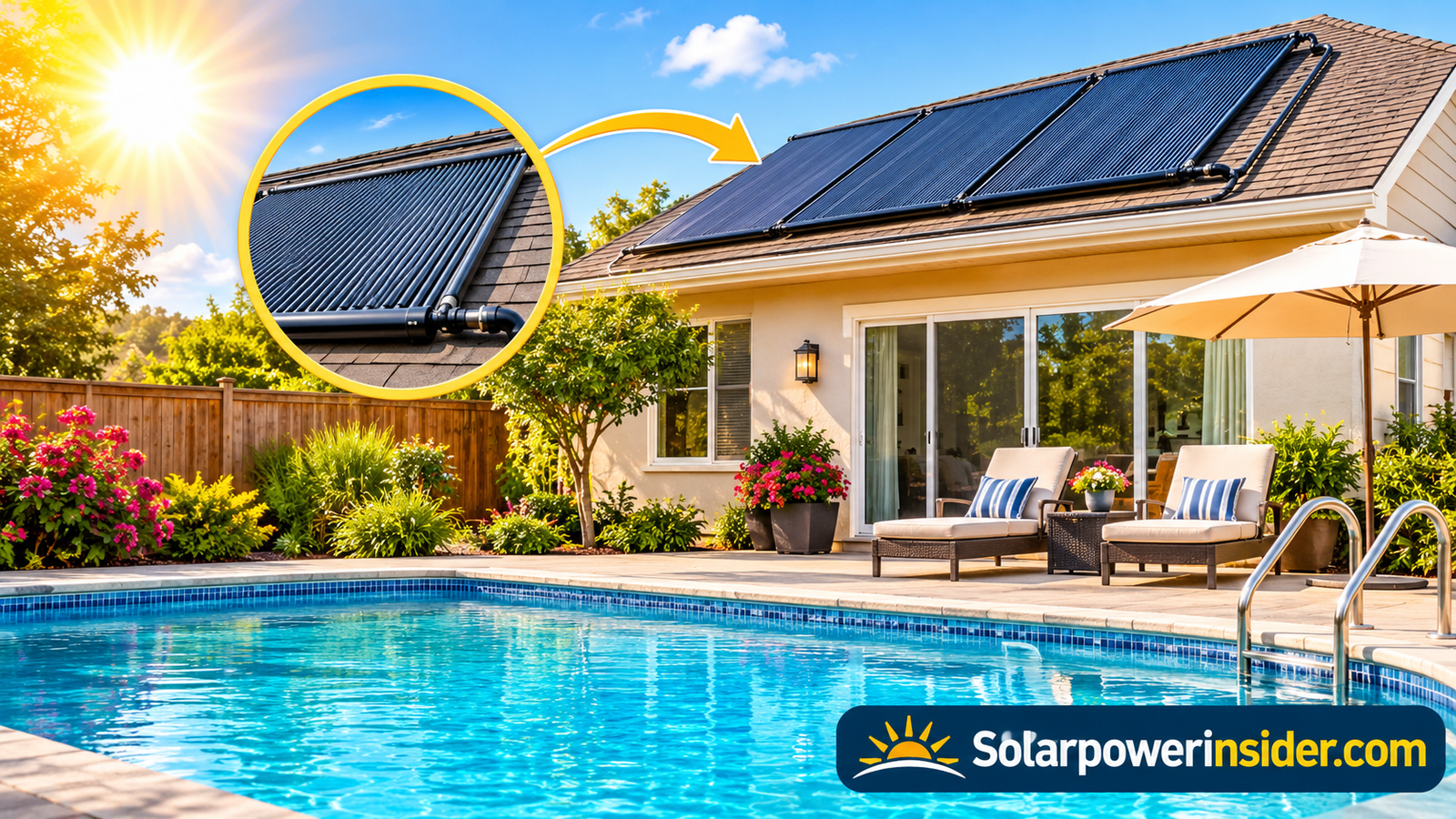
Do Solar Pool Heaters Really Work? An Honest Answer
Yes — but only when the sizing, placement, and expectations line up. Here is the physics, the real-world numbers behind the comfort, and the cases where solar is the wrong tool.
Ask ten pool owners whether solar heating works and you will get ten different answers, usually reflecting ten different installations. One person swears their pool is swimmable from early spring. Another bought a single mat, threw it on the lawn, and concluded the whole technology is a gimmick. Both of them are telling the truth about their own experience — and the difference between those two outcomes has almost nothing to do with luck.
Solar pool heating is one of the simplest, most physically honest forms of home energy technology available. There is no compressor to fail, no fuel to buy, no thermostat to argue with. Sunlight hits a dark surface, water flows through it, and the water comes out warmer. The question is never really “does it work” in the scientific sense — of course it does. The useful question is whether it will work enough, where you live, for your pool, and at the size you are willing to buy.
The Direct Answer
Yes, solar pool heaters really work — they reliably raise pool water temperature and extend the comfortable swimming season, often by several weeks, with zero operating cost. Their effectiveness depends on three things: collector area relative to pool surface area, daily sunlight exposure, and how well you prevent heat loss with a cover.
Undersized systems disappoint. Properly sized systems change how often you use your pool.
'/%3E%3Ctext x='672' y='228' font-family='sans-serif' font-size='26' fill='%23ffffff'%3ESwimming pool%3C/text%3E%3Cg stroke='%23d9622b' stroke-width='8' stroke-linecap='round'%3E%3Cpath d='M760 168 L760 96'/%3E%3Cpath d='M880 168 L880 96'/%3E%3Cpath d='M1000 168 L1000 96'/%3E%3C/g%3E%3Cg fill='%23d9622b'%3E%3Cpath d='M760 96 l-14 22 h28 Z'/%3E%3Cpath d='M880 96 l-14 22 h28 Z'/%3E%3Cpath d='M1000 96 l-14 22 h28 Z'/%3E%3C/g%3E%3Ctext x='742' y='70' font-family='sans-serif' font-size='26' fill='%23b04a1c'%3EHeat loss to air%3C/text%3E%3Ctext x='672' y='350' font-family='sans-serif' font-size='24' fill='%23415c58'%3EEvaporation, wind and radiation remove heat day and night%3C/text%3E%3C/svg%3E)
In this guide we will walk through how these systems actually transfer heat, why some pools warm up beautifully while others barely move, what a realistic temperature gain looks like, and how solar compares to gas heaters and heat pumps on cost and comfort. By the end, you will know whether solar is a good fit for your pool — and if it is, exactly how to size it so it works the first time.
Curious What Solar Pool Heating Costs?
Browse current systems, mats, and covers in one place.
Check Price on Amazon1. The Short Answer: Yes, With an Asterisk
Let us stay with the direct answer a little longer, because the asterisk is where all the useful information lives. Solar pool heaters demonstrably raise water temperature. Owners who size their collectors correctly and cover their pools report warmer water, longer seasons, and far fewer days when the pool simply sits unused. That is not marketing — it is a straightforward consequence of putting a large, dark, sun-facing surface in series with your pool’s circulation.
The asterisk is about magnitude and reliability. A solar heater cannot guarantee a specific temperature on a specific day, because its fuel source is weather. It works by accumulation rather than by force: each pass through the collector adds a small amount of heat, and over the course of a sunny day those small additions compound. That means output is genuinely impressive during bright, warm stretches and noticeably reduced during cool, cloudy ones.
There is also a persistent confusion between two very different products that share the word “solar.” An active solar heater is a plumbed collector with real output. A “solar cover” is a floating blanket that mostly prevents heat loss. Both are valuable, but people frequently buy the second expecting the first, then report that solar heating does not work. It is like buying a raincoat and concluding that heating systems are a scam.
What “working” looks like in practice
- A noticeably longer swimming season on both ends, spring and fall
- Warmer water during sunny weeks without any fuel or electricity bill
- Better overnight temperature retention when paired with a cover
- Fewer abandoned swim days because the water felt too cold
- No ongoing running cost once the equipment is installed
What “not working” usually looks like
- A single undersized mat on a large pool in a mixed climate
- Collectors installed in afternoon shade or on a cool, sheltered roof
- A system left bypassed because a valve was never opened
- Expectations of hot-tub temperatures in a northern spring
Notice that almost every failure mode is a sizing, placement, or expectation problem rather than a technology problem. That is the theme of this entire article, and it is genuinely good news: it means the outcome is largely within your control.
If you want a ranked rundown of specific systems once you reach that stage, our full guide to the best solar pool heaters covers mats, tube panels, and complete kits by pool type.
See the Range of Solar Pool Options
From simple mats to full collector systems.
Check Price on Amazon2. How Solar Pool Heaters Actually Work
The mechanism is almost embarrassingly simple, which is part of why it is so reliable. There are no exotic materials and no precision components — just a dark absorber, a lot of small water channels, and the sun. Understanding the flow also makes you a better buyer, because it explains why collector area matters more than any feature on a product page.
Step one: filtered water enters the collector
Water is drawn from the pool by your existing pump, passes through the filter, and is then routed toward the solar collector. Placing the solar loop after the filter matters. Debris that would sail through the pool’s plumbing can settle inside small collector tubes and quietly restrict flow over time.
Step two: sunlight heats the absorber surface
The collector’s exposed surface is dark for a reason. Dark materials absorb a broad range of wavelengths rather than reflecting them back into the sky. The absorber gets hot — often much hotter than the surrounding air — and that heat conducts into the water sitting in the tubes bonded to it. This is direct solar thermal conversion, and it is more efficient than converting sunlight to electricity and then back to heat.
Step three: warm water returns to the pool
Each pass through the collector raises the water temperature by a modest amount. The system compensates with volume: the pool’s entire water body circulates through the collector repeatedly over a day, and every pass contributes a little. Heating is cumulative and gradual, which is exactly why the process works best with long pump runtimes during daylight hours.
Step four: the pool mixes
Warm water returns to the pool and mixes with the rest. This is where circulation design earns its keep — good return placement distributes warmth instead of creating a hot corner. It is also why running the pump during the day, rather than only overnight, improves results.
The Core Principle
Output is governed by collector surface area and sunlight. Everything else — tube density, header design, flow rate — is about how efficiently that area converts sun into warm water. This is why buying decisions should be led by area, not by feature lists.
The same sunlight-to-useful-energy logic runs through every solar device on a property. If you enjoy the underlying mechanics, our explanation of how a solar-powered generator works covers the electrical side of the same coin.
Want the Mechanism in a Box?
Complete kits include collectors, valves, and hardware.
Check Price on Amazon3. Where Pool Heat Actually Goes
Here is the part that surprises most people: the biggest threat to a warm pool is not the cost of adding heat. It is the speed at which the pool loses it. A solar heater that works perfectly while the sun is out can still produce disappointing results if the pool sheds that heat overnight, which is why this section belongs in any honest answer to “do they really work.”
Evaporation is the heavyweight
Water turning into vapor on the surface carries away enormous amounts of energy. On an uncovered pool, evaporation is typically the dominant loss mechanism, and it accelerates with wind and low humidity. This is why a breezy evening can undo a beautiful sunny afternoon’s worth of heating.
Radiation and convection
A warm pool also radiates heat to the cooler sky and heats the air immediately above it, which then drifts away. Both losses scale with the temperature difference between the water and its surroundings. The warmer you make the pool relative to the air, the faster it loses energy — a reality that quietly caps how hot a solar-only system can push a pool in cool weather.
Ground and plumbing losses
Heat also moves into the surrounding soil and out through exposed plumbing. These are smaller than evaporation but real, particularly for above-ground pools with thin walls. Insulating exposed pipes and reducing unnecessary run lengths helps more than people expect.
Why covers change the equation
A cover stops most evaporation, which is why the combination of a solar collector and a cover consistently outperforms either one alone. The collector deposits energy during the day; the cover prevents withdrawals at night. If you have to choose between a much larger heater and a moderate heater plus a cover, the second option usually delivers the better experience.
| Heat Loss Route | What Drives It | Relative Impact | Best Countermeasure |
|---|---|---|---|
| Evaporation | Wind, humidity, water temperature | Usually the largest loss | Solar cover or rings |
| Radiation | Water vs. air and sky temperature | Significant at night | Nighttime cover |
| Convection | Wind speed across the surface | Moderate to high | Windbreaks, covers |
| Ground and plumbing | Soil temperature, pipe exposure | Smaller but steady | Insulation, short pipe runs |
The takeaway is simple and slightly counterintuitive: before you spend money making your pool warmer, spend a little money making it leak less heat. It is the highest-return upgrade in the entire category.
Stop the Heat You Already Paid For
A solar cover is the cheapest efficiency upgrade available.
Check Price on Amazon4. Realistic Temperature Expectations
This is the section that separates satisfied owners from disappointed ones. Solar pool heating is not marketed with precise performance figures the way gas heaters are, so buyers fill the gap with imagination — and imagination tends to overshoot. Let us set expectations in terms you can actually plan around.
Think in ranges, not promises
Output depends on pool size, collector area, sun hours, wind, and whether the pool is covered. Rather than quoting a single number, think in bands: modest gains from a small system, comfortable gains from a properly sized one, and season-extending gains from a generous array in a sunny climate. Any product promising a specific temperature in a specific timeframe is guessing.
| Scenario | Collector Coverage | What to Expect | Cover Used? |
|---|---|---|---|
| Sunny region, mid-size pool | Close to full pool area | Noticeably warmer, longer season | Strongly recommended |
| Mixed climate, average pool | Roughly half to full area | Useful warming on bright days | Essential for consistency |
| Cool or cloudy region | Full area or more | Shoulder-season extension | Essential |
| Large pool, single mat | Well under half area | Minimal measurable change | Will not rescue it |
The difference between “warmer” and “warm”
A few degrees sounds trivial in the abstract and feels enormous in the water. Swimming comfort is surprisingly sensitive to small changes, which is why owners who gain a modest amount of heat often describe the improvement as dramatic. Set your goal as “more comfortable, more days” rather than “tropical,” and you will almost certainly be pleased.
Timing expectations
Solar heating is a daylight process. The pool is typically at its coolest in the early morning and warmest in late afternoon. Plan swims accordingly, and run the pump during peak sunlight rather than overnight if heating is the goal. Overnight circulation does not add heat — it only moves it around while the pool loses it.
Plan for the Season You Want
Compare solar panels sized for different pool volumes.
Check Price on Amazon5. The Variables That Decide Your Results
Two neighbors with identical pools can install solar heating and end up with completely different experiences. The variables below explain why, and they are worth auditing before you spend anything. In most cases, you can improve your outcome by changing one of these rather than buying more equipment.
Daily sunlight hours and sky conditions
This is the fuel supply. Direct, unobstructed sunlight is worth far more than diffuse overcast light, and a site that gets six clear hours will outperform one that gets two. Look at your yard honestly through a full day, including the afternoon when most families swim.
Shade patterns and orientation
Chimneys, trees, fences, and neighboring buildings cast moving shadows. A collector that is fully exposed at noon can be half-shaded by four o’clock, which is precisely when you want the warmest water. Orientation matters too: a south-facing surface collects the most energy across the day in the Northern Hemisphere.
Wind exposure
Wind strips heat from the pool surface and cools the collector itself, reducing output. Sheltered pools warm faster and hold heat better. If your pool sits in a windy corner, a windbreak delivers a double benefit.
Pool volume and surface area
Surface area drives both heat gain potential and heat loss, while volume determines how much energy it takes to change the temperature. Big, deep pools are the hardest to heat and need proportionally more collector area. Small, shallow pools respond quickly and can be warmed dramatically by modest equipment.
Pump runtime and flow
No circulation means no heating. Systems need the pump running during sunny hours, and flow needs to stay within a sensible range — too fast and each pass picks up less heat, too slow and the collector runs hot while output suffers. Consistency beats intensity here.
Insulation and cover use
We have said it before and it deserves repetition: a cover is the single highest-leverage variable you control. Owners who cover consistently get dramatically better results from identical collectors.
Homeowners working through similar trade-offs elsewhere on the property often find the same mindset useful. Our guide to solar attic fans and the companion piece on whether solar attic fans really work apply the same site-specific reasoning to another solar question.
6. Solar System Types Compared
“Solar pool heater” covers several distinct products with different strengths. Choosing the right type is often more important than choosing the right brand, because the type determines how much collector area you get for your money and how much installation effort is involved.
| System Type | How It Performs | Best Suited To | Main Trade-Off |
|---|---|---|---|
| Mat heaters | Wide flat surface, modest output per unit | Small above-ground pools, tight budgets | Often needs several for real effect |
| Tube panel collectors | Efficient heat transfer per square foot | Most residential pools | Requires plumbing and mounting |
| Complete system kits | Panels plus valves, mounts, adapters | First-time installs, roof arrays | Higher upfront cost |
| Passive covers and rings | Retains heat, adds modest warming | Any pool, any active system | Not a substitute for a collector |
| Ground rack arrays | Panels in an open sunny yard area | Shaded roofs, large lots | Longer plumbing runs, yard space |
Mats and pads
These are the entry point and the most common source of mixed reviews. A mat is inexpensive and easy to install, and on a small pool in a sunny climate it delivers real warmth. On a large pool, one mat is decorative. The correct mental model is that mats are modular: buy the coverage you need, not the single cheapest unit.
Tube panels
The long, dark panels seen on rooftops throughout warm regions are tube collectors, and they are the workhorse of the category. They are efficient per square foot, durable across seasons, and easy to expand in series. If you are serious about heating a real pool, this is almost certainly your category.
Complete kits
Kits bundle the collectors with mounting hardware, diverter valves, and plumbing adapters. They cost more, but they eliminate the most frustrating part of a solar install: sourcing fifty small parts that fit together. For roof installations especially, a kit saves time and reduces mistakes.
Passive systems
Covers and floating rings are not heaters in the active sense — they stop losses. They are, however, the fastest and cheapest way to improve a pool’s temperature stability, and they make every active system work better.
7. Solar vs Gas vs Heat Pump: Which Actually Delivers?
“Do solar pool heaters really work?” is often really asking “do they work as well as the alternatives?” The honest comparison is not about raw power — gas wins on raw power — but about cost per comfortable swim day, reliability, and how much ongoing attention each system demands.
| Factor | Solar Collector | Gas Heater | Heat Pump |
|---|---|---|---|
| Running cost | Effectively none | Continuous fuel cost | Continuous electricity cost |
| Speed of heating | Gradual, cumulative | Fast | Moderate |
| Cold or cloudy weather | Reduced output | Unaffected | Efficiency drops in cold |
| Maintenance | Minimal | Burner and vent servicing | Mechanical components |
| Best role | Daily warmth, season extension | On-demand heating for events | Steady, all-season heating |
Where solar wins
On cost, sustainability, and long-term ownership experience. Once installed, a solar heater adds warmth for free and asks almost nothing of you. For owners whose goal is extending the season and taking the chill off the water, it is the strongest option available, particularly in sun-rich regions.
Where gas wins
On speed and on-demand performance. If you need the pool at a specific temperature for a specific occasion, gas delivers. The cost is ongoing fuel consumption and more mechanical complexity.
Where heat pumps win
On consistency. Heat pumps move heat rather than create it, so they run efficiently in moderate conditions and can maintain temperature steadily. They do need electricity, and their efficiency falls off in cold weather.
The hybrid approach
Many well-served owners run solar as the daily workhorse and keep a backup heater for edge cases. Solar handles the ordinary sunny day; the backup handles the surprise cold front before a party. This combination delivers the lowest lifetime cost of any setup we see.
Cost comparisons across technologies are a recurring theme at home too. Our breakdown of solar generators versus gas generators and whether solar generators are worth it applies the same operating-cost logic to backup power.
Compare Heating Options Side by Side
See today’s pricing across solar pool equipment.
Check Price on Amazon8. Sizing: The Make-or-Break Factor
If you read only one section of this article, make it this one. Sizing is the difference between a system that delights and a system that disappoints, and it is the most common reason solar pool heating earns a bad reputation it does not deserve.
Think surface area, not gallons
Collector area should be planned against the pool’s surface area, because that surface is where both heat gain and heat loss happen. Volume affects how quickly temperature changes, but surface area determines how much collector you need. A deep pool and a shallow pool with the same footprint need similar collector area, though the deep one will respond more slowly.
Coverage ratios by climate
- Hot, sunny regions: roughly half the pool’s surface area can deliver meaningful results.
- Mixed or temperate regions: plan toward full surface-area coverage.
- Cool or frequently cloudy regions: full coverage or more, with a cover, for shoulder-season use.
- Very large pools: expect multiple panels and plan the array layout early.
Modular sizing beats guessing
Most tube panels are designed to run in series, which means you can start with a realistic fraction and add capacity once you see how your pool responds. This is a smarter approach than trying to calculate your way to perfection up front, because local wind, shade, and usage patterns only reveal themselves in practice.
Common sizing mistakes
- Buying one panel because it was the cheapest unit, not the right total area.
- Sizing against gallons instead of surface area.
- Ignoring afternoon shade when planning the array location.
- Forgetting that a cover effectively reduces the area you need.
- Undersizing the pump for the added plumbing resistance.
A Practical Sizing Routine
Measure your pool’s surface area, decide your coverage ratio based on climate, choose a panel format that fits your mounting space, and install one unit less than you think you need — then add another after your first full season if your climate asks for it.
Sizing logic is a transferable skill. Our guide to what size solar generator you need walks through the same demand-first calculation for home backup power.
9. Installation, Placement and Plumbing Realities
Installation is well within reach for a hands-on owner, but it is also where small mistakes quietly cost performance. The panels themselves are rarely the hard part; the loop design, the mounting, and the safety considerations are what determine whether the system delivers.
Put the solar loop after the filter
Clean water enters the collector, protecting small tubes from debris. Route the loop so that filtered water feeds the panels before returning to the pool. This is a simple decision that prevents years of reduced flow.
Install a diverter valve
A three-way valve lets you send water to the panels, bypass them, or blend both. It gives you control on the hottest days, when the pool may not need more heat, and it makes winterizing far simpler. Manual valves are inexpensive and precise.
Mounting: sun first, looks second
Choose the location with the most direct sunlight over the longest part of the day, even if it is not the most attractive one. Roof mounts must attach to structure rather than to roofing material alone, and ground racks must be anchored against wind. Long panels act like sails in a storm.
Flow, air, and drainage
Keep plumbing runs short and direct, avoid unnecessary elbows, and make sure air can escape the loop — trapped air creates hot spots and chokes output. Systems must also be able to drain, so freezing water cannot expand and crack headers and tubes.
Know when to call a professional
Cutting into a return line, working at height, or modifying a pressurized system are all reasonable points to bring in help. A professional install is a one-time cost against years of performance, and it removes the risk of a slow leak you discover too late.
DIY-friendly tasks
- Ground-mounted mats and panels
- Adding a diverter valve to existing plumbing
- Routine cleaning and seasonal checks
- Adding a cover or rings
Worth hiring out
- Roof mounting and structural attachment
- Modifying pressurized pool plumbing
- Systems needing extensive pipe runs
- Any work at height or with power tools overhead
Get the Plumbing Sorted First
Installation kits with valves and adapters save time.
Check Price on Amazon10. Maintenance and Longevity
One of the strongest arguments for solar pool heating is how little attention it demands once installed. There is no combustion system to service and no refrigerant circuit to monitor. A handful of seasonal habits keeps output high and prevents the slow decline that gets misread as “the heater stopped working.”
Check flow before anything else
When output drops, suspect circulation first. Dirty filters, a bumped valve, or an air-locked collector will all cut heating before the equipment itself is at fault. Verify the diverter position, look at filter pressure, and confirm the pump is running during sunny hours.
Keep the collector surface clean
Pollen, dust, and leaves shade the absorber and reduce output. A periodic rinse with a hose is usually enough. Trim back vegetation as it grows, remembering that shading shifts through the season.
Inspect for wear
Walk the system monthly in season. Look for weeping fittings, chafing where pipes contact the roof, and any brittleness or discoloration in the collector material. Small leaks caught early are cheap; left alone, they become damage.
Winterize properly
Drain collectors and lines completely before freezing weather. Blow out residual water where possible and leave drain valves open. This one task prevents the most expensive form of damage in the entire category.
How long do these systems last?
Quality collectors are built for continuous UV exposure and pool chemistry, and many give long service lives with basic care. Durability tracks material quality, mounting correctness, and whether the system was winterized — three things entirely within your control.
| Symptom | Likely Cause | First Action |
|---|---|---|
| Pool not warming | Valve bypassed, dirty filter | Verify flow path and filter pressure |
| Good morning, poor afternoon | Afternoon shade on collectors | Map shadows across a full day |
| Cool water returning | Air lock or low flow | Bleed air and check pump runtime |
| Overheating the pool | Excess collector area in peak sun | Use the diverter to bypass panels |
Caring for outdoor solar equipment is a habit worth building across your whole property. Our piece on how long solar lights last covers similar maintenance rhythms for garden lighting.
Keep Your System in Shape
Replacement hoses and fittings are inexpensive insurance.
Check Price on Amazon11. Cost, Payback and Long-Term Value
Do solar pool heaters really work financially? This is where the case is strongest. Solar heating has a one-time cost and near-zero running cost, which is a fundamentally different shape from gas or electric heating. Over any reasonable period, that difference dominates the calculation.
Cost structure
With solar, you pay for equipment and installation once. With gas, you pay continuously for fuel. With a heat pump, you pay continuously for electricity. Solar also has fewer moving parts, which means fewer failure points and lower service costs over the years.
The payback logic
Take the installed cost of your solar system and divide it by what you would otherwise spend heating the pool for the same number of comfortable days. In sunny regions the result is typically favorable, and every season afterward is essentially free warmth. Add the value of a longer season and the calculation looks even better.
Where solar pays off
- Zero ongoing fuel or electricity cost
- Minimal maintenance and long service life
- Season extension on both ends
- No emissions during operation
- Simple, robust equipment
Honest limitations
- Upfront cost before any benefit
- Output depends on weather
- Needs collector area and mounting space
- Cannot guarantee a set temperature
- Installation requires plumbing work
Value beyond money
There is also the practical value of a pool that is simply used more. A heater that works only when you remember to switch it on gets forgotten; a passive solar system that quietly warms the water every sunny day changes habits. That is a harder number to quantify but an easy one to feel.
The whole-home picture
Pool equipment is one of the larger daytime loads in many households, and some owners size home solar generation to cover it. If that is your direction, start with our roundup of the best solar-powered generators, and see the best balcony solar systems if your space is limited.
12. When Solar Pool Heating Is the Wrong Choice
An honest answer has to include the cases where solar is not the right tool. Recommending it universally would be lazy, and it would set people up for the exact disappointment we have been trying to prevent. If any of the following describe your situation, consider a different approach.
Shade-dominant properties
If your available mounting surfaces receive only a couple of hours of direct sun, a solar collector will underperform badly. In that case, a heat pump is the more reliable option, and there is no configuration of panels that fixes a shading problem.
Guaranteed temperature requirements
Planning an event on a fixed date and need the water at a specific temperature? Solar is the wrong primary tool. It works by accumulation and depends on the forecast. Use gas for on-demand heating and keep solar for the everyday baseline.
Genuinely cold climates
In regions with short seasons and cool water, even a large array may only nudge the temperature. Solar can still help at the shoulder of the season, but expectations should be modest and a backup heater will likely be doing the real work.
Very large, deep pools with limited roof area
Big water volumes need big collector areas. If your roof and yard cannot host the area required, you will spend a lot to get a little. A heat pump sized for the volume is often the better investment.
Unwillingness to cover the pool
This sounds trivial, but it is decisive. If you will not use a cover or rings, you will lose most of what you gain overnight, and the results will feel underwhelming no matter how good the collectors are.
The same “right tool, right job” thinking applies across solar products. Our comparison of whether solar chargers are worth it takes the same skeptical approach to portable solar.
Solar Not the Fit? Explore Alternatives
See the full range of pool heating options.
Check Price on AmazonFrequently Asked Questions
Do solar pool heaters really work, or are they mostly hype?
They really work. Solar collectors reliably raise pool water temperature and extend the season, with no ongoing energy cost. The hype problem comes from undersized installations and unrealistic expectations, not from the technology itself.
How much warmer can a solar heater make my pool?
That depends on collector area, sunlight, wind, and whether the pool is covered. Small systems on large pools produce minimal change, while properly sized arrays in sunny conditions can make a substantial difference to comfort and season length.
Do solar pool heaters work on cloudy days?
They still function, but output falls because diffuse sunlight carries less energy. Pools covered overnight tend to coast through cloudy spells using warmth stored previously.
How many collectors does my pool need?
Size collector area relative to your pool’s surface area. Sunny regions can succeed with roughly half the pool’s footprint in collectors, while cooler or cloudier areas usually need full coverage or more. Modular panels let you expand after a season of real-world results.
Can I install a solar pool heater myself?
Yes, if you are comfortable with basic plumbing. Mats and ground-mounted panels are the most approachable. Roof work and modifications to pressurized plumbing are the points where professional help makes sense.
Do I still need a pool cover with a solar heater?
Strongly recommended. Evaporation is usually the largest source of heat loss, and a cover stops most of it. The combination of collector plus cover consistently outperforms either alone.
Are solar pool heaters better than gas heaters?
For everyday warmth and season extension at near-zero running cost, solar is better. For fast, on-demand heating to a set temperature, gas is better. Many owners use both.
Do solar heaters work in cold climates?
They contribute, but output is limited when sunlight and air temperatures are low. In cold regions, treat solar as a supplement and expect a backup heater to handle the heaviest lifting.
How long does it take to heat a pool with solar?
Solar heating is gradual and cumulative rather than fast. Temperature builds over successive sunny days, especially with a cover retaining heat overnight. Expect progress measured in days, not hours.
Will a solar heater work with my existing pump?
Usually yes. Solar collectors integrate with standard pool circulation, though the pump must handle the extra resistance of the loop. Make sure your pump is appropriately sized for the plumbing run you plan.
How long do solar pool heaters last?
Quality systems are built for years of outdoor UV exposure and pool chemistry, and many last a long time with basic maintenance. Longevity depends on materials, mounting, and whether the system is properly winterized.
Can solar heating make my pool too warm?
Yes, in peak summer with generous collector area. A diverter valve solves this neatly — bypass the collectors during the hottest part of the day and rely on the cover at night.
Ready to Warm Up Your Pool?
Start with the right collector size for your climate.
Check Price on AmazonConclusion
So, do solar pool heaters really work? Yes — clearly, consistently, and at a running cost of nothing. Sunlight hits a dark collector, water flows through it, and your pool gets warmer. That much is settled physics.
What is up to you is the quality of the outcome. Size the collector area against your pool’s surface area, put it where the sun actually reaches it, run the pump during daylight hours, and cover the water at night. Do those four things and solar heating will extend your season and make your pool genuinely more enjoyable. Skip them and no technology will rescue the result.
If you are ready to move forward, start by auditing your site’s sun exposure and measuring your pool’s surface area — then choose a system type that matches. Our ranked guide to the best solar pool heaters is the natural next step once you know what you are sizing for.
Make This the Season It Works
Browse solar pool heaters sized for real backyard pools.
Check Price on AmazonThis article contains affiliate links. If you purchase through them, we may earn a commission at no additional cost to you. Product details and availability can change, so always verify current information on the retailer’s page before buying.
You May Also Like
More guides and reviews from across the world of solar power.