Do Solar Attic Fans Really Work? An Honest, Evidence-Based Answer
Solar attic fans are promoted as a cheap fix for scorching attics and rising cooling bills. But do they actually deliver? Here is what the science says, where the real-world results come from, the situations where they fall flat, and how to tell whether one will work on your roof.
Why This Question Comes Up So Often
Few home upgrades attract as much contradictory advice as solar attic fans. Some homeowners swear their upstairs bedrooms became bearable the day the fan went in. Others insist the whole category is a waste of money. Both experiences can be completely genuine — and the reason tells you almost everything you need to know before buying one.
The disagreement exists because a solar attic fan is not a product with a single fixed outcome. It is one component in a system that includes your roof, your insulation, your intake ventilation, your climate, your shading, and the way your house is used. Change any one of those variables and the results change with it.
So rather than asking “do solar attic fans work?” in the abstract, the more useful question is: under what conditions do they work, how well, and for whom? That is exactly what this guide answers. We will cover the physics of attic heat, what the fan actually does and does not do, the factors that decide your outcome, the myths worth ignoring, and a practical checklist to help you decide whether your home is a good candidate.
Direct Answer
Yes — solar attic fans really do move hot air out of an attic, and in the right conditions they measurably reduce attic heat and ease the load on cooling systems.
The important qualifier is “in the right conditions.” A solar attic fan performs best on a well-ventilated attic with adequate intake, a correctly sized fan, and an unshaded solar panel. In those situations it is a genuine, low-cost improvement. In a shaded attic with blocked soffits or a badly undersized unit, the same product will look like a gimmick. The fan is rarely the problem — the setup usually is.
One more thing before we begin: attic performance is not the same as air conditioning. A fan reduces heat in the space above your ceiling; it does not cool rooms directly, and it cannot replace insulation, sealing, or proper cooling equipment. Understanding that boundary is the difference between satisfaction and disappointment.
Comparing Solar Attic Fans Right Now?
See our tested picks across every attic size and mounting style.
Read Our Top PicksSection 01
The Short Answer: What Solar Attic Fans Actually Do
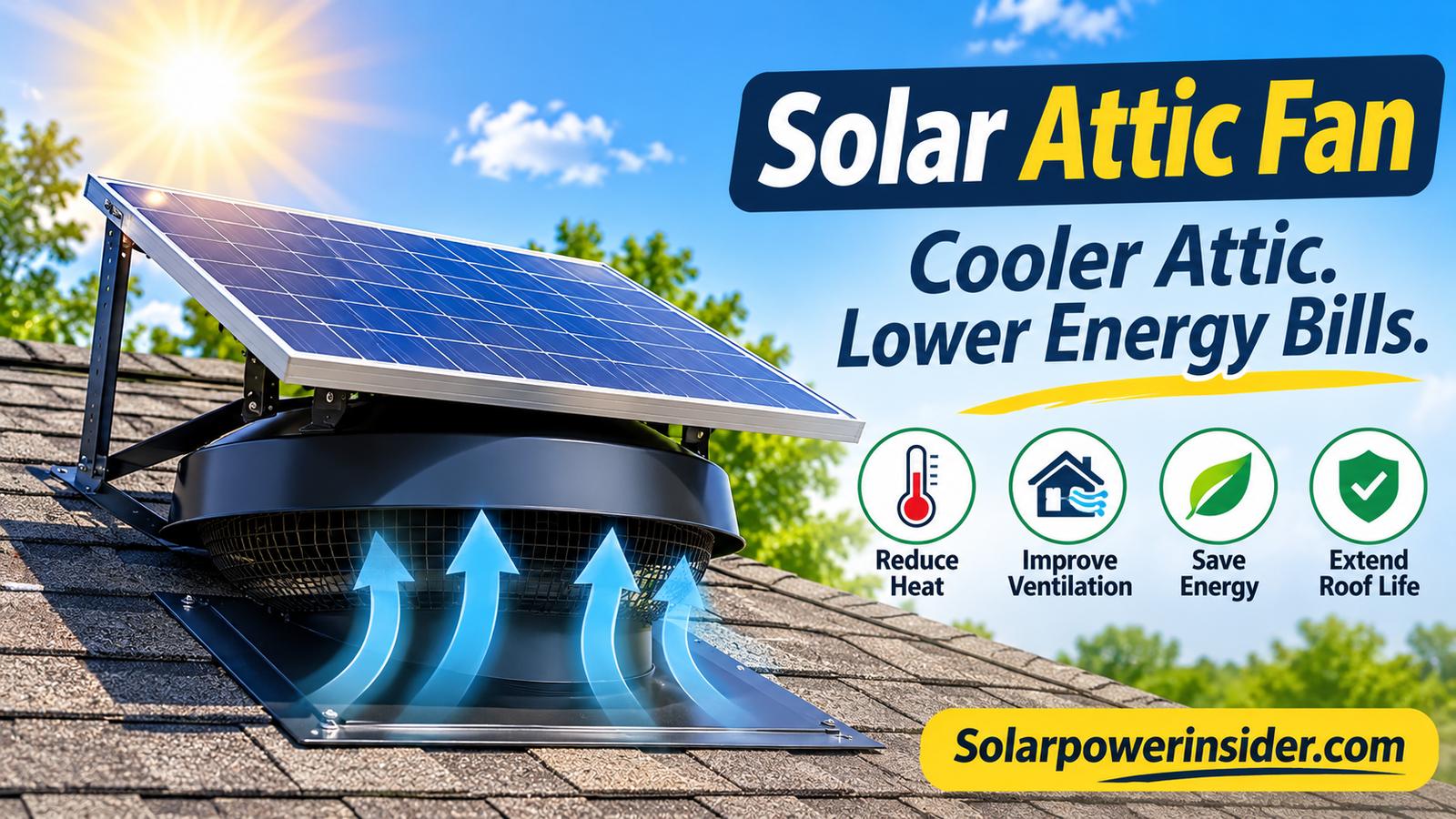
Strip away the marketing and a solar attic fan is a very simple machine with a very specific job: exchange the hot, stagnant air trapped in your attic for cooler outside air, using energy harvested from the sun.
The mechanism, in one paragraph
A photovoltaic panel converts sunlight into electricity. That electricity spins a fan motor mounted at a high point in the attic, which pushes hot air out through an exhaust opening. As that air leaves, replacement air is drawn in through intake vents — typically soffit vents under the eaves, gable vents, or ridge vents. This continuous exchange keeps the attic’s air mass from reaching the extreme temperatures it otherwise would.
What it definitely does
- Moves large volumes of air. Even modest fans exchange the air in a residential attic many times per hour when running.
- Works hardest when it is hottest. Solar output rises with sun intensity, so the fan speeds up exactly when attic heat peaks.
- Runs without operating cost. No wiring, no meter, no monthly bill — the fuel is sunlight.
- Reduces heat stored in the structure. A cooler attic means less thermal energy radiating downward through the ceiling.
- Helps remove moisture. Air exchange carries water vapour out of the roof space, which matters in every climate.
What it does not do
- It does not cool your rooms. It works on the space above your ceiling, indirectly lowering the heat entering living areas.
- It does not replace insulation. Fans remove heat; insulation resists its transfer. You need both for a full solution.
- It does not run at night. Standard solar-only fans stop when the sun does; hybrid designs are the exception.
- It does not fix blocked ventilation. Without clear intake pathways, the fan has little air to move.
Why results differ from house to house
Two neighbours can install the identical fan and report opposite outcomes. Usually the difference comes down to roof orientation and shading, attic volume, soffit condition, insulation coverage, and how much glass the upper floor has. That variability is not evidence that the technology is unreliable — it is evidence that ventilation is a system, not a single product.
Bottom line
A solar attic fan works mechanically and thermodynamically. The question of whether it works for your home is answered by your attic’s size, intake, and sun exposure — and the rest of this guide helps you evaluate all three.
Want the Hardware Options?
Compare solar attic fans by airflow, panel wattage, and mounting style.
Check Price on AmazonSection 02
How a Solar Attic Fan Works, Step by Step
Understanding the energy path — from sunlight to airflow — makes every purchasing decision easier, because each specification on a product page maps onto one stage of that chain.
Stage one: the panel collects energy
The photovoltaic panel is the power plant of the system. Panel size is measured in watts, and in this product category panels commonly range from compact units for sheds up to much larger panels intended for full residential attics. The wattage determines how much current is available to drive the motor — and therefore how early, how late, and how reliably the fan turns.
Stage two: the motor converts energy into airflow
Electricity drives a small motor attached to a fan blade assembly. Modern units generally use efficient, low-maintenance motor designs that run quietly and start spinning at relatively low light levels. Airflow is measured in cubic feet per minute (CFM), which tells you how much air the fan moves when running at full output.
Stage three: the attic exchanges air
Hot air exits through the fan’s opening, and — critically — cooler air enters through intake vents. This is the step people overlook. An exhaust fan without intake is like a straw with a finger over the top: the physics is right, but nothing moves. Intake area should be adequate for the fan’s capacity, and vents must be free of insulation, paint, and debris.
Stage four: controls manage the process
Some units add thermostats and built-in temperature sensors that adjust operation to attic conditions. Others run whenever the sun provides power. Hybrid designs add an AC/DC inverter so the unit can continue operating on household power when sunlight is unavailable. Each approach suits a different home and climate.
Where the energy balance shows up
Solar attic fans sit inside a broader trend of using sunlight for practical home tasks rather than paying for grid power. Whether it is lighting the garden path, charging devices, heating pool water, or ventilating a roof space, the appeal is the same: the equipment works hardest during the hours when the sun is doing the most. Our guide to how solar lights work covers the same photovoltaic principle in a different application.
Shopping for Attic Ventilation Gear?
Browse solar attic fans, vents, and installation accessories.
Check Price on AmazonSection 03
Why Attic Heat Matters for Comfort and Cost
To judge whether a fan is worth installing, it helps to appreciate just how much heat a roof space can accumulate — and how stubbornly it holds on to that heat.
The roof as a solar collector
On a clear summer day, a dark roof surface absorbs a tremendous amount of solar radiation. That heat conducts into the decking and radiates into the air trapped beneath it. Because hot air rises and has nowhere to go in a poorly ventilated space, temperatures climb steadily from morning through late afternoon.
The evening problem
Here is the part that affects sleep: the attic stores heat in the structure itself. Even after the sun sets, the decking and framing continue radiating warmth downward into bedrooms on the upper floor. That is why upstairs rooms can feel uncomfortable long after the outside air has cooled — the heat source is above you, not outdoors.
Moisture is the quiet second problem
Attics are not only about heat. Everyday household activity releases substantial water vapour, which migrates upward into the roof space. In cooler weather that vapour condenses on cold surfaces such as nail tips and roof decking. Over time, repeated condensation invites mould, degrades materials, and reduces the effectiveness of insulation. Ventilation addresses moisture year-round, which is often the more important benefit in mixed or cold climates.
How heat enters your rooms
Heat travels into living spaces by conduction through the ceiling, by radiant transfer, and through air leaks around fixtures and access hatches. Insulation slows conduction and sealing stops leaks, but neither removes heat already accumulated in the attic. Ventilation is the only part of the system that actively pushes that heat outdoors.
Think in layers
Insulation resists heat, sealing stops air movement, shading reduces solar gain, and ventilation removes what gets through. A solar attic fan addresses the last layer — powerful on its own, stronger in combination.
What a cooler attic changes
- Bedroom comfort. Upper-floor rooms feel less stuffy during and after hot afternoons.
- Cooling workload. Less heat entering the living space means cooling equipment does not have to compensate as hard.
- Material durability. Lower attic temperatures reduce thermal stress on roofing materials and decking.
- Moisture control. Consistent airflow helps protect framing and insulation from condensation damage.
- Storage conditions. Items kept in the attic fare far better without extreme heat cycling.
It is also worth noting how much of this problem is self-inflicted by design choices. Dark shingle colours, complex roof shapes with multiple sun-facing planes, and minimal soffit ventilation all amplify attic heat. Solar upgrades elsewhere in the home follow the same logic of working with sunlight rather than against it — see our guide to the best balcony solar systems for another example.
Ready to Cool That Attic?
Compare solar attic fans rated for different attic sizes.
Check Price on AmazonSection 04
What Determines the Results You Actually Get
This is the core of the debate. The technology works; the outcomes vary. Here are the five factors that decide how much difference a solar attic fan makes in your home, roughly in order of importance.
- Intake ventilation A fan can only exhaust as much air as the attic can draw in. Clean, unblocked, generously sized soffit or gable vents are the single biggest predictor of good results. If intake is restricted, fix that first — it costs little and unlocks whatever fan you own.
- Sun exposure on the panel Partial shading from trees, chimneys, dormers, or neighbouring structures cuts output dramatically. A panel in open sun runs the fan at full capability; the same panel under dappled shade may barely turn the blades.
- Fan sizing versus attic volume An undersized fan in a large or compartmentalized attic moves air but never enough to change conditions. Oversizing is less of a problem, but a fan far larger than the space needs is wasted money. Coverage figures stated by manufacturers give a useful starting point.
- Climate and roof design Homes in hot, sunny regions with large roof areas benefit most. Cooler climates shift the value toward moisture control rather than cooling. Complex roofs with isolated attic sections may need more than one fan.
- Insulation, sealing, and shading A fan works alongside the rest of the envelope. Well-insulated ceilings and shaded roof areas lower the heat entering the house, which changes how noticeable the fan’s contribution feels.
How to test your own attic before buying
A simple experiment removes most of the guesswork. On a hot afternoon, measure the temperature in your attic and just outside in the shade. If the difference is large and the attic air feels stifling, there is real heat to remove and a fan has something to work with. Next, check your soffit vents — can air actually get in? Finally, stand outside and note whether your chosen panel location gets direct sun through the middle of the day.
Setting realistic expectations
Owners who report the best experiences describe the same pattern: upper-floor rooms feel more comfortable in the late afternoon and evening, and the cooling system cycles less aggressively. Owners who report disappointment usually expected room-by-room cooling or dramatic bill reductions in a poorly ventilated, shaded attic. Adjust expectations to the mechanism and you will not be misled.
Quick diagnostic
Blocked soffits, shaded panels, and undersized fans cause the vast majority of negative experiences. If you can rule those three out, the odds of a good result are strongly in your favour.
Planning an Attic Upgrade?
Find thermostat-controlled solar fans and ventilation accessories.
Check Price on AmazonSection 05
Comfort, Cooling Load, and Energy Bills
Most homeowners are really asking two questions: will my house feel better, and will I spend less to cool it? The honest answers are related but not identical.
The comfort effect is usually the most noticeable
Comfort is the benefit owners talk about first. When the air mass above your ceiling is cooler, rooms on the upper floor lose less heat gain through the ceiling, and the stuffy, oppressive quality of hot afternoons eases. Because comfort is subjective and immediate, it is often the change that convinces people the upgrade was worthwhile.
The energy effect is real but indirect
Cooling equipment removes heat from indoor air. If less heat is entering the living space from above, the cooling system has less work to do. The size of that effect depends on how much of your home’s heat gain actually comes through the ceiling versus windows, walls, and air infiltration — and that ratio varies enormously between homes.
Why bill savings are hard to predict
Utility costs depend on equipment efficiency, thermostat habits, insulation, air sealing, window exposure, and weather. Anyone promising a specific percentage is guessing. What can be said with confidence is directional: a cooler attic reduces one of the heat sources your cooling system must overcome, and it does so at zero operating cost.
Where the value compounds
- Zero running cost. Unlike an electric fan, a solar unit adds nothing to your bills while it works.
- Peak-hour alignment. The fan runs hardest during the hottest hours, which is exactly when cooling demand peaks.
- Passive winter benefit. Moisture removal continues to protect the roof space outside the cooling season.
- Long, quiet service. No filters, fuel, or routine mechanical service beyond keeping the panel clean.
- Added home appeal. A cooler upper floor and a ventilated roof space are attractive qualities to future buyers.
Other solar upgrades that follow the same logic
Solar attic fans belong to a family of sunlight-powered improvements that eliminate ongoing running costs. Whether you are lighting paths and beds (our guide to the best solar garden lights covers that), heating pool water, or keeping devices charged outdoors, the appeal is consistent: the equipment earns its keep without metered power.
Looking to Cut Home Energy Costs?
Explore solar-powered home and garden upgrades.
Check Price on AmazonSection 06
Pros and Cons of Solar Attic Fans
Every technology has a balance sheet. Here is the honest one for solar attic fans, organized by the factors homeowners actually weigh.
| Factor | Strength | Limitation |
|---|---|---|
| Operating cost | Powered entirely by sunlight — nothing to run, no metered power | Hybrid models that run after dark do use household electricity |
| Installation | No electrical wiring, circuits, or electrician required for solar-only units | Roof work carries fall and weather risks; correct flashing is essential |
| Runtime | Output rises naturally with sun intensity through the hottest hours | Stops at night and slows on heavily overcast days |
| Comfort | Reduces the heat mass above your ceiling and eases upper-floor stuffiness | Does not cool rooms directly or replace air conditioning |
| Moisture control | Continuous air exchange helps remove water vapour from the roof space | Less active in low-light winter conditions without hybrid power |
| Maintenance | Very low — mainly panel cleaning and occasional visual checks | Roof-mounted hardware is awkward to access for service |
| Noise | Quiet operation located away from living spaces | Poorly mounted units can transmit vibration if hardware loosens |
| Dependence on setup | Works reliably when sized correctly with good intake and full sun | Underperforms badly with blocked vents, shading, or undersized fans |
The case for going solar
The strongest argument is cumulative. Zero running cost, no wiring, silent operation, reduced cooling workload, and moisture protection combine into a package that is hard to argue with on a suitable roof. For most homeowners in sunny climates with accessible attics and clear soffits, the technology is a sensible, low-risk improvement.
The case for caution
The strongest counterargument is that a fan cannot overcome a bad setup. Blocked intake, heavy shading, or an attic far larger than the fan’s capacity will produce a poor experience regardless of product quality. Roof condition matters too — installing a fan into a roof already near the end of its service life is asking for trouble.
Pros
- Zero operating cost
- No electrical wiring required
- Runs hardest on the hottest days
- Quiet and low maintenance
- Helps control attic moisture
- Simple, long-lived design
Cons
- Output depends on sunlight
- Needs adequate intake ventilation
- Roof penetration must be sealed correctly
- Sizing must match the attic
- Not a substitute for insulation
- Results vary with shading and climate
Decided It’s Worth Trying?
Compare solar attic fans for every attic size and budget.
Check Price on AmazonSection 07
Solar Attic Fans vs Electric Attic Fans
The natural comparison is against the technology solar fans largely replaced: conventional powered attic ventilators. Both move air, but they differ in almost every practical respect.
| Consideration | Solar Attic Fan | Electric Attic Fan |
|---|---|---|
| Power source | Onboard photovoltaic panel; hybrid models can also draw household power | Hardwired household electricity |
| Running cost | None during solar operation | Continuous metered consumption while running |
| Installation | No wiring or circuit work for solar-only units | Usually requires an electrician and dedicated wiring |
| Runtime | Tracks sunlight; strongest at midday, idle at night | Runs whenever the thermostat calls, day or night |
| Output control | Varies with available light | Consistent output whenever switched on |
| Best suited to | Hot, sunny climates where peak-hour ventilation matters most | Homes needing guaranteed ventilation regardless of weather |
| Ownership | Very low maintenance; panel cleaning is the main task | Low maintenance, but ongoing energy use |
Where solar clearly wins
Installation simplicity and operating cost. There is no electrician to schedule, no circuit to add, and no monthly expense. For most retrofit situations on an existing roof, that combination is decisive. The fact that solar output naturally peaks when attic heat peaks is a further advantage that electric fans have to approximate with thermostat settings.
Where electric fans hold their ground
Consistency. An electric fan runs regardless of cloud cover, time of day, or season, which matters in humid or overcast climates where moisture control is the priority and solar output is intermittent. Hybrid solar designs attempt to bridge this gap by combining a panel with an inverter and household power.
Which should you choose?
- Choose solar if: your roof is sun-exposed, you want to avoid wiring, and heat is the main concern.
- Choose hybrid if: you want solar economics with the option of evening or cloudy-day operation.
- Choose electric if: moisture is the primary issue and you need guaranteed, constant ventilation.
- Choose passive improvements first if: your intake vents are blocked or inadequate — that fix benefits any fan.
Section 08
Five Myths About Solar Attic Fans
A surprising amount of the disagreement around this technology comes down to claims that were never accurate in the first place. Let us clear them up.
Myth 1: “They cool your whole house”
No fan mounted in an attic cools rooms. What it does is reduce the heat stored above your ceiling, which lowers one of several heat sources reaching the living space. Homes gain heat through windows, walls, air leaks, and appliances too. If anyone promises whole-house cooling from an attic fan, be skeptical.
Myth 2: “Bigger is always better”
Sizing matters enormously. A small attic ventilated by an oversized fan can develop negative pressure that draws conditioned air from living spaces. The right fan is the one matched to attic volume with proper intake — not the one with the highest number on the box.
Myth 3: “They don’t work at all in cloudy weather”
Photovoltaic panels produce less energy under cloud, but they do not necessarily stop. Output — and therefore airflow — drops with light intensity. Modern efficient motors begin turning at relatively low light levels, so many units keep moving some air through hazy or partly cloudy conditions. Heavy overcast is where performance truly falls away.
Myth 4: “Solar fans are just toys compared with electric fans”
This underestimates how much air a well-designed solar unit moves during peak hours. Since attic heat peaks when the sun is brightest, the ventilation is delivered precisely when it counts most. The limitation is duration, not capability.
Myth 5: “If my attic still feels warm, the fan is broken”
Warm air will always be present in a sunlit attic — the goal is reduction, not elimination. Judging a fan by whether the attic feels cool to the touch is judging it by the wrong standard. Compare attic temperature to outside shade temperature across the day instead, and the picture becomes much clearer.
A note on claims
Anyone quoting precise temperature drops or percentage savings without knowing your attic is speculating. Outcomes depend on variables only your home can supply — which is exactly why we discuss ranges and conditions rather than guarantees.
Myth-busting applies to solar gear generally. If you have encountered similar claims around portable power or outdoor lighting, our explainer on whether solar security cameras are any good takes the same balanced approach.
Want Facts Before You Buy?
See current solar attic fan models and buyer reviews on Amazon.
Check Price on AmazonSection 09
When Solar Attic Fans Disappoint — And What to Do Instead
Being honest about failure cases is what makes a guide useful. Here are the situations where a solar attic fan is unlikely to deliver, and the alternatives worth considering first.
Scenario one: heavily shaded roofs
If trees or neighbouring structures shade the panel for much of the day, output will be modest. Before giving up, consider whether a gable-mounted arrangement could reach a sunnier face, or whether selective tree trimming is acceptable. Otherwise, a powered fan is the more reliable route.
Scenario two: blocked or missing intake
This is the most common and most fixable problem. Soffit vents painted over, covered with insulation, or obstructed by debris starve any exhaust fan. Clearing and enlarging intake is inexpensive and frequently transforms performance — do this before blaming the hardware.
Scenario three: attic far larger than the fan’s rating
Undersized units circulate a little air but cannot shift conditions in a large space. Check the coverage figure the manufacturer states and compare it with your actual attic footprint, allowing extra margin for complex or multi-section roofs.
Scenario four: the roof needs replacing soon
Installing a fan into a roof near the end of its life means paying for penetration work twice and risking leaks in the interim. If a replacement is on the horizon, coordinate the fan installation with the new roof instead.
Scenario five: moisture is the real issue
If condensation and mould are your concern rather than summer heat, remember that solar output dips during the very months when moisture is most problematic. Addressing bathroom and kitchen exhaust, sealing air leaks from the living space, and ensuring insulation is installed correctly often matters more than any fan.
Alternatives worth considering
- Passive ventilation upgrades. Additional soffit or ridge venting improves any attic, powered or not.
- Radiant barriers and reflective coatings. These reduce solar heat gain at the source rather than removing it afterwards.
- Insulation and air sealing. The highest-impact improvements for most homes overall.
- Shading. Trees, awnings, and reflective roofing cut the heat load before it ever reaches the attic.
- Hybrid or electric fans. For overcast climates or moisture-focused needs.
It is worth remembering that other solar technologies have their own sweet spots too. Solar pool heating, for instance, works beautifully in sunny regions but modestly in cool ones — our article on whether solar pool heaters really work makes a similar case for matching the technology to conditions.
Exploring Alternatives?
Compare attic vents, radiant barriers, and ventilation fans.
Check Price on AmazonSection 10
Choosing the Right Fan: Airflow, Panel, and Controls
Once you have confirmed your attic is a good candidate, three specifications decide whether the product you buy will perform: airflow, panel wattage, and control method.
Airflow (CFM) and attic coverage
Airflow is stated in cubic feet per minute and indicates how much air the fan moves at full output. Manufacturers usually pair this with a coverage figure for attic square footage. Treat the coverage number as a starting point rather than a promise: complex roofs, hot climates, and multiple attic sections all argue for more capacity.
A widely used guideline in residential building is that attic ventilation should provide adequate net free vent area relative to attic floor space — often expressed as a proportion such as one square foot of ventilation per 150 square feet of attic floor, with adjustments where conditions allow. The practical takeaway is simple: ventilation area should scale with attic size, and so should your fan.
Panel wattage
Panel ratings span a wide range in this category, from compact panels suited to sheds and garages up to large panels intended for residential attics. More wattage does not necessarily mean more maximum airflow — it means usable airflow for more hours of the day and in less-than-perfect light. In hazy or partly cloudy climates, that margin is the difference between a fan that runs and one that idles.
Control method
- Solar-only, always on: simplest and cheapest; runs whenever the panel produces power.
- Thermostat controlled: manages operation based on attic temperature, avoiding unnecessary running.
- Sensor-equipped: adjusts output automatically as conditions change through the day.
- Remote control: allows adjustment without accessing the attic, useful for high or awkward installations.
- Hybrid AC/DC inverter: continues operating on household power when sunlight is unavailable.
Mounting style
Roof-mounted units install directly on the deck and combine panel and fan in one location. Gable-mounted designs use existing openings and avoid new roof penetrations. Round, low-profile units keep the roof line tidy. Choose based on your roof’s shape, material, and where the sun falls.
A practical buying checklist
| Specification | What It Means | What to Look For |
|---|---|---|
| Airflow (CFM) | Volume of air the fan moves at full output | Sized to your attic footprint with margin for hot climates |
| Attic coverage | Manufacturer-stated attic area the fan suits | Equal to or greater than your actual attic area |
| Panel wattage | Energy available to drive the motor | Larger panels for hazy or partly shaded conditions |
| Control type | How and when the fan operates | Thermostat or sensors for automatic management |
| Mounting style | Where the fan and panel are installed | Roof, gable, or round profile to suit your roof |
| Certification & warranty | Tested safety marks and manufacturer support | Recognized certification and clear warranty terms |
The same principle of matching capacity to need applies everywhere in solar gear. If you are also considering portable power for outages or off-grid use, our guide to what size solar generator you need walks through exactly the same sizing logic.
Ready to Pick Your Fan?
Compare solar attic fans by airflow, wattage, and mounting style.
Check Price on AmazonSection 11
Installation and Maintenance: What Keeps Them Working
A solar attic fan is a set-and-forget appliance — provided the installation is sound. Both the placement decisions and the small amount of ongoing care determine whether the unit performs for years.
Placement fundamentals
- High in the attic. Exhaust works best near the peak where the hottest air collects.
- Full sun on the panel. Avoid chimneys, dormers, trees, and anything that casts partial shade.
- Away from intake vents. Position the exhaust so it cannot short-circuit by pulling its own supply air.
- Panel angle matters. Tilt toward the sun’s path for stronger output across the day.
- Accessible for maintenance. You will need to clean the panel occasionally.
Roof safety and weatherproofing
Roof work is genuinely hazardous, and every penetration is a potential leak if handled carelessly. Use proper fall protection appropriate to your pitch, work only in dry and calm conditions, and never work alone on a steep roof. Flashing and sealants must be roofing-grade, applied generously, and inspected after the first heavy rain. If your roof is steep, tiled, or in poor condition, hire a professional — the labour cost is modest against the risk.
Simple seasonal maintenance
- Twice yearly: clean the panel surface with water and a soft cloth.
- After storms: check flashing seals and surrounding shingles for damage.
- Annually: clear soffit and gable intake vents of paint, insulation, and nesting insects.
- Occasionally: listen for changes in fan sound that could indicate mechanical wear.
Troubleshooting quick reference
| Symptom | Likely Cause | First Action |
|---|---|---|
| Fan barely spins on sunny days | Dirty panel, partial shading, or shifted panel angle | Clean the panel and check for new shading |
| Attic stays hot with the fan running | Blocked or insufficient intake ventilation | Clear soffit vents and verify intake area |
| Rattling or vibration | Loose mounting hardware or worn fan bearing | Retighten hardware and inspect the fan |
| Water staining below the unit | Failed flashing or sealant | Reseal immediately and inspect decking |
| Fan has stopped entirely | Panel damage, wiring issue, or motor failure | Inspect panel and connections, then contact support |
Solar equipment generally gives long, quiet service when kept clean and undamaged — the same principle applies to outdoor solar lighting. If you use solar lights elsewhere on the property, our guide on how long solar lights last and troubleshooting guide on why solar lights stop working cover the same care fundamentals.
Need Panels, Flashing, or Vents?
Shop attic ventilation hardware and installation supplies.
Check Price on AmazonSection 12
Are Solar Attic Fans Worth It? A Practical Decision Checklist
Everything discussed so far can be condensed into one useful question: is your home a good candidate? Work through these points and the answer usually becomes clear.
Signs your home is a strong candidate
- You live in a hot, sunny climate. More sun means more ventilation at exactly the right time.
- Your attic is large and sun-exposed. Big roof areas gather serious heat and benefit most.
- Upper-floor rooms feel uncomfortable. Especially in the afternoon and evening.
- Your soffit vents are open and clear. Adequate intake is the foundation of good results.
- You want to avoid electrical work. Solar-only units need no wiring or circuits.
- You value low ownership effort. Panel cleaning is essentially the entire maintenance routine.
Signs you should pause first
- Heavy shading over the roof. Low light means limited output.
- Blocked or missing intake vents. Fix ventilation before buying hardware.
- The roof is due for replacement. Coordinate installation with the new roof.
- Your attic is small or compartmentalized. A tiny space needs a small fan — or none at all.
- Moisture is your only concern in a dim climate. Consider addressing exhaust and sealing first.
- Insulation and air sealing are poor. Those upgrades usually deliver more comfort per dollar.
The value equation
Solar attic fans sit at an attractive intersection: modest purchase cost, no ongoing energy expense, no electrical work, and benefits that compound across cooling seasons. For a suitable roof, that is a genuinely good proposition. For an unsuitable one, no amount of spending on hardware fixes the underlying problem.
How homeowners rate the experience
Across the people who report satisfaction, the same themes recur: upper-floor comfort improved, the cooling system seemed to run less aggressively, and the fan demanded no attention year after year. Among those who were disappointed, blocked intake, shading, and undersized units appear again and again. The technology is not fickle — the installation context is decisive.
Finally, remember that a solar attic fan is part of a broader approach to using sunlight around the home. Whether that is portable power for outages (see whether a solar generator is worth it), garden lighting, or roof ventilation, the evaluation method is identical: match the technology to your conditions, size it correctly, and set realistic expectations.
Ready to See If It Works for You?
Compare solar attic fans suited to your attic size and climate.
Check Price on AmazonFrequently Asked Questions
Do solar attic fans really lower attic temperature?
Yes. By exhausting hot air and drawing in outside air, they reduce the heat mass in the roof space. The degree of reduction depends on attic size, intake ventilation, panel sun exposure, climate, and insulation. Homes with open soffits and full-sun panel placement see the clearest results.
Will a solar attic fan lower my air conditioning bill?
It reduces one of several heat sources your cooling system must overcome, so the effect is directional rather than precise. Homes that gain much of their heat through the ceiling tend to notice more of a difference. Bill outcomes also depend on equipment efficiency, insulation, and habits.
Do solar attic fans work at night?
Standard solar-only fans do not, since they rely entirely on sunlight. Hybrid designs with an AC/DC inverter can continue running on household power after dark, which is useful where attics hold heat into the evening.
Do solar attic fans work on cloudy days?
Output falls as light intensity drops, but panels do not necessarily stop producing energy entirely. Many units keep moving some air through hazy or partly cloudy conditions. Heavy, sustained overcast is where performance genuinely falls away.
How big a solar attic fan do I need?
Match the fan’s stated attic coverage to your actual attic footprint, and give yourself extra margin if your climate is hot or your roof is complex. Attics with multiple isolated sections may need more than one fan rather than a single large unit.
Can a solar attic fan cause problems?
Improperly set up, yes. If intake ventilation is inadequate, an exhaust fan can create negative pressure that draws conditioned air from living spaces. Blocked vents, poor flashing, and undersized units are the usual culprits — all preventable with correct sizing and installation.
Are solar attic fans better than electric attic fans?
They solve the same problem differently. Solar fans cost nothing to run and need no wiring but operate only when sunlight is available. Electric fans run consistently regardless of weather but consume household power and usually require an electrician. Hybrid designs combine both approaches.
Do solar attic fans help with moisture and mould?
Air exchange helps remove water vapour from the roof space, which supports moisture control. However, solar output dips during the seasons when condensation is most common, so addressing bathroom and kitchen exhaust and sealing air leaks is often equally important.
Where should a solar attic fan be installed?
High in the attic near the roof peak, where the hottest air collects and where the panel receives unobstructed sunlight. Keep the unit away from intake vents to prevent short-circuiting, and ensure the panel avoids shading from chimneys, dormers, and trees.
How long do solar attic fans last?
Photovoltaic panels are very durable and degrade only slowly over many years; fan motors are mechanical and eventually wear. Regular panel cleaning, secure mounting, and sound flashing extend service life considerably. Choosing a product with clear warranty terms is the best protection.
Do solar attic fans need maintenance?
Very little. Clean the panel surface occasionally, check flashing seals after storms, and keep intake vents clear. There are no filters, fuels, or routine mechanical service items to manage.
Is it worth installing a solar attic fan myself?
Many homeowners do, particularly on accessible, low-slope roofs. Roof work carries real fall and weather risks, and every penetration must be flashed and sealed correctly. For steep, tiled, or deteriorating roofs, or where electrical work is involved, professional installation is the sensible choice.
Still Have Questions?
Compare the latest solar attic fans and read verified buyer feedback.
Check Price on AmazonConclusion: So, Do Solar Attic Fans Really Work?
Yes — with the caveats that matter. A solar attic fan genuinely moves hot air out of a roof space, works hardest at the very hours when attic heat peaks, costs nothing to run, and quietly helps manage moisture year-round. On a suitable roof, it is one of the more sensible comfort upgrades available.
What decides your outcome is not the brand or the price tag. It is the setup: clear intake ventilation, an unshaded panel, a fan sized to your attic, and realistic expectations about what ventilation can achieve. Get those four things right and the technology does exactly what it promises.
Ready to Try One on Your Roof?
Compare solar attic fans and find the right size for your attic.
Check Price on Amazon
Pingback: Best Solar Attic Fan: 9 Roof and Gable Fans Compared