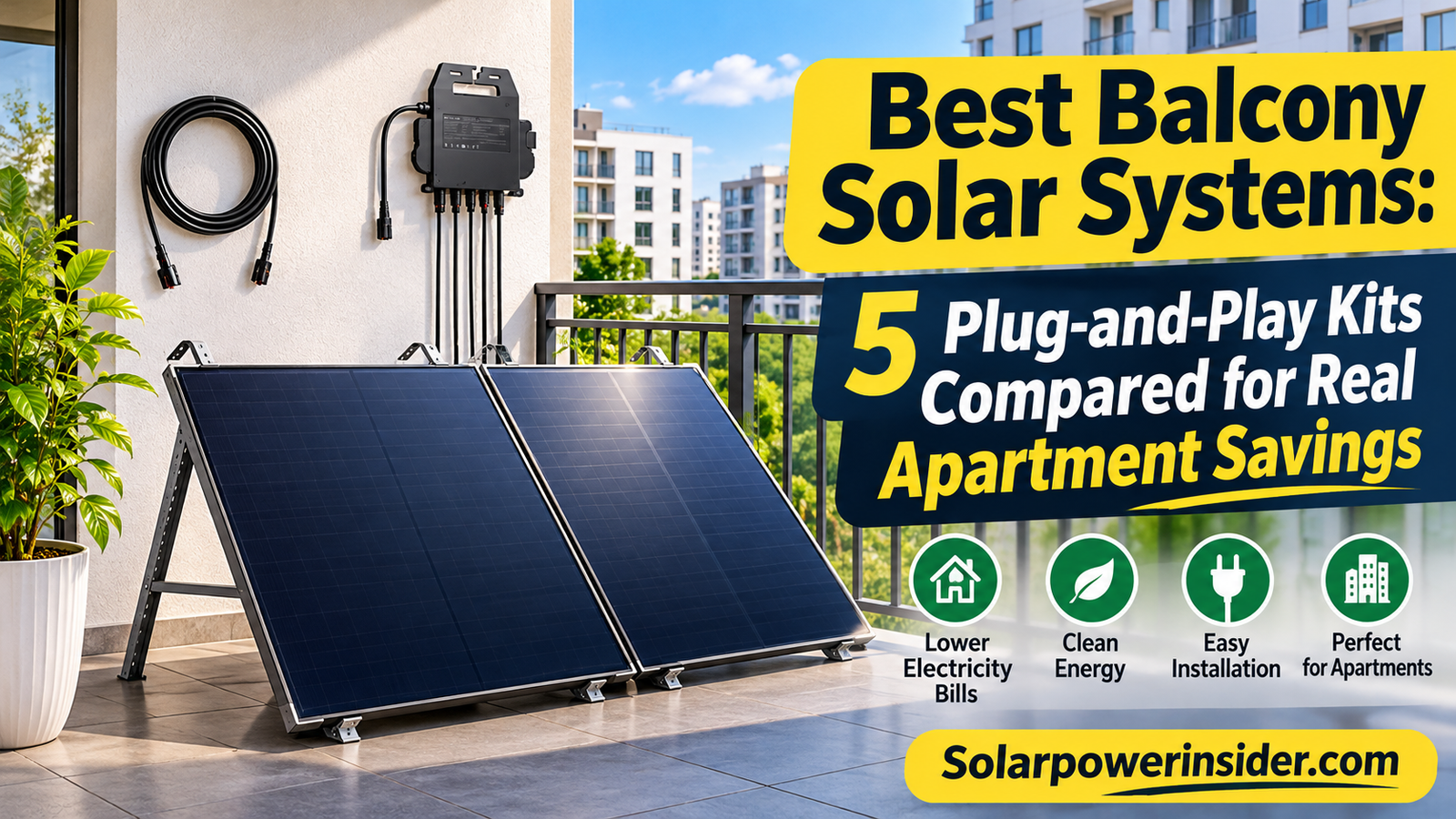
Best Balcony Solar Systems: 5 Plug-and-Play Kits Compared for Real Apartment Savings
Balcony power plants have turned renters, apartment dwellers, and small-home owners into everyday electricity producers. We compared the most talked-about plug-and-play kits — panel sets, microinverters, and battery bundles — to find the best balcony solar system for different balconies, budgets, and goals.
Choosing the Best Balcony Solar System Without Wasting Money
A balcony solar system — often called a balcony power plant, plug-in solar kit, or plug-and-play photovoltaic set — is the simplest way to start generating your own electricity without owning a roof, hiring a construction crew, or signing a complicated installation contract.
The idea is refreshingly straightforward: one or two solar panels mount on a balcony railing or a small stand, a microinverter converts the sunlight into household-ready power, and a cable runs into a normal wall socket. From that moment, your refrigerator, router, laptop charger, and washing machine start pulling free energy from the sky before they pull anything from the grid.
What used to be a niche hobby for engineers has become a mainstream product category, and the market now spans everything from bare panel-and-inverter bundles to full systems with lithium iron phosphate batteries that store sunshine for the evening. That variety is good news for choice — and a headache for anyone trying to figure out which setup actually deserves a place on their railing.
That is exactly the problem this guide solves. We looked at five of the most popular configurations you can order today: a complete four-panel grid-tie kit from PLUGGEDSOLAR, two very different offerings from Anker SOLIX (a high-efficiency panel set and a battery-backed kit), and two EcoFlow builds centered on the PowerStream microinverter, including the version bundled with a portable power station. Each has a genuinely different reason to exist, and the wrong pick can mean either spending more than you need or missing the feature that would have made the system pay for itself faster.

Before we dive into individual reviews, one honest note about how to read this article. Solar output depends on your geography, shading, tilt, season, and how you use electricity at home. Rather than quoting imaginary numbers, we describe each system by what it is designed to do and the kind of balcony it suits best. Where a specification matters, it is the specification stated in the product’s own name or description — nothing more.
With that settled, let’s start with a side-by-side look at all five systems.
Short on Time?
Jump straight to the comparison table and pick the kit that matches your balcony.
See Our Top PicksAt a Glance
Quick Comparison: Our Top Picks
Every product covered in this guide appears in the table below. Use it to shortlist, then read the full review blocks further down for the details that matter on your specific balcony.
| # | Image | Product | Key Specs | Verdict | Check Price |
|---|---|---|---|---|---|
| 1 | |
Top Pick Anker SOLIX Solarbank E1600 Solar Kit Best Overall |
|
Stores the sun for evening use — the most complete package here. | Check Price on Amazon |
| 2 |  |
PLUGGEDSOLAR 800W Plug-in Balcony Solar Kit Best Complete Four-Panel Kit |
|
A ready-to-mount set with monitoring and a recognized safety standard. | Check Price on Amazon |
| 3 |  |
Anker SOLIX RS40P Balcony Power Plant Best Panel Efficiency |
|
Serious panel technology in a smooth black finish; brackets sold separately. | Check Price on Amazon |
| 4 |  |
EcoFlow PowerStream 800 W Micro Inverter Best Modular Starting Point |
|
Weatherproof and app-driven; the cleanest way to start small and expand. | Check Price on Amazon |
| 5 |  |
EcoFlow PowerStream + DELTA 2 Power Station Best for Day-and-Night Power |
|
Turns balcony solar into an all-day system with portable backup. | Check Price on Amazon |
If you only read one paragraph of this article, make it this one: the best balcony solar system is not the one with the biggest headline number, it is the one that matches how you use electricity. Households that run the dishwasher and washing machine during the day get excellent value from a simple panel-and-inverter kit. Households that come home in the evening and cook, watch television, and charge devices want storage. That single decision — with or without a battery — shapes everything else.
Ready to Compare Prices?
See current availability for balcony solar kits and accessories.
Check Price on AmazonSection 01
What Exactly Is a Balcony Solar System?
Strip away the marketing language and a balcony solar system is a miniature power plant with four core parts: modules to catch light, a microinverter to convert it, a safe connection to your home, and — increasingly — a battery to hold it for later.
The four building blocks
1. Solar panels (modules). These are the visible part of the system. Small-format modules are designed to fit a standard balcony railing rather than a rooftop mounting rail, which means they are lighter, narrower, and easier for one person to handle. Panels in this category are typically described in watt-peak (Wp), a lab-measured maximum under ideal conditions — for example, a two-panel set rated at 890 Wp total in the product name above.
2. The microinverter. Panels produce direct current (DC), but your home runs on alternating current (AC). A microinverter does that conversion right at the panel instead of in a large box on a wall. The practical benefits are meaningful: simpler wiring, panel-by-panel optimization through integrated MPPT, and easier expansion later. Several systems in this guide are rated at 800 W output, which reflects the feed-in limits used in many markets for plug-connected solar.
3. The connection to your home. In a plug-and-play system, the microinverter feeds power through a dedicated cable into a standard household socket. Because the inverter synchronizes with your home’s supply, it simply reduces the amount you draw from the grid while the sun is shining.
4. Battery storage (optional). A storage unit sits between the panels and your home, capturing surplus generation that would otherwise be exported or wasted. Battery capacity in this class is measured in watt-hours or kilowatt-hours — for instance, 1.6 kWh or 1024 Wh — and the chemistry matters as much as the size.
How the energy actually flows
During a bright afternoon, panels generate more than your refrigerator and router need. That surplus flows through the inverter and into whatever else is running — the washing machine, a laptop charger, a kettle. Any excess either exports to the grid or charges a battery, depending on your setup. In the evening, a battery-equipped system reverses course and supplies those same devices from stored energy.
The elegance of the whole concept is that nothing about your home has to change. No rewiring, no roof penetration, no inverter cabinet in the basement. That is precisely why these systems have become so popular among renters.
Good to know
A balcony system reduces the electricity you buy from the grid; it does not disconnect you from the grid. During cloudy stretches, at night, or when you run a high-draw appliance, your home simply pulls the remainder from your utility as usual.
Grid-tie versus battery-first designs
There are two schools of thought. A grid-tie kit (like the PLUGGEDSOLAR set) prioritizes daytime self-consumption and simplicity. A battery-first kit (like the Anker SOLIX Solarbank or the EcoFlow bundle) prioritizes time-shifting energy into the evening. Neither is objectively better; they solve different problems, and we compare them properly in a later section.
Want to Understand the Bigger Picture?
Our solar generator explainer covers the same energy flow in depth.
Read the Full BreakdownSection 02
Why a Balcony Solar System Is Worth Considering
Ask ten balcony solar owners what surprised them most and you will hear the same themes: the simplicity of setup, the visibility of savings through an app, and the quiet satisfaction of watching a household appliance run on sunlight.
The genuine advantages
- It works for renters. Railing-mounted systems are removable and portable. When you move, the system moves with you — something no rooftop installation can offer.
- Entry cost is modest compared with rooftop PV. A single kit covers a fraction of the outlay of a full roof system, and you can add components later.
- Installation is genuinely approachable. Most people complete a basic panel-and-inverter setup with a wrench, a drill for a bracket, and an afternoon.
- Feedback is immediate. WiFi monitoring and app control mean you can see generation as it happens, which tends to shift habits in a useful direction.
- It is quiet, emission-free, and low maintenance. No fuel, no exhaust, no noise, no servicing schedule beyond cleaning.
- It builds a foundation. Understanding your generation profile makes every later decision — battery sizing, heat pump planning, or an electric vehicle — far easier.
The honest limitations
Balcony systems are not magic. A north-facing, heavily shaded balcony will produce far less than a sunny south-facing one. Winter output drops sharply compared with summer. Panels need cleaning occasionally. And the total contribution of a small system is best understood as a meaningful dent in your bill rather than a complete replacement for grid electricity.
There is also the paperwork question. Regulations on plug-connected solar differ significantly between countries and even between utilities and building managements, so notification or registration requirements vary. We cover this properly in the installation section.
Who benefits most
The sweet spot is a household with daytime consumption and a sunny balcony: people who work from home, families running laundry and dishwashing cycles during daylight hours, or anyone with always-on devices such as routers, servers, and security cameras. If that describes you, a balcony system starts paying attention to your bill almost immediately.
Realistic expectation
Think of balcony solar as a steady, quiet contributor rather than a dramatic one. Its value compounds over years, and it becomes far more powerful the moment you add storage.
Is Solar Worth It for Your Home?
We break down the real economics in a dedicated guide.
Read the Full GuideSection 03
How to Choose the Right Balcony Solar Kit
There is no single best balcony solar system — there is a best system for a particular balcony, household, and goal. These eight factors decide the answer.
1. Available space and mounting
Measure your railing length and check what you are allowed to attach to it. Some systems ship with everything needed to mount; others — the Anker SOLIX RS40P is a clear example — supply panels and electronics but require brackets chosen for your specific railing. If you rent, a clamp-based, non-penetrating mount is usually the safest conversation with your landlord.
2. Panel efficiency versus panel price
Efficiency matters most when space is scarce. A module described at 25% efficiency squeezes more generation into a small footprint than a conventional panel of the same size. On a wide, unobstructed balcony, buying more affordable standard panels may deliver more total energy per unit of currency spent.
3. Microinverter output and expandability
Check both the panel input rating and the inverter output rating. A system built around an 800 W microinverter gives you a defined ceiling for feed-in, and some inverters can be updated over the air to a different output profile. Integrated MPPT is worth prioritizing because it extracts more from partial shading.
4. Battery or no battery
This is the biggest decision in the guide. Storage lets you use sunshine after sunset, but it adds weight, cost, and a mounting or placement consideration. Battery quality is best judged by chemistry and cycle life — lithium iron phosphate (LFP) with a high rated cycle count is the reference standard in this category.
5. Weather resistance
Balcony equipment lives outdoors year-round. Look for a clear ingress protection rating: IP65 indicates strong dust and water protection, IP67 goes further. Anything mounted on an exposed railing should be built for rain, snow, and heat.
6. Monitoring and app control
WiFi monitoring transforms an invisible system into a visible one. Good apps show live generation, daily totals, and battery state, and they make troubleshooting far faster when something looks off.
7. Safety certification
Electrical equipment that connects to your home deserves recognized safety standards. Products that state compliance — such as a system citing UL 3700 — deserve a place at the top of your shortlist.
8. Warranty, support, and future expansion
Ask what happens in year three: are replacement parts available, can you add a battery later, and is support reachable in your language? Expandable ecosystems age far better than closed bundles.
| Decision Point | Choose Simpler (No Battery) | Choose Storage (With Battery) |
|---|---|---|
| Household schedule | Someone home during the day | Mostly evening consumption |
| Primary goal | Lower daytime grid draw | Round-the-clock self-supply |
| Balcony space | Compact; panels only | Room for a wall or floor unit |
| Budget priority | Lowest entry cost | Best long-term self-consumption |
| Future plans | Add storage later | Start complete and expand |
Shopping for Solar Gear?
Browse balcony solar systems, panels, and inverters in one place.
Check Price on AmazonReview 01
PLUGGEDSOLAR 800W Plug-in Balcony Solar Kit (4-Panel)
For anyone who wants a complete, coordinated kit rather than a shopping list of components, this four-panel grid-tie system is the most straightforward route to a working balcony power plant. Panels, microinverter, and monitoring arrive as one matched package.
- 800 W plug-and-play grid-tie system — designed around a defined, standards-conscious feed-in level.
- Four-panel configuration — spreads generation across more surface area for steadier output through the day.
- APsystems microinverter — a recognized name in module-level power conversion.
- WiFi monitoring — live output visibility without extra hardware.
- UL 3700 — a stated safety standard for plug-connected photovoltaic equipment.
What stands out
The appeal here is coherence. With many DIY builds, the buyer carries the risk of mismatched connectors, incompatible monitoring platforms, and cable runs that do not quite fit the balcony layout. A curated kit removes those guesswork points, and the inclusion of an APsystems microinverter is a meaningful quality signal — module-level conversion means each panel works independently, so partial shading on one corner of the railing does not drag down the whole array.
The four-panel layout also deserves more credit than it gets. Two large panels generate strongly at midday and taper at the shoulders of the day; four smaller panels spread over a wider stretch of railing tend to produce a broader, flatter generation curve, which is generally more useful for a household with steady daytime loads.
WiFi monitoring is the other quietly transformative feature. When you can see generation on your phone, you learn when to run the dishwasher. That behavioral shift often saves as much as the hardware itself.
Key features at a glance
- Complete four-panel plug-and-play grid-tie kit
- APsystems microinverter with panel-level conversion
- WiFi monitoring for live and historical output
- Built to a recognized plug-in solar safety standard (UL 3700)
- Matched components for simpler setup and support
Pros
- Everything matched in one package
- Four panels smooth out daily output
- Panel-level microinverter performance
- Monitoring included, not an add-on
- Stated safety certification
Cons
- Four panels need real railing length
- No integrated battery storage
- Wider array means more mounting hardware
PLUGGEDSOLAR 800W Four-Panel Kit
Complete plug-and-play balcony system with monitoring.
Check Price on AmazonReview 02
Anker SOLIX RS40P Balcony Power Plant
If your balcony is small but your expectations are high, panel efficiency is the specification that matters most. The RS40P is built around exactly that idea: advanced module technology in a refined, low-profile package.
- 890 Wp photovoltaic array — generous peak capacity from a compact two-panel layout.
- 2 x 445 W panels — a manageable pair for standard balcony railings.
- Type-N IBC module technology — a high-performance cell architecture.
- 25% efficiency — among the strongest figures quoted for modules in this class.
- OTA update to 800 W micro inverter — software-adjustable output profile.
- Smooth black finish; brackets not included — a clean look with mounting chosen separately.
What stands out
The headline here is module quality. Interdigitated back contact (IBC) cell architecture places the electrical contacts on the rear of the cell, which means the front surface is unobstructed and can capture light more effectively — the reason the stated efficiency reaches 25%. In plain terms, you get more generation per square metre of balcony, which is the single most valuable attribute in an apartment setting.
The over-the-air update capability to an 800 W micro inverter is a modern touch that reflects how these products are evolving. Rather than being frozen at the settings present on the day of purchase, the system’s output profile can be adjusted as rules and household needs change.
The smooth black finish is not merely cosmetic. All-black modules sit far more discreetly against a building facade than traditional silver-framed panels, which matters enormously when the building has an appearance committee or a landlord with opinions.
Key features at a glance
- Two high-output 445 W modules for a compact footprint
- Type-N IBC cell technology with 25% stated efficiency
- Micro inverter with over-the-air output update capability
- Discreet smooth black appearance
- Brackets supplied separately for mounting flexibility
Pros
- Excellent output per unit of space
- Two-panel setup suits narrow balconies
- Updatable inverter output profile
- Discreet, modern black design
- Choose brackets that fit your railing
Cons
- Brackets must be purchased separately
- Premium modules demand a premium budget
- No storage included in the base package
Anker SOLIX RS40P Balcony Power Plant
High-efficiency two-panel set for space-limited balconies.
Check Price on AmazonReview 03
Anker SOLIX Solarbank E1600 Solar Kit with Battery
This is the system that changes the conversation. Rather than asking how much you can generate, it asks how much of your own generation you can actually keep — and the answer transforms a balcony kit into something that works after dark.
- 800 W solar kit with integrated battery — generation and storage designed as one system.
- 1.6 kWh capacity — meaningful storage for evening household loads.
- 600 W / 800 W micro inverter — adjustable output profile.
- LFP battery chemistry — the stability and longevity standard for home storage.
- 6000 charge cycles — a cycle rating that implies years of regular use.
- IP65 rated — built to live outdoors on a balcony year-round.
What stands out
Storage is what separates a gadget from an energy system. Without a battery, every watt you generate must be consumed at that exact moment or it is effectively lost. With 1.6 kWh of storage, the Solarbank E1600 captures the midday surplus that a typical household cannot use and holds it for the hours when people actually run their appliances.
The chemistry deserves emphasis. Lithium iron phosphate (LFP) is preferred in stationary home storage for thermal stability, long cycle life, and a flatter degradation curve than conventional lithium-ion formulations. Paired with a stated 6000 charge cycles, it suggests a unit built for daily service rather than occasional use.
The dual 600 W / 800 W micro inverter output profile is another thoughtful detail. In regions or utility setups where a lower feed-in level applies, the system can operate at the lower figure and be raised where the higher one is permitted — a far better answer than forcing every customer into one configuration.
And being IP65 rated matters more than it sounds. A balcony is a hostile environment: driving rain in autumn, dust in summer, condensation in spring. Equipment that is genuinely weather-sealed simply lasts longer.
Key features at a glance
- Integrated battery storage rather than panels alone
- LFP chemistry with a 6000-cycle rating
- Adjustable 600 W / 800 W micro inverter output
- IP65 enclosure for year-round outdoor mounting
- Designed as a matched solar-plus-storage ecosystem
Pros
- Keeps your sunshine for the evening
- LFP battery with long cycle life
- Flexible inverter output settings
- Weather-sealed for outdoor use
- True system rather than loose components
Cons
- Needs a mounting or placement spot for the battery unit
- Higher entry cost than a panel-only kit
- Best value requires evening consumption
Anker SOLIX Solarbank E1600
Battery-backed balcony solar kit for evening power.
Check Price on AmazonReview 04
EcoFlow PowerStream 800 W Micro Inverter
Not everyone should start with a full kit. If you already own panels, want to choose them yourself, or simply prefer to build gradually, a capable microinverter is the smartest first purchase — and this is one of the most complete options available.
- 800 W micro inverter — sized for a typical two-panel balcony setup.
- Supports 2 solar panels — a natural starting point that can grow.
- IP67 waterproof rating — exceptional protection against dust and water.
- Integrated MPPT — extracts maximum power even in shifting light.
- WLAN and app control — full monitoring and control from your phone.
What stands out
The IP67 rating is the specification that leaps off the page. Where many outdoor electronics settle for IP65, IP67 indicates the unit tolerates temporary immersion — reassuring for equipment mounted on an exposed balcony rail through years of storms and snow.
Integrated MPPT (maximum power point tracking) is equally important in daily use. Real balconies are messy places for sunlight: a railing casts a shadow, a neighbour’s tree grows, low winter sun is blocked by a building across the street. MPPT continuously adjusts the electrical operating point of the panels so partial shade costs you far less output than it would with simpler electronics.
Then there is the ecosystem argument. Because the PowerStream forms the core of a wider system, you can begin with two panels and a single inverter, monitor output through the app, and add storage or additional components as your understanding and budget grow. That incremental path is far kinder to a first-time buyer than a large upfront commitment.
WLAN connectivity is well implemented, giving live generation data and straightforward control without requiring a separate gateway. For anyone who enjoys seeing numbers move in real time, this alone is worth having.
Key features at a glance
- Two-panel input with 800 W output class
- IP67 enclosure for demanding outdoor conditions
- Integrated MPPT for shading resilience
- WLAN monitoring and smartphone app control
- Core of an expandable balcony solar ecosystem
Pros
- Exceptional weather protection
- MPPT handles shading gracefully
- Easy to start small and expand
- Strong app-based monitoring
- Choose your own panels
Cons
- Panels and mounting sourced separately
- No storage in the base configuration
- Requires comfort selecting components
EcoFlow PowerStream 800 W Micro Inverter
IP67-rated, app-controlled core for a modular balcony system.
Check Price on AmazonReview 05
EcoFlow PowerStream + DELTA 2 Balcony Solar Power Station
Where the standalone inverter is a foundation, this bundle is a finished idea: balcony generation paired with a portable power station so your sunshine keeps working long after sunset — and follows you anywhere you need it.
- PowerStream micro inverter system — the same monitoring and control platform.
- DELTA 2 power station with 1024 Wh — portable storage for evening and backup use.
- MPPT algorithm — optimized extraction from the connected panels.
- Green energy day and night — generation and storage working as one.
- Smart system app control — unified control of inverter and battery.
What stands out
The genius of pairing a balcony system with a portable power station is flexibility. A fixed wall-mounted battery does one job extremely well. A portable station does that job and then leaves the balcony when you need power elsewhere — on a camping trip, at an outdoor event, in the garden, or during a blackout when the router and a lamp matter more than anything.
With 1024 Wh of storage in the DELTA 2, the setup comfortably covers the always-on essentials of a typical household through an evening and into the night. The MPPT algorithm works behind the scenes to keep the panels operating efficiently through changing light, while the app provides one place to see generation, storage, and consumption together.
This configuration also gives you an unusually graceful upgrade path. If you later decide you want a second storage unit or additional panels, you are building on an established platform rather than starting over.
Key features at a glance
- Balcony micro inverter paired with a portable power station
- 1024 Wh storage capacity for evening and backup power
- MPPT optimization for real-world shading conditions
- Unified smart app control across the system
- Portable battery doubles as off-balcony power
Pros
- Day-and-night self-consumption
- Battery is portable and versatile
- Single app controls the whole system
- Useful during power interruptions
- Easy to expand later
Cons
- Portable unit needs a safe, dry placement
- Two products to set up and manage
- Premium combination pricing
EcoFlow PowerStream + DELTA 2
Balcony solar and portable storage in one smart system.
Check Price on AmazonSection 09
Kits Versus Build-Your-Own: Panels, Microinverters, and Batteries
Once you have read five reviews, a pattern emerges: two of these products are complete kits, two are component-led builds, and one sits in between. Choosing between those approaches is really a choice about how much control you want versus how much risk you are willing to carry.
The case for a complete kit
A coordinated kit such as the PLUGGEDSOLAR four-panel set or the Anker Solarbank E1600 removes compatibility questions from the equation. The panels are matched to the inverter, the cables are the right length and connector type, and monitoring is configured for the hardware you actually own. If something fails, there is one point of contact rather than three.
The trade-off is less freedom. You take the panel size, panel count, and mounting approach the manufacturer chose. For most buyers, that is an excellent trade.
The case for building around a microinverter
Starting with a strong microinverter — the EcoFlow PowerStream is a natural example — lets you select panels for your exact railing, sun angle, and aesthetic preferences. It also spreads cost over time and makes adding storage later a straightforward decision rather than a full replacement.
The trade-off is that you carry the research. You must confirm connector compatibility, mounting hardware suitability, cable routing, and local registration requirements yourself.
Battery-ready versus solar-only
This is the other dividing line, and the smaller table below groups the products accordingly. Solar-only systems maximize simplicity and minimize cost; battery-ready systems maximize the share of your generation you actually consume.
| # | Image | Product | Key Specs | Best For | Check Price |
|---|---|---|---|---|---|
| 1 | |
Anker SOLIX Solarbank E1600Battery-Ready Kit |
|
Evening-heavy households wanting storage from day one | Check Price |
| 2 | |
EcoFlow PowerStream + DELTA 2Portable Storage Bundle |
|
Buyers who want evening power and a portable backup | Check Price |
| 3 | |
PLUGGEDSOLAR 800W (4-Panel)Solar-Only Complete Kit |
|
Wide railings and daytime consumption patterns | Check Price |
| 4 | |
EcoFlow PowerStream Micro InverterModular Starting Point |
|
DIY builds and future expansion plans | Check Price |
A note on mixing brands
It is tempting to buy panels from one brand, an inverter from another, and a battery from a third. Sometimes that works beautifully. Often it creates monitoring headaches, connector mismatches, and warranty ambiguity. If you go this route, confirm voltage and connector compatibility in writing before purchasing, and remember that a system assembled from parts behaves like a system assembled from parts.
Building Your Own Setup?
Compare microinverters, panels, and balcony mounting hardware.
Check Price on AmazonSection 10
Real-World Output, Sizing, and What It Means for Your Bill
Watt-peak ratings are measured in a laboratory. Balconies are not laboratories. Understanding the gap between the two is what separates satisfied owners from disappointed ones.
What influences your output most
- Orientation and tilt. A panel facing the sun’s typical path produces dramatically more than one facing a shaded courtyard.
- Shading. A single shaded cell region can disproportionately reduce output on a simple array; panel-level conversion and MPPT mitigate this substantially.
- Season and latitude. Summer output can be several times winter output in higher latitudes — worth knowing before you project annual savings.
- Temperature. Ironically, extremely hot days can reduce panel efficiency compared with cool, bright ones.
- Cleanliness. Dust, pollen, and bird deposits reduce light reaching the cells.
How to think about sizing
Start with your consumption, not with panels. Look at your electricity bill, identify the hours when consumption is highest, and then decide whether you are trying to cover daytime baseload or shift generation into the evening. Households running appliances during daylight hours may find a solar-only kit perfectly sufficient; households with a sharp evening peak should prioritize storage from the start.
That logic mirrors the way people size portable solar generators, and it is worth reading a proper sizing guide if you are new to matching generation to consumption.
The storage multiplier
Without storage, self-consumption is limited to whatever your home happens to be drawing at the moment of generation. With storage — whether a fixed 1.6 kWh unit or a portable station with 1024 Wh — you convert surplus midday energy into useful evening energy, which is generally the more expensive electricity on a time-of-use tariff.
| Household Profile | Consumption Pattern | Best Configuration | Why It Fits |
|---|---|---|---|
| Home office / remote work | Steady daytime baseload | Solar-only grid-tie kit | Consumption tracks generation closely |
| Commuting couple | Evening and weekend peak | Battery-backed kit | Storage shifts surplus to the evening |
| Family with appliances | Mixed day and evening | Kit plus portable station | Covers both windows plus backup |
| Small apartment | Low overall, always-on devices | High-efficiency two-panel set | Maximum output from minimal space |
Managing expectations
A balcony system will not eliminate an electricity bill. It will steadily reduce it, quietly, for years, while requiring almost nothing from you. Owners who understand that distinction are consistently the happiest — and they are the ones who add a second panel or a battery a year later because they have seen the numbers for themselves.
Need Help Sizing a System?
Our sizing guide walks through matching generation to consumption.
Read the Sizing GuideSection 11
Installation, Safety, Permits, and Grid Rules
Balcony solar is designed to be simple, but simple is not the same as careless. Getting the mounting, electrical connection, and paperwork right is what turns a weekend project into a decade of reliable generation.
Mounting done properly
The most common failure point in balcony solar is not the electronics — it is the bracket. Panels act like sails in wind, and a mounting that is merely adequate in a calm week can be dangerous in a storm. Use hardware designed for your railing type, respect stated load limits, and check every clamp and bolt after the first week of use and again after any severe weather.
If you rent, choose non-penetrating clamp mounts and document the installation with photographs. It makes conversations with landlords and building management far easier.
Electrical safety
- Use the cable and connector supplied or specified for the system, and keep connections off the ground and protected from standing water.
- Never daisy-chain extension leads to reach a socket; position the system so the supplied cable reaches cleanly.
- Ensure the socket and circuit you connect to are in good condition and appropriate for continuous feed-in.
- Look for products with stated compliance to recognized safety standards — the UL 3700 reference on the PLUGGEDSOLAR kit is exactly the kind of signal worth prioritizing.
- If anything about your wiring is uncertain, consult a qualified electrician. That is not overcaution; it is ordinary prudence around mains electricity.
Registration, permits, and building rules
Requirements for plug-connected solar vary widely. Some utilities and grid operators require prior notification or registration; others have simplified the process substantially for small systems. Building management may have additional rules about facade appearance and drilling. Because these rules change and differ by location, verify current requirements with your utility and building administration before installing — never rely on a general article, including this one, for legal specifics.
Weight and structural considerations
Balcony railings are designed for people leaning on them, not necessarily for concentrated equipment loads. Battery units in particular add real weight and should be placed on a solid, level surface rather than hung. If you are uncertain about load capacity, a structural opinion is money well spent.
Safety first
Water and electricity are a poor combination. Keep connectors elevated and dry, inspect cables for abrasion before every season, and disconnect the system before any cleaning that involves more than a dry wipe.
Positioning for performance
Beyond the rules, positioning is where the value is won. Maximize sun exposure across the middle of the day, avoid permanent shade from railings and planters, and angle panels as steeply as your mount allows if you are in a higher latitude. Even modest improvements in orientation can outperform expensive hardware upgrades.
Shopping Mounting Hardware and Accessories?
Browse brackets, cables, and balcony solar add-ons.
Check Price on AmazonSection 12
Maintenance, Monitoring, and Troubleshooting
The best thing about a balcony solar system is that it asks almost nothing of you. The second-best thing is that when something does go wrong, the app usually tells you before you notice it yourself.
A simple seasonal routine
- Monthly: glance at the monitoring app. Compare a sunny day against the same day last month. Sudden unexplained drops deserve investigation.
- Quarterly: visually inspect mounting hardware, cable runs, and connectors for loosening, corrosion, or abrasion.
- Seasonally: clean panel surfaces with water and a soft cloth. Avoid abrasive cleaners and never spray cold water onto a hot panel in midsummer.
- After severe weather: check clamps and fasteners, and confirm the system is reporting normally.
Common issues and what they usually mean
| Symptom | Likely Cause | First Action |
|---|---|---|
| Output far below usual | Shading from new foliage, dirt, or a nearby obstruction | Inspect and clean panels; trim growth |
| Output drops midday | Shadows moving across the array | Re-angle or reposition panels |
| No data in the app | WiFi connection or router change | Reconnect the monitoring module |
| Battery not charging | Full state of charge or protective shutdown | Check status in the app; power-cycle |
| Rattling in wind | Loosened clamp or bracket | Retighten hardware immediately |
Keeping the battery healthy
Batteries last longest when treated gently. Storage units built on LFP chemistry with high cycle ratings — such as the 6000-cycle figure associated with the Solarbank E1600 — are inherently forgiving, but good habits still help: avoid leaving a unit completely discharged for long periods, keep it within its stated temperature range, and keep ventilation openings clear.
When to call for help
Persistently abnormal output after cleaning and repositioning, any sign of heat damage or discoloration on connectors, and any RCD or circuit tripping are the three moments to stop DIY and contact the manufacturer or a qualified electrician. Mains electricity is not the place for improvisation.
Upgrading over time
Most owners expand rather than replace. A second panel, a battery added a year later, or a monitoring upgrade keeps a system feeling current without repeating the initial outlay. This is where choosing an expandable platform early pays for itself.
Want a System That Lasts?
Learn what really determines solar equipment lifespan.
Read the Lifespan GuideFrequently Asked Questions About Balcony Solar Systems
What is the best balcony solar system for a complete beginner?
A matched, complete kit is almost always the best starting point, because the panels, inverter, cables, and monitoring are designed to work together. Look for a plug-and-play configuration with monitoring included and a stated safety standard, such as the PLUGGEDSOLAR four-panel set reviewed above. Beginners consistently find that the hardest part of a first install is not the electronics but the mounting, so a kit with a clear hardware plan removes the biggest obstacle.
Do I need a battery with my balcony solar system?
Not necessarily — it depends entirely on when you use electricity. If your home runs appliances during daylight hours, a solar-only kit delivers most of the value on its own. If your consumption peaks in the evening, storage changes the economics completely, because it captures midday surplus you would otherwise not use. Battery-equipped kits like the Anker SOLIX Solarbank E1600 or the EcoFlow PowerStream with DELTA 2 are built precisely for that pattern.
How much space do I need on my balcony?
Less than most people assume. A two-panel configuration uses a relatively small stretch of railing, and high-efficiency modules deliver more output per unit of area, making them ideal for tight spaces. Four-panel arrangements need considerably more linear railing length but spread generation across a wider area, which often produces a smoother output curve through the day. Always measure your railing and confirm permitted coverage with your building management first.
Are balcony solar systems legal for renters?
In many markets, plug-connected balcony solar is explicitly supported for tenants, but rules vary by country, utility, and building. You may need to notify your landlord, your building administration, or your grid operator, and there may be limits on feed-in power. Because these requirements change over time, always check the current rules that apply to your specific address before installing rather than relying on general guidance.
What does an 800 W rating actually mean?
It describes the electrical output class of the microinverter — the level at which the system converts and feeds solar power into your home. Many plug-connected systems operate within this class because it aligns with simplified rules for small installations. Some inverters can be adjusted between lower and higher output profiles, either at setup or through an over-the-air update, which helps the same hardware comply with different local requirements.
How long do balcony solar panels last?
Solar modules are among the most durable consumer electronics ever made, with no moving parts and weatherproof construction. Real-world installations routinely run for decades with only gradual output decline. Batteries are the shorter-lived component and are typically rated in charge cycles — the higher the cycle count, the longer the useful life. Choosing LFP chemistry with a high cycle rating is the single best predictor of storage longevity.
Will a balcony solar system work on a cloudy day?
Yes, but at reduced output. Panels respond to light intensity rather than direct sunlight alone, so diffuse light on an overcast day still produces usable power — just considerably less than a clear summer afternoon. This is one reason battery-equipped systems are popular in cloudier climates: they store the good days to cover the grey ones.
Do I need an electrician to install a balcony solar kit?
Plug-and-play systems are designed for self-installation, and many people complete one in an afternoon. However, any uncertainty about your socket, circuit, wiring condition, or local regulations is a good reason to involve a qualified electrician. Mounting on an exposed railing also deserves care, since wind loads are the most common cause of damage and injury.
Can a balcony solar system run a refrigerator?
It can contribute meaningfully toward one, particularly during daylight hours when the appliance cycles regularly. Whether it covers the entire load depends on panel output, sunlight, and the fridge’s efficiency. Combining generation with storage is what makes a real dent in always-on appliances, and it is the same logic that applies to sizing a portable solar generator for home backup.
What is the difference between a microinverter and a string inverter?
A microinverter converts power at each panel, so shading or a fault on one module does not cripple the whole array — a significant advantage on balconies where shadows from railings, plants, and neighbouring buildings are unavoidable. A string inverter converts power for the entire array at once, which is efficient and economical on large, unshaded roof surfaces but less forgiving in the patchy light typical of an apartment balcony.
How do I monitor my system’s performance?
Most modern systems include WiFi monitoring and a smartphone app showing live generation, historical totals, and — where a battery is present — state of charge. Checking the app monthly and comparing similar weather days is the easiest way to spot problems early. A sudden unexplained drop usually points to shading, dirt, or a connectivity issue rather than equipment failure.
Is a portable solar charger a better option than a balcony system?
They solve different problems. A portable charger keeps phones and small devices topped up on the move, while a balcony system offsets household electricity continuously and automatically. Many owners eventually have both: the balcony system handles home consumption, and a portable charger or power bank covers travel and outdoor use.
Conclusion: Which Balcony Solar System Should You Buy?
After comparing all five systems, the answer is satisfyingly specific rather than universally prescriptive. The best balcony solar system is the one built around how your household actually uses electricity — and each of these products wins decisively for a different kind of owner.
- Anker SOLIX Solarbank E1600 — Best Overall If you want one purchase that genuinely changes your energy habits, a battery-backed kit with LFP chemistry and long cycle life is the answer. It turns midday surplus into evening power, which is where the real value lives.
- PLUGGEDSOLAR 800W Four-Panel Kit — Best Complete Kit The cleanest path to a working system with monitoring, a recognized safety standard, and no component-matching guesswork.
- Anker SOLIX RS40P — Best for Small Balconies Advanced module technology and excellent efficiency in a discreet black finish, ideal when railing space is the limiting factor.
- EcoFlow PowerStream Micro Inverter — Best Modular Start Rugged, weatherproof, and app-connected — the smartest first purchase for anyone building a system over time.
- EcoFlow PowerStream + DELTA 2 — Best for Day-and-Night Power Balcony generation plus portable storage, giving you evening power, backup capability, and a system you can expand.
Whichever you choose, three habits will determine whether the investment feels worthwhile: mount the panels properly, position them for maximum midday sun, and check your monitoring app often enough to understand your own consumption. Do those three things and a balcony solar system quietly pays you back for years.
Ready to Start Generating Your Own Power?
Our top pick pairs generation with battery storage for all-day savings.
Check Price on Amazon