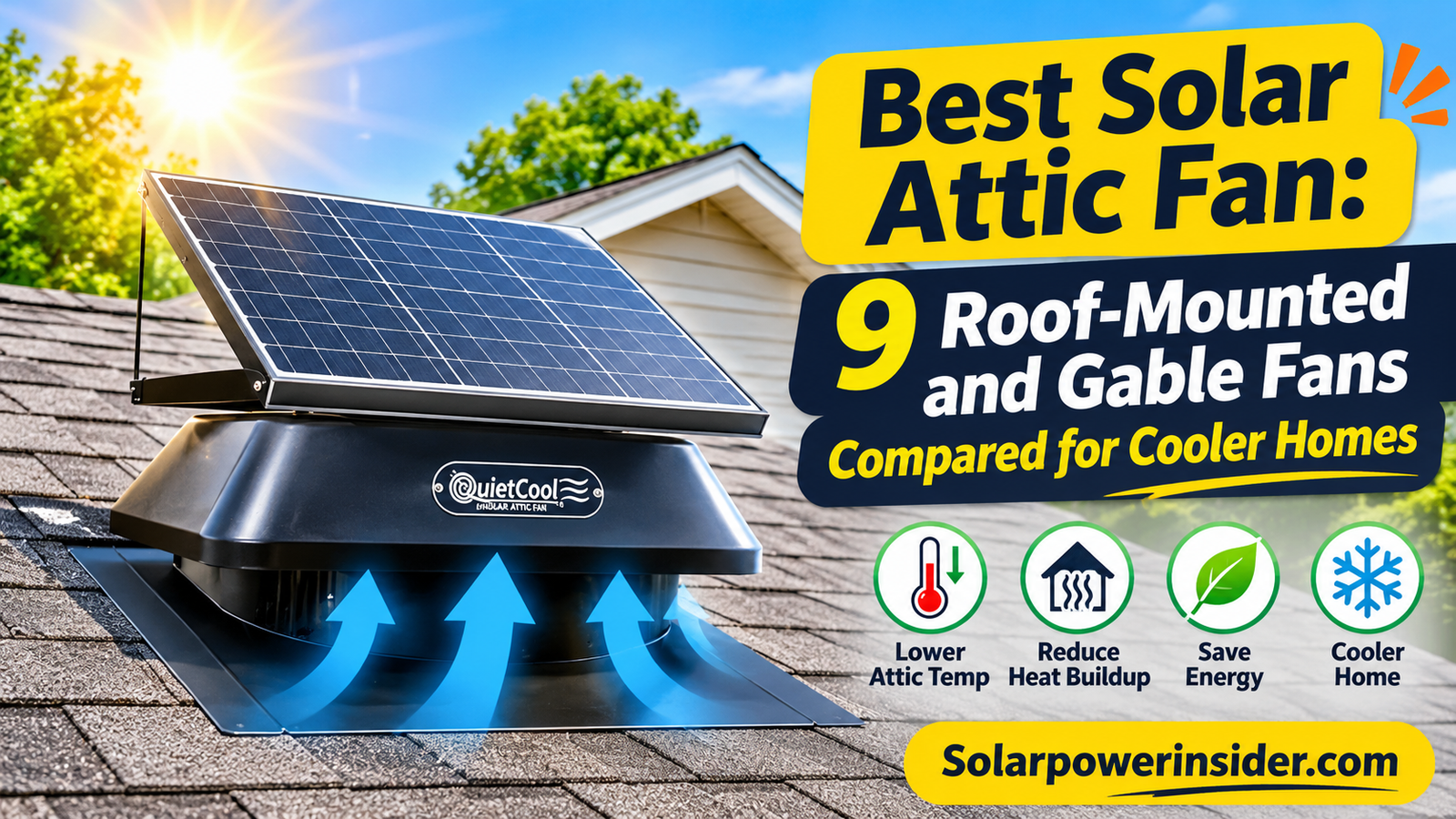
Best Solar Attic Fan: 9 Roof-Mounted and Gable Fans Compared for Cooler Homes
A solar attic fan quietly pulls superheated air out of your attic using nothing but sunlight — no wiring, no running cost, no noise in the living space below. We compared nine of the most popular units across wattage, airflow, mounting style, and smart features to find the best solar attic fan for every roof and budget.
Cooler Attics, Lower Cooling Bills, Zero Running Cost
Ask anyone who has climbed into an attic on a hot afternoon: the air up there is not just warm, it is punishing. Roof decks can reach temperatures that push heat straight down into the rooms below, forcing air conditioning systems to work far harder than they should.
A solar attic fan is the simplest answer to that problem. A small photovoltaic panel sits in the sun, a fan motor turns, and the hottest air in the house is pushed outside while fresh air is drawn in through soffit and ridge vents. Because the power source is the same sun that is heating the attic, the fan runs hardest exactly when you need it most — and it costs nothing to operate.
Compared with traditional electric attic fans, solar models skip the electrician, the wiring run, and the ongoing energy draw. Compared with passive ventilation alone, they move vastly more air on still, hot days when natural airflow collapses. That combination is why solar attic fans have become one of the most popular home comfort upgrades available.
The catch is that not all solar attic fans are equal. Airflow ratings, panel wattage, thermostat control, mounting style, and build quality vary widely — and a fan that suits a small garden shed would be hopelessly undersized for a large, complex roof. To make sense of the market, we compared nine widely available units ranging from compact 12 W panel designs for outbuildings to powerful 50 W gable-mounted systems and smart hybrid models with automatic temperature control.

One important note before we begin. Attic performance depends on your roof area, insulation, climate, soffit ventilation, and shading — no article can guarantee a specific temperature drop in your home. Rather than inventing numbers, this guide explains what each specification actually means and which household it suits, so you can match a fan to your roof with confidence.
Let’s start with the side-by-side view of all nine fans.
At a Glance
Quick Comparison: Our Top Picks
Every fan reviewed in this guide is listed below, along with the specifications stated for each product. Use the table to shortlist, then read the full review blocks further down for the detail that matters on your roof.
| # | Image | Product | Key Specs | Verdict | Check Price |
|---|---|---|---|---|---|
| 1 |  |
Top Pick iLIVING 14″ HYBRID Smart Thermostat Fan Best Overall |
|
Smart thermostat control with serious coverage in one unit. | Check Price on Amazon |
| 2 | |
QuietCool AFR SLR-40 Roof Mount Fan Best for 24/7 Runtime |
|
Keeps ventilating after sunset when heat still lingers. | Check Price on Amazon |
| 3 |  |
VEVOR 42W Solar Attic Fan Best High-Output Pick |
|
Big airflow and convenient control from below the roof. | Check Price on Amazon |
| 4 |  |
Natural Light 48-Watt Solar Attic Fan Best Premium Panel |
|
The largest panel here means confident output in weak sun. | Check Price on Amazon |
| 5 |  |
DC HOUSE 32W Solar Attic Fan Best Coverage Value |
|
Generous stated coverage from a mid-size panel. | Check Price on Amazon |
| 6 |  |
Remington Solar 30 Watt Roof Mount Fan Best Simple Roof Mount |
|
No-frills solar ventilation from a specialist brand. | Check Price on Amazon |
| 7 |  |
Amtrak Solar Attic Fan Best for Gable Openings |
|
Strong panel output in a gable-friendly package. | Check Price on Amazon |
| 8 |  |
SunRise Solar Round Model RFB 1250 FT Best Round Roof Design |
|
Neat, tidy roof line for appearance-conscious homes. | Check Price on Amazon |
| 9 |  |
4SEASONS Solar Attic Vent Fan Best for Sheds & Small Attics |
|
Right-sized for sheds where big fans are overkill. | Check Price on Amazon |
If you take one idea from this article, make it this: the best solar attic fan is not the one with the biggest number on the box, it is the one sized correctly for your attic and matched to how your roof is built. A compact fan in a huge attic does almost nothing; an oversized fan in a small shed wastes money and can even depressurize the space. Everything that follows is about getting that match right.
Ready to Compare Prices?
See the latest solar attic fans, panels, and accessories.
Check Price on AmazonSection 01
How a Solar Attic Fan Actually Works
Before choosing a model, it helps to understand the physics the device is exploiting. An attic acts like a heat battery: the roof deck absorbs solar radiation all day, heats the trapped air beneath it, and radiates that heat downward into the living space long after the sun sets.
The basic mechanism
A solar attic fan interrupts that cycle with three components. A photovoltaic panel converts sunlight into direct current electricity. That electricity drives a small, efficient fan motor. The fan pulls hot, stale air out of the attic while cooler replacement air is drawn in through intake vents — usually located in the soffits beneath the eaves.
Because the panel produces more power as the sun gets stronger, the fan naturally speeds up on the hottest, brightest days and slows down in the evening. In other words, the system self-regulates in exactly the right direction without any electronics at all.
Why moving air matters more than adding insulation
Insulation slows heat transfer, but it does not remove heat already trapped in the attic. Ventilation does. By continuously exchanging the hottest air for ambient outside air, a fan lowers the temperature of the air mass sitting above your ceiling, which reduces the thermal load pushing into bedrooms and living areas below.
There is a second benefit that matters in colder climates: moisture. Everyday activities — showers, cooking, drying clothes — release water vapour that rises into the attic. In winter, that vapour condenses on cold roof decking and can cause mould and structural damage. A ventilating fan keeps the air moving and helps carry that moisture out.
Panel wattage, airflow, and what the numbers mean
Two numbers dominate every solar attic fan specification sheet: panel wattage (measured in watts) and airflow (measured in cubic feet per minute, or CFM). Wattage tells you how much energy the panel can supply; CFM tells you how much air the fan moves when running. A 42 W panel paired with 2,800 CFM represents a very different machine from a 12 W panel delivering 400 CFM — and neither is inherently better. They are built for different spaces.
The ventilation rule of thumb
Bigger attics need more airflow, and complex roof shapes often need more than one fan or a larger unit. If your attic has multiple disconnected sections, treat each as its own space.
Intake is half the system
A fan can only exhaust as much air as the attic can draw in. Blocked, painted-over, or insufficient soffit vents will choke even the most powerful unit. Before blaming the fan for weak performance, check that intake pathways are clear and unobstructed by insulation baffles.
Want the Full Science Explained?
Our dedicated guide answers whether solar attic fans really work.
Read the Full GuideSection 02
Are Solar Attic Fans Worth It? Benefits, Limits, and Honest Expectations
Solar attic fans sit in that rare category of home upgrade that is inexpensive, self-powering, and almost entirely maintenance-free. That does not make them magic, and understanding both sides of the ledger is what separates satisfied buyers from disappointed ones.
Where they genuinely shine
- Zero operating cost. The energy that powers the fan is free and arrives precisely when cooling demand peaks.
- No electrician required. There is no wiring run, no circuit addition, and no permit question in most cases for an unpowered device.
- Quiet, invisible operation. Modern brushless motors run softly and are mounted away from living spaces.
- Reduced air conditioning strain. A cooler attic means less heat entering rooms, which eases the load on cooling equipment.
- Moisture control. Continuous air exchange helps protect roof decking and framing from condensation damage.
- Long, simple service life. With no fuel, filters, or belts, the main maintenance task is keeping the panel clean.
Where expectations should be tempered
Solar fans stop when the sun does. In the depth of night or during long cloudy spells, a purely solar unit simply sits idle. For most homes that is fine, because the heat load disappears with the sun — but if you want continuous ventilation, a hybrid design with an AC/DC inverter is the appropriate answer.
Sizing matters enormously. An undersized fan in a large, complex attic will move air, but not enough to change the temperature meaningfully. Conversely, an oversized fan in a small, tightly sealed building can create negative pressure that pulls conditioned air from the living space.
The results that matter in practice
The most noticeable outcome for most homeowners is comfort: upper-floor bedrooms stop feeling stuffy in the afternoon, and the air conditioning cycles less aggressively. In colder months, the same fan reduces the risk of moisture accumulation in the roof space. Neither benefit shows up dramatically on a single day, which is exactly why owners who track attic temperatures tend to be the most enthusiastic.
Realistic expectation
Think of a solar attic fan as a permanent, silent improvement to how your home handles heat and moisture — not as an air conditioner replacement. It works with your ventilation, not instead of it.
Who should skip them
Homes with no intake ventilation, sealed cathedral ceilings without an accessible attic, or buildings where the roof is heavily shaded for most of the day will see limited benefit. In those situations, addressing insulation, sealing, or shading usually delivers more than any fan.
Exploring Other Solar Upgrades?
See how a balcony solar system can offset household power.
Read the Balcony Solar GuideSection 03
How to Choose the Right Solar Attic Fan
Seven decisions separate a good purchase from a regretted one. Work through them in order and the right model usually becomes obvious.
1. Size the fan to your attic, not your budget
Airflow is expressed in CFM, and manufacturers often pair it with a stated attic coverage figure — for example, 1,150 CFM with coverage up to 2,900 square feet, or 2,500 CFM with coverage up to 3,000 square feet. Match the coverage figure to your actual attic footprint, then give yourself margin if your roof is complex or your climate is particularly hot.
2. Panel wattage decides when the fan runs
Panel ratings in this category range from a compact 12 W unit for sheds up to 50 W panels on larger systems. A bigger panel delivers usable airflow earlier in the morning, later in the afternoon, and on partly cloudy days — that is the real-world advantage, not just maximum speed at noon.
3. Mounting style: roof, gable, or hybrid
Roof-mounted units sit on the roof deck and are the most common choice. Gable-mounted designs fit existing gable openings and avoid new roof penetrations entirely — a significant advantage on complex or delicate roofing. Round, low-profile units keep the roof line tidy.
4. Thermostat and sensor control
Smart thermostats and built-in temperature sensors prevent the fan from running when it is not needed and speed it up when attic temperatures climb. Remote control adds convenience for units installed high or out of reach.
5. Runtime philosophy: solar-only or hybrid
Solar-only fans run whenever the sun provides power. Hybrid designs add an AC/DC inverter so the unit can continue running on household power after dark — useful in hot climates where attics retain heat well into the evening.
6. Build quality and certification
Roof equipment lives through hail, heat, and wind for years. Look for robust housings, quality weatherproofing, and stated safety certification — CSA certification is one such recognized mark, found on products like the 4SEASONS vent fan.
7. Warranty and support
A fan on a roof is inconvenient to replace. Established brands with clear warranty terms and reachable support are worth a modest premium.
| # | Image | Product | Key Specs | Best Suited To | Check Price |
|---|---|---|---|---|---|
| 1 | |
iLIVING 14″ HYBRID SmartLarge Standard Attics |
|
Big attics needing automatic temperature control | Check Price |
| 2 | |
4SEASONS Solar Attic Vent FanSheds & Small Attics |
|
Outbuildings, garages, and compact attic spaces | Check Price |
| 3 | |
Amtrak Solar Attic FanGable Openings |
|
Homes with existing gable vents, no new roof holes | Check Price |
| 4 | |
QuietCool AFR SLR-40Hot Climates |
|
Regions where attics stay hot long after sunset | Check Price |
Shopping for Solar Attic Fans?
Compare thermostat models, roof mounts, and gable designs.
Check Price on AmazonReview 01
iLIVING 14″ HYBRID Smart Thermostat Solar Attic Fan
This is the model that does almost everything well, which is why it leads our list. The combination of a smart thermostat, a generous 40 W panel, and coverage figures that reach into large attics makes it the safest recommendation for a typical family home.
- 14-inch hybrid design — a substantial fan built for real attic volumes rather than token ventilation.
- Smart thermostat control — manages operation automatically based on attic conditions.
- 40 W solar panel — strong energy supply for dependable daytime airflow.
- 1,150 CFM airflow — meaningful air exchange for a residential roof space.
- Up to 2,900 sq ft coverage — sized for large standard attics.
What stands out
The word that matters in this product’s name is “hybrid.” Purely solar fans follow the sun and nothing else; a hybrid design coordinates with household power and smart control so ventilation continues to be useful beyond the brightest hours. Combined with a thermostat, the unit responds to what the attic is actually doing rather than running blindly.
Panel size is the other headline. At 40 W, the panel has enough headroom to keep the fan moving meaningfully in the shoulder hours of the day and through thin cloud, which is when a smaller panel would already be producing too little to matter.
For a homeowner who does not want to think about attic ventilation ever again, this is the appeal: install it, let the thermostat manage it, and enjoy the cooler upper floors.
Key features at a glance
- Smart thermostat for automatic temperature-based operation
- 40 W photovoltaic panel for strong real-world output
- 1,150 CFM airflow with coverage up to 2,900 sq ft
- Hybrid design combining solar and household power
- 14-inch format suited to residential attics
Pros
- Automatic thermostat control
- Generous stated attic coverage
- Strong 40 W solar panel
- Hybrid operation extends useful runtime
- Set-and-forget ownership
Cons
- Large format needs real roof space
- Overkill for sheds and small attics
- More features mean a higher budget
iLIVING 14″ HYBRID Smart Thermostat Fan
Smart control and wide coverage for large attics.
Check Price on AmazonReview 02
Remington Solar 30 Watt Roof Mount Solar Attic Fan
Not every buyer wants smart features, remotes, or hybrid electronics. Some want a well-built solar fan that does one job reliably for years — and that is precisely the territory Remington occupies.
- 30 W solar panel — a sensible mid-range supply for everyday residential ventilation.
- Roof-mount configuration — the most common and straightforward installation style.
- Solar-only operation — no wiring, no running cost, no controls to configure.
- Specialist brand focus — built as a dedicated solar ventilation product.
What stands out
Simplicity is the feature here. There is something genuinely appealing about a device with no settings to adjust and no app to install: mount it, and it works whenever the sun shines. For many homes, that is all a solar attic fan needs to do.
The 30 W panel sits in the sensible middle of the market — enough to keep the fan turning through most of the daylight hours without the size and cost of the largest panels. In a straightforward gabled roof with decent soffit intake, a well-positioned 30 W unit is a very effective upgrade.
Roof mounting is also the fastest path to good performance, since the panel and fan sit together in full sun at the highest, hottest point of the attic.
Key features at a glance
- 30 W photovoltaic panel for dependable daytime operation
- Roof-mounted fan and panel arrangement
- Direct solar power with no electrical connection
- Focused, no-frills design from a solar ventilation specialist
Pros
- Simple install-and-forget operation
- Sensible 30 W panel size
- No wiring or configuration
- Straightforward roof-mount setup
Cons
- No smart thermostat features
- Stops working once the sun sets
- Fewer convenience extras than premium units
Remington Solar 30 Watt Roof Mount Fan
Reliable, straightforward solar attic ventilation.
Check Price on AmazonReview 03
VEVOR 42W Solar Attic Fan with Remote Control
If airflow is your priority and you want to control it without climbing a ladder, the VEVOR unit is a compelling combination: a high-capacity fan, a strong panel, and a remote you can use from the floor below.
- 42 W solar panel — near the top of the panel range in this group.
- 2,800 CFM airflow — among the highest stated airflow figures here.
- Remote control included — operate the fan without accessing the attic.
- Built-in temperature sensors — automatic response to attic heat.
What stands out
The airflow figure is the headline, but the temperature sensors are what make it liveable day to day. Sensing-based control means the fan increases output as attic temperatures climb and eases off when conditions improve, keeping the space balanced without constant attention.
The remote control solves a real problem. Once a fan is mounted high in a roof space, checking settings becomes a chore — being able to adjust operation from below changes how often owners actually interact with the system.
Paired with a 42 W panel, the whole package is built to move serious air on serious summer days, which makes it a natural fit for larger or more complex attic spaces.
Key features at a glance
- High-output fan rated at 2,800 CFM
- 42 W panel for strong daytime power
- Remote control for convenient operation
- Built-in temperature sensors for automatic adjustment
Pros
- Excellent stated airflow
- Remote control is genuinely convenient
- Automatic temperature response
- Strong panel for shoulder-hour output
Cons
- High output is unnecessary for small spaces
- More electronics to consider on a roof
- Remote adds another thing to keep track of
Review 04
Natural Light 48-Watt Solar Attic Fan
Panel size is the single most underappreciated specification in solar attic fans, and this is where the Natural Light unit earns its place: the largest panel in the entire group.
- 48 W solar panel — the highest panel rating among the fans compared here.
- Roof-mounted system — positioned for maximum sun exposure at the roof peak.
- Panel-forward design — engineered around consistent power delivery.
- Premium positioning — built for owners who prioritize performance margin.
What stands out
Why does panel size matter so much? Because real-world conditions are rarely ideal. Morning haze, afternoon cloud, low winter sun, dust on the surface, and the inevitable shading from trees all reduce panel output. A larger panel simply has more headroom to keep the fan turning when a smaller panel would have dropped below useful output.
For homes in variable climates — places where hot days often come with hazy skies — that headroom is the difference between a fan that runs and a fan that idles. It also means the fan starts earlier in the morning and continues later into the afternoon, extending the useful ventilation window.
Roof mounting complements the panel perfectly, placing both the collector and the exhaust point at the highest, hottest part of the structure where airflow is most effective.
Key features at a glance
- 48 W panel — the largest capacity in this comparison
- Roof-mounted installation for peak sun exposure
- Designed around reliable, consistent power delivery
- Suits variable climates and partly shaded roofs
Pros
- Best panel headroom in the group
- Runs longer through the day
- Performs better in hazy conditions
- Clean roof-mounted arrangement
Cons
- Larger panel needs unobstructed roof space
- Premium positioning suits higher budgets
- No smart control highlighted
Natural Light 48-Watt Solar Attic Fan
The largest panel here for confident daily output.
Check Price on AmazonReview 05
QuietCool AFR SLR-40 Roof Mount Solar Attic Fan
Most solar attic fans share the same limitation: when the sun goes down, so does the fan. The QuietCool AFR SLR-40 addresses exactly that, with an AC/DC inverter that allows continued operation after dark.
- 40 W adjustable panel — panel angle can be optimized toward the sun.
- AC/DC inverter design — enables operation on household power when solar output fades.
- 24/7 runtime capability — ventilation continues into the evening and night.
- Roof-mount configuration — installed at the highest point of the attic.
What stands out
The adjustable panel is a subtle but meaningful feature. A fixed panel on a roof receives whatever angle the roof happens to provide; an adjustable panel can be tilted toward the sun’s path, extracting more energy from the same footprint. On north-facing or low-slope roofs, that adjustability can be decisive.
The real story, though, is the inverter. In hot climates, attics store enormous amounts of heat that continues radiating downward long after sunset. A fan that keeps running through the evening helps shed that stored heat before it reaches bedrooms — precisely when families are trying to sleep.
For anyone living where summer nights stay warm, this day-and-night capability is not a gimmick. It addresses the exact hours when attic heat is most uncomfortable.
Key features at a glance
- 40 W adjustable solar panel for optimized angle
- AC/DC inverter allowing extended runtime
- Designed for day-and-night ventilation
- Roof-mount installation at the attic’s highest point
Pros
- Keeps running after sunset
- Adjustable panel angle
- Ideal for hot climates
- Addresses stored evening heat
Cons
- Extended runtime uses household power
- More complex than solar-only units
- Adjustable panel needs occasional checking
QuietCool AFR SLR-40 Solar Attic Fan
Adjustable panel with day-and-night runtime.
Check Price on AmazonReview 06
DC HOUSE 32W Solar Attic Fan
This unit is all about coverage per dollar. It pairs a modest panel with impressive stated airflow and an attic coverage figure that matches or exceeds far more expensive competitors.
- 32 W solar panel — efficient mid-size supply for everyday conditions.
- 2,500 CFM airflow — strong air movement for a residential attic.
- Up to 3,000 sq ft coverage — among the highest stated coverage in this group.
- Roof-mounted ventilation — installed where heat collects most.
What stands out
The combination here is unusual: a 32 W panel delivering airflow figures that compete with units carrying much larger panels. That suggests a well-matched fan motor and blade design, since airflow is ultimately produced by the fan itself — the panel simply determines when it runs.
For a homeowner with a large attic and a practical budget, the coverage figure is the number that matters most. It means you can ventilate a broad roof space with a single unit rather than buying two smaller fans and installing both.
Roof mounting keeps installation conventional and positions the exhaust at the peak of the attic where the hottest air collects — the most effective place to remove it.
Key features at a glance
- 2,500 CFM airflow from a 32 W panel
- Stated coverage up to 3,000 sq ft
- Roof-mounted installation
- Strong airflow-to-panel ratio
Pros
- Excellent stated coverage
- Strong airflow output
- Efficient panel-to-fan matching
- Straightforward roof installation
Cons
- Panel size is modest for very cloudy regions
- No smart control highlighted
- Broad coverage needs good intake ventilation
Section 10
Compact and Specialty Picks: Amtrak, 4SEASONS, and SunRise
Not every attic is a sprawling residential roof space. Garages, workshops, sheds, and homes with existing gable vents need a different kind of fan — smaller, differently mounted, or designed around a specific opening. These three units fill that gap.
| # | Image | Product | Key Specs | Best Suited To | Check Price |
|---|---|---|---|---|---|
| 1 | |
Amtrak Solar Attic FanBest for Gable Openings |
|
Homes with existing gable vents and no roof penetration | Check Price |
| 2 | |
4SEASONS Solar Attic Vent FanBest for Small Spaces |
|
Sheds, garages, and small attic volumes | Check Price |
| 3 | |
SunRise Solar Round Model RFB 1250 FTBest-Looking Roof Line |
|
Appearance-conscious roofs and neat installations | Check Price |
Cutting into a roof is the step most homeowners dread. The Amtrak unit sidesteps that entirely by working with existing gable openings, while still delivering one of the strongest panel ratings in the group.
- 50 W solar panel — the highest panel wattage among all nine products compared.
- Compact gable-opening design — mounts to an existing vent rather than the roof deck.
- Panel-forward configuration — generous solar supply for consistent operation.
What stands out
A 50 W panel is a serious power source for an attic fan, and it means this unit keeps working through hazy conditions and into the shoulder hours of the day. For gable-mounted installations — where the panel may not sit at the ideal roof angle — that extra capacity compensates beautifully.
Avoiding new roof penetrations is another real advantage. Roofs are expensive, warranties matter, and many homeowners would rather not create a new opening. Working within an existing gable vent removes that objection completely.
Pros
- Largest panel in the comparison
- No new roof penetration
- Compact fit for gable openings
- Strong output in hazy conditions
Cons
- Requires an existing gable opening
- Panel placement depends on gable orientation
- Not suited to roofs without gable vents
Not every space needs 2,800 CFM. For a garden shed, a detached garage, or a small attic, a compact fan sized correctly performs far better than an oversized unit — and this is exactly that product.
- 12 W solar panel — appropriately scaled for small spaces.
- 400 CFM airflow — right-sized for sheds and compact attics.
- CSA certified — a recognized safety certification mark.
- Small attic and shed focus — designed for outbuildings rather than large homes.
What stands out
Sizing correctly is the whole argument here. Small, enclosed structures heat up rapidly and hold that heat stubbornly; a proportionate fan exchanges the air frequently enough to make a real difference without drawing more power than a compact panel can supply.
The CSA certification is worth noting as well. Stated third-party certification is exactly the kind of signal that separates considered products from anonymous ones, particularly for equipment that will sit in the elements for years.
Pros
- Correctly sized for small structures
- CSA certified
- Compact and unobtrusive
- Ideal for sheds and garages
Cons
- Too small for large residential attics
- Modest airflow output
- Panel is compact by design
Roof aesthetics matter more than people admit. A bulky, angular fan can be the most visible feature on a roof from the street, which is why the round, low-profile format of the SunRise model appeals to so many homeowners.
- Round model design — a tidy, unobtrusive roof profile.
- RFB 1250 FT designation — a defined model within a specialist solar ventilation range.
- Low-profile appearance — blends into the roof line rather than dominating it.
- Compact all-in-one unit — integrated panel and fan arrangement.
What stands out
Design-conscious buyers will appreciate how little this unit announces itself. A round housing sits naturally on a shingled roof, and the integrated form factor means fewer separate components to align during installation.
Being made by a specialist in solar ventilation also matters for long-term ownership: companies focused on a single product category tend to support their hardware properly and design for the realities of rooftop service life.
Pros
- Neat, low-profile round design
- Blends into the roof line
- Integrated all-in-one construction
- Specialist solar ventilation design
Cons
- Round format limits some mounting options
- Less focused on headline airflow figures
- Design-first positioning
Looking for a Gable or Shed Fan?
Compare compact solar attic fans and vents for small spaces.
Check Price on AmazonSection 11
Installation, Positioning, and Roof Safety
A solar attic fan is only as good as its placement. Get positioning right and the unit works for years with minimal attention; get it wrong and even the best fan will disappoint.
Choosing the location
Exhaust fans belong high in the attic, ideally near the peak of the roof where the hottest air collects. Solar panels belong where they receive the most unobstructed sunlight across the middle of the day. On many roofs, a combined unit satisfies both requirements in a single location — but on shaded or unusually shaped roofs, separating panel and fan can be worthwhile.
Panel orientation fundamentals
South-facing exposure (in the northern hemisphere) and a tilt that roughly matches your latitude deliver the best annual output. Avoid locations shaded by chimneys, dormers, trees, or neighbouring structures. Even partial shading across a portion of a panel can noticeably reduce output, so pick a clear span of roof.
Intake ventilation: the step people skip
A fan exhausts air; something has to supply it. Soffit vents, gable vents, or ridge vents provide that intake, and they must be clear of insulation, paint, and debris. If your intake is blocked, the fan will work harder for less result and can pull conditioned air from the living space.
Roof safety is non-negotiable
- Work only on dry, calm days and never alone on a steep or wet roof.
- Use proper fall protection appropriate to your roof pitch, not improvised solutions.
- Plan cable routing before drilling, keeping penetrations sealed and above water lines.
- Use flashing and sealants designed for roofing, and inspect the seal after the first heavy rain.
- If you are not comfortable on a roof, hire a professional. Roof work is one of the most common sources of serious home injury.
Weatherproofing details that prevent callbacks
Every penetration is a potential leak. Correct flashing, generous sealant, and cables that drain rather than pool water are the difference between a decade of trouble-free service and a ceiling stain. Take the extra time here; it is the highest-value hour of the whole installation.
Safety first
Never install a fan into a roof that is in poor condition. If the decking is soft, the shingles are at the end of their life, or you see signs of existing leaks, address the roof first — a fan installed into failing material will only make things worse.
When to bring in a professional
Complex roofs, tile or slate surfaces, steep pitches, and any installation requiring electrical work for hybrid models are all good reasons to call an experienced installer. The cost is modest compared with repairing water damage or correcting a poor installation.
Need Mounting Hardware or Accessories?
Browse attic ventilation fans, flashing, and installation supplies.
Check Price on AmazonSection 12
Maintenance, Troubleshooting, and Long-Term Care
Solar attic fans are among the least demanding appliances you can install. That said, a little attention each season keeps them performing at their best and prevents small issues from becoming expensive ones.
A simple seasonal routine
- Twice a year: clean the panel surface with water and a soft cloth. Dust, pollen, and bird droppings reduce output more than most owners expect.
- After storms: check the flashing seal and surrounding shingles for damage or lifting.
- Annually: inspect soffit and gable intake vents for blockage by insulation, paint, or nesting insects.
- Every few years: check that the fan spins freely and quietly, and listen for any change in sound that might indicate a worn bearing.
Common symptoms and what they mean
| Symptom | Likely Cause | First Action |
|---|---|---|
| Fan barely turns on sunny days | Dirty panel, partial shading, or a shifted panel angle | Clean the panel and check for new shading |
| Attic stays hot despite the fan | Blocked or insufficient intake ventilation | Clear soffit vents; verify intake area |
| Rattling or vibration | Loose mounting or a worn fan bearing | Retighten hardware; inspect the fan |
| Water staining below the fan | Failed flashing or sealant | Reseal immediately; inspect decking |
| Fan stops entirely | Panel damage, wiring issue, or motor failure | Inspect panel and connections; contact support |
Keeping the panel productive
The photovoltaic panel is the heart of the system and the part most affected by neglect. A gentle wash in dry weather, avoiding abrasive cleaners, and trimming back overhanging branches are usually all that is required. Solar equipment generally lasts for many years when kept clean and undamaged.
Troubleshooting beyond the fan
If your fan seems healthy but the attic is not cooling, the problem is usually elsewhere: inadequate intake area, radiant heat from the roof deck, or air leaks from the living space below. Sealing those leaks and checking insulation coverage often makes a bigger difference than upgrading the fan.
When to replace rather than repair
Fan motors eventually wear, and panels degrade slowly over many years. If output has declined noticeably after cleaning and the fan shows mechanical wear, replacing the unit is usually more sensible than pursuing parts — particularly given how straightforward a like-for-like replacement is once the opening exists.
Related reading
Other solar gear follows similar care principles. If you also use solar lighting around the property, our guide to how long solar lights last covers the same panel-care basics, and why solar lights stop working is a useful troubleshooting companion.
Upgrading Your Attic Setup?
Compare the latest solar attic fans and ventilation gear.
Check Price on AmazonFrequently Asked Questions About Solar Attic Fans
What size solar attic fan do I need?
Match the fan’s stated attic coverage to your actual attic footprint. Products in this comparison range from compact units rated at 400 CFM for small attics and sheds, through mid-size systems covering roughly 2,900 square feet, up to high-output fans rated at 2,800 CFM covering up to 3,000 square feet. If your roof has multiple disconnected attic sections, treat each as a separate space and size accordingly.
Do solar attic fans really lower attic temperature?
They move large volumes of hot air out of the attic and replace it with outside air, which reduces the heat mass sitting above your ceiling. The degree of improvement depends on attic size, insulation, intake ventilation, climate, and shading. Homes with clear soffit intake and full-sun roof placement see the most noticeable results.
How much airflow (CFM) should I look for?
CFM describes how much air the fan moves, and bigger attics need more of it. The fans in this comparison range from around 400 CFM for outbuildings to 2,800 CFM for large residential spaces. Choose based on the coverage figure the manufacturer states, then give yourself margin if your climate is very hot or your roof is complex.
Does panel wattage really matter?
Yes, more than most buyers expect. Panel ratings here range from 12 W to 50 W. A larger panel keeps the fan running earlier, later, and through hazy conditions — meaning more total ventilation across the day. In consistently sunny climates a modest panel performs well; in variable climates, the extra wattage pays for itself in reliability.
Do solar attic fans work at night?
Standard solar-only fans do not, since they rely entirely on sunlight. Hybrid designs with an AC/DC inverter can continue running on household power after dark, which is useful in hot climates where attics hold heat well into the evening. If night-time ventilation matters to you, look specifically for that hybrid capability.
Can I install a solar attic fan myself?
Many homeowners do, particularly on low-slope roofs with straightforward access. Roof work carries real fall and weather risks, and every penetration must be flashed and sealed correctly to prevent leaks. If your roof is steep, tiled, or in poor condition, or if the installation requires electrical work, hire a professional.
Will a solar attic fan cause my home to pull in outside air?
It can, if intake ventilation is inadequate. A fan can only exhaust as much air as the attic can draw in through soffit, gable, or ridge vents. Ensuring sufficient, unblocked intake prevents negative pressure and keeps the fan working as intended.
How long do solar attic fans last?
Solar panels are extremely durable and degrade only slowly over many years; fan motors are mechanical and eventually wear. Regular panel cleaning, secure mounting, and sound flashing extend service life considerably. Choosing a product with clear warranty terms from an established manufacturer is the best protection against early failure.
Are solar attic fans better than electric attic fans?
They solve the same problem differently. Electric fans move air consistently regardless of sunlight but require wiring and consume household power. Solar fans cost nothing to run and need no electrician but operate only when the sun provides energy. Hybrid models bridge the gap by running on solar during the day and household power when needed.
Where should a solar attic fan be placed?
High on the roof near the peak, where the hottest air collects and where the panel can receive unobstructed sunlight. Avoid areas shaded by chimneys, trees, or dormers, and keep the unit well away from intake vents so short-circuiting does not occur.
Do solar attic fans help in winter?
They can help with moisture control. Everyday household activities release water vapour that rises into the attic and condenses on cold surfaces, which over time can damage decking and framing. Air movement helps carry that moisture out, making year-round ventilation valuable in many climates.
Is a solar attic fan worth it compared with adding insulation?
They address different problems. Insulation slows heat transfer into living spaces; ventilation removes heat and moisture already in the attic. Ideally you have both. If your attic is well insulated but still roasts in summer, a fan is the logical next step.
Conclusion: Which Solar Attic Fan Should You Buy?
Nine fans, one honest answer: the best solar attic fan is the one sized for your attic and matched to your roof. That said, a few clear winners emerge depending on your situation.
- iLIVING 14″ HYBRID Smart Thermostat — Best Overall Smart thermostat control, a strong 40 W panel, and coverage up to 2,900 sq ft make this the safest recommendation for a typical large attic.
- QuietCool AFR SLR-40 — Best for Hot Climates An adjustable panel and AC/DC inverter mean ventilation continues after sunset, exactly when stored attic heat is most uncomfortable.
- VEVOR 42W — Best for Large, Hot Attics Serious airflow, remote control, and built-in temperature sensors for owners who want power and convenience together.
- Natural Light 48-Watt — Best for Variable Climates The largest panel in the group delivers the performance margin needed in hazy or changeable conditions.
- 4SEASONS 400 CFM — Best for Sheds & Small Attics Correctly sized, CSA certified, and ideal for outbuildings where a big fan would be wasteful.
Whichever model you choose, remember the two fundamentals that decide the outcome: clean, unshaded panel placement and unobstructed intake ventilation. Get those right and even a modest fan will noticeably change how your home handles summer heat.
Ready to Cool Your Attic for Free?
Our top pick pairs smart thermostat control with wide attic coverage.
Check Price on Amazon