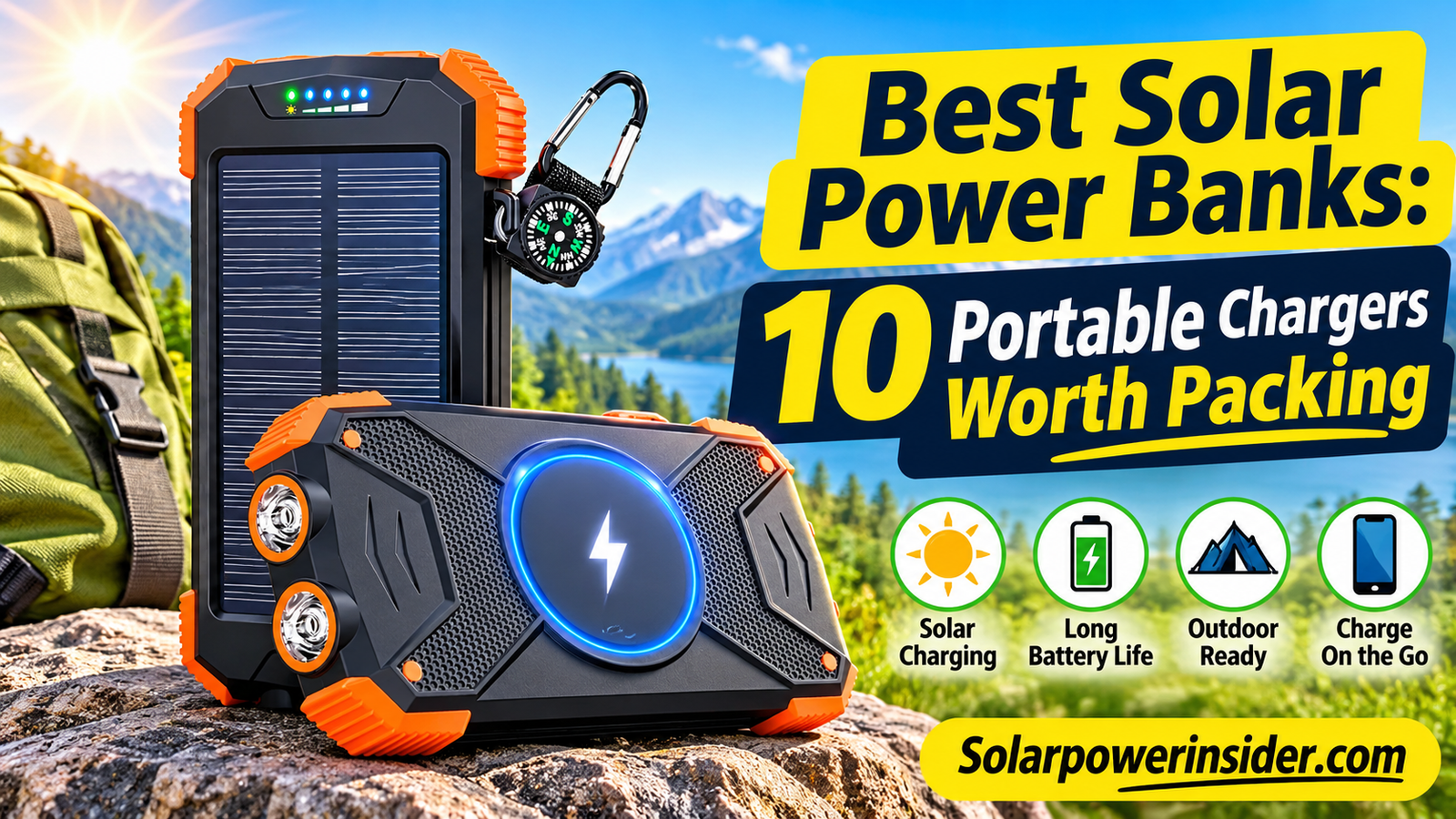
Best Solar Power Banks: 10 Portable Chargers Worth Packing
Solar power banks promise endless charging from sunlight — but they are not all built for the same job. We compare ten of the most popular options, from pocketable everyday carry units to high-capacity models built for long trips, so you can match the capacity to how and where you actually travel.
Choosing a Solar Power Bank Is Really About Trade-Offs
A solar power bank is one of those products where more is not automatically better. The biggest unit in the lineup is also the heaviest to carry, the most compact unit is also the one with the least reserve capacity, and every one of them charges faster from a wall outlet than it ever will from the sun.
That last point is worth saying up front, because it changes how you should shop. The photovoltaic panel on a portable power bank is best understood as a top-up and emergency capability — a way to put energy back into the unit while it sits clipped to a backpack on a long hike or sits on a rock at a campsite. The primary charging method for nearly every one of these products is a cable and a wall adapter, and that is completely normal for the category.
Once you accept that, the buying decision becomes refreshingly straightforward: pick the capacity that matches your trip length, the weight you are willing to carry, and the number of devices you need to keep alive. The ten products in this roundup span the whole range, from pocketable everyday units to high-capacity banks designed to keep a small group connected for days.
Quick Answer
For most people, a mid-size solar power bank in the compact-to-mid range offers the best balance of portability and usable reserve.
Smaller banks like the BLAVOR 10000mAh are ideal for daily carry and short outings, while models from 20000mAh to 25000mAh cover weekend trips comfortably. High-capacity units in the 38800mAh to 49800mAh range make sense when you are charging several devices over multiple days away from power. Match the bank to the trip, not to the biggest number on the box.

Below you will find a quick comparison table covering all ten products, followed by detailed look at each one — what it suits, where it sits in the range, and who should consider it. If you want to understand the technology behind solar charging first, our guide to solar power banks versus solar chargers explains the difference between the two approaches.
Quick Comparison: Our Top Picks
| # | Image | Product | Key Specs | Verdict | Check Price |
|---|---|---|---|---|---|
| 1 |  |
Top PickBLAVOR Solar Power Bank 10000mAhBest Compact Everyday Carry |
|
The one you will actually carry every day. | Check Price on Amazon |
| 2 |  |
Durecopow Solar Power Bank 20000mAhBest Budget Step-Up |
|
A sensible, affordable first solar bank. | Check Price on Amazon |
| 3 |  |
GOODaaa Solar Power Bank 24000mAhBest Value All-Rounder |
|
Balanced capacity without much bulk. | Check Price on Amazon |
| 4 |  |
Hiluckey Solar Charger 25000mAhBest for Light Travel |
|
A smart choice for weekend adventures. | Check Price on Amazon |
| 5 |  |
QiSa Solar Charger Power Bank 38800mAhBest Mid-Capacity |
|
Serious reserve for multi-day outings. | Check Price on Amazon |
| 6 |  |
MINRISE Solar Power Bank 40000mAhBest for Extended Trips |
|
Built for long stretches away from outlets. | Check Price on Amazon |
| 7 |  |
SOARAISE Solar Charger Power Bank 48000mAhBest for Group Travel |
|
One bank that can serve the whole crew. | Check Price on Amazon |
| 8 | |
ERRBBIC Solar Charger Power Bank 49800mAhBest Maximum Capacity |
|
The biggest safety net in this lineup. | Check Price on Amazon |
| 9 |  |
Kepswin Solar Power Bank 49800mAhBest High-Capacity Alternative |
|
Another heavyweight worth a close look. | Check Price on Amazon |
| 10 |  |
Nuynix Solar Power Bank 49800mAhBest for Off-Grid Charging |
|
Ideal when outlets are days away. | Check Price on Amazon |
Want the Full Product Details?
Each review below links straight to the current listing.
Browse Solar Power BanksSection 01
How We Compared These Solar Power Banks
Every product in this roundup solves the same basic problem — keeping devices charged away from an outlet — but they differ enormously in how much energy they hold and how much weight that adds to your bag.
Capacity is the headline number
The capacity figure in each product name is the single most important specification for matching a bank to your trip. It is expressed in milliamp-hours, and the practical way to use it is simple arithmetic: check the battery size of the devices you carry, and divide. A phone with a large battery will consume more of the bank’s reserve than a small earbuds case, so your own device list tells you far more about required capacity than any generic recommendation.
Portability is the real-world counterweight
Capacity and portability pull in opposite directions. A high-capacity bank carries enough energy for days but adds noticeable weight to a pack, while a compact unit disappears into a jacket pocket but needs recharging more often. The right answer depends on whether you are commuting across town or trekking far from the nearest power socket.
Solar charging is a supplement, not the engine
The integrated panel on these products provides useful top-up charging during outdoor hours, particularly on bright, direct sunlight days. It is a genuinely valuable emergency capability, but the practical reality is that wall charging refills a power bank far more quickly. Understanding this balance is what separates satisfied owners from disappointed ones — and our explainer on whether solar power banks are worth it explores that trade-off in depth.
Best by use case
| Use Case | Capacity Range | Recommended Pick | Check Price |
|---|---|---|---|
| Daily carry and short outings | Compact | BLAVOR Solar Power Bank 10000mAh | Check Price on Amazon |
| Weekend trips | Mid range | Hiluckey Solar Charger 25000mAh | Check Price on Amazon |
| Multi-day group travel | High | SOARAISE Solar Charger Power Bank 48000mAh | Check Price on Amazon |
| Extended off-grid use | Maximum | ERRBBIC Solar Charger Power Bank 49800mAh | Check Price on Amazon |
Not Sure Which Size You Need?
Compare solar power banks across every capacity range.
Check Price on AmazonSection 02
Solar Charging in Practice: What to Realistically Expect
If you understand how these panels behave before you buy, you will choose better and enjoy the product far more. Here is the honest version of how solar charging works on a portable power bank.
Sunlight intensity drives everything
The panel converts light into a small stream of electricity, and that stream varies with the angle of the sun, the clarity of the sky, and how directly the panel faces the light. On a clear day with the unit positioned well, the panel does useful work. Through cloud, in shade, or through a car windshield, output falls away considerably.
Think top-up, not full recharge
Panel output is designed for gradual replenishment rather than rapid refill. The practical habit that works best is simple: keep the bank topped up from a wall outlet before you leave, and let the panel add what it can while you are outdoors. That way the panel extends your range instead of being expected to rescue an empty battery.
Placement tips that genuinely help
- Face the panel directly at the sun. Angle matters more than most people expect.
- Keep the surface clean. Dust and fingerprints reduce light reaching the cells.
- Avoid heat build-up. Never leave a charging bank on a scorching dashboard.
- Clip it outside, not inside. A backpack strap in open sunlight beats a closed pocket.
- Charge devices sparingly while solar charging. Energy in is modest, so let the bank fill first.
Where solar power banks fit in a bigger system
For a phone, earbuds, and a headlamp, a solar power bank is exactly the right tool. For laptops, appliances, or running a campsite kitchen, you are into portable power station territory — our guide to the best solar powered generators covers equipment designed for far heavier loads.
| Scenario | What Matters Most | Capacity Tier |
|---|---|---|
| Commuting and city days | Low weight, pocket size | Compact |
| Weekend camping | Reserve for two or three days | Mid range |
| Road trips and festivals | Multiple devices, shared use | High |
| Remote expeditions | Maximum reserve and solar top-up | Maximum |
Curious About Solar Tech?
Explore solar chargers and power banks side by side.
Check Price on AmazonSection 03
BLAVOR Solar Power Bank 10000mAh
Best Compact Everyday Carry
If the best power bank is the one you actually have with you, the BLAVOR 10000mAh makes a compelling case as our top pick. Its capacity sits in the sweet spot for daily life — enough to get a typical phone through a full day of heavy use or two lighter ones — while the overall package stays small enough to live in a bag permanently.
That combination is more important than it sounds. Larger banks are wonderful on expeditions and dead weight on a Tuesday commute. A 10000mAh unit is the size most people never leave behind, which means it is charged, packed, and ready precisely when a surprise low-battery warning appears.
Key considerations
- Capacity that matches daily needs. Solid reserve for phones and smaller devices without unnecessary bulk.
- Solar top-up on the move. Useful for adding charge during bright outdoor hours.
- Pocketable form factor. Slips into a day bag, glovebox, or carry-on without a second thought.
- Everyday durability. Designed as an outdoor-friendly companion rather than a delicate gadget.
Pros
- Easy to carry every day
- Enough capacity for typical phone use
- Solar charging adds outdoor flexibility
- Great entry point into solar power banks
Cons
- Not sized for multi-device expeditions
- Solar top-up is gradual by nature
- Requires periodic top-ups on longer trips
Who it is best for
Commuters, travellers, students, and anyone who wants an unobtrusive safety net for daily device charging. If you value portability over maximum reserve, this is the one to start with.
Section 04
Durecopow Solar Power Bank 20000mAh
Best Budget Step-Up
The Durecopow 20000mAh represents the natural next step up from a compact bank: roughly double the reserve of the smallest units in this lineup, still compact enough to travel with, and positioned as one of the most affordable ways to move into solar-assisted charging.
That makes it a great first purchase. Many buyers discover after one trip that they want more capacity than a pocketable bank provides — and going straight to a 20000mAh model avoids buying twice. The extra reserve comfortably covers a weekend’s worth of phone charging plus a smaller device or two.
Key considerations
- Meaningful capacity step up. Substantially more reserve than pocketable models.
- Value focused. An approachable way to own a solar power bank without overspending.
- Outdoor oriented design. Suited to being clipped to a pack or stowed in a tent.
- Still travel friendly. Manageable size for weekends away and day hikes.
Pros
- Affordable entry into higher capacity
- Good balance of size and reserve
- Well suited to casual outdoor use
- Comfortable with everyday device charging
Cons
- Heavier than compact everyday units
- Solar charging remains gradual
- Less reserve than the largest models here
Who it is best for
First-time buyers, occasional campers, and anyone who wants more capacity than a compact unit without the weight of a high-capacity model.
Section 05
GOODaaa Solar Power Bank 24000mAh
Best Value All-Rounder
The GOODaaa 24000mAh occupies the middle ground that suits the widest range of people. It carries enough capacity to see a solo traveller through several days, while remaining compact enough to toss into a day bag without planning your packing around it.
This is the category where a solar power bank starts to feel genuinely reassuring. You can charge a phone generously, keep earbuds topped up, and still have reserve left for an emergency — and because the bank is not oversized, the solar panel has a realistic chance of meaningfully contributing during long outdoor days.
Key considerations
- Balanced capacity. Generous reserve without moving into expedition-sized hardware.
- Multi-device friendly. Comfortable keeping a small collection of gadgets alive.
- Travel convenient. A natural fit for road trips, festivals, and weekends away.
- Practical solar top-up. Adds charge during bright, sunny outdoor hours.
Pros
- Excellent balance of size and reserve
- Handles several days of solo use
- Comfortable for everyday and travel
- Useful emergency safety margin
Cons
- Not the lightest option for minimalists
- Overkill for a single short day out
- Full solar refill takes considerable time
Who it is best for
Travellers and outdoor enthusiasts who want one bank that covers most situations without constantly thinking about the next charge.
Section 06
Hiluckey Solar Charger 25000mAh
Best for Light Travel
The Hiluckey 25000mAh is built for the traveller who counts grams but refuses to run out of power. Sitting just above the mid-range, it provides a comfortable buffer for multi-day trips while keeping the overall package reasonable for hiking and backpacking.
For anyone who spends weekends outdoors, this capacity band is arguably the most sensible choice. It is large enough that you stop watching the battery percentage anxiously, and small enough that you forget it is in your pack until you need it.
Key considerations
- Backpack friendly. Sized for carrying over distance without complaint.
- Weekend-ready reserve. Comfortable capacity for short trips away from power.
- Outdoor oriented. Designed for campsites, trails, and travel days.
- Solar assistance. Adds charge while you are on the move in bright conditions.
Pros
- Strong capacity-to-size balance
- Comfortable for hiking and travel
- Keeps multiple devices going
- Reliable reserve for weekends away
Cons
- More capacity than a day trip needs
- Still charges fastest from a wall outlet
- Solar panel output varies with conditions
Who it is best for
Hikers, campers, and weekend travellers who want reassuring capacity without committing to a heavyweight bank.
Section 07
QiSa Solar Charger Power Bank 38800mAh
Best Mid-Capacity
Crossing into the higher capacity bracket, the QiSa 38800mAh is designed for people whose trips run longer than a weekend. This is the point in the range where a single bank can keep several devices alive across multiple days away from the grid.
The trade-off is obvious and worth stating: you will feel this one in your pack. In exchange, you gain a reserve that turns power management from a daily concern into a background detail — which is exactly what you want when your nearest outlet is several days away.
Key considerations
- Extended reserve. Sized for multi-day use rather than quick outings.
- Group-friendly capacity. Enough energy to share across several devices.
- Solar top-up capability. Adds energy during extended outdoor stretches.
- Expedition mindset. Built for trips where charging opportunities are scarce.
Pros
- Substantial capacity for longer trips
- Comfortable sharing between devices
- Good solar top-up surface area
- Strong emergency reserve
Cons
- Noticeably heavier to carry
- More bank than casual users need
- Full refill is a slow process
Who it is best for
Extended travellers, remote workers, and outdoor enthusiasts who regularly spend multiple days away from power.
Section 08
MINRISE Solar Power Bank 40000mAh
Best for Extended Trips
The MINRISE 40000mAh is aimed squarely at long-haul use. At this capacity, the conversation stops being about a single weekend and starts being about sustaining devices across a full week of travel, work, or outdoor activity.
Owners of high-capacity banks often describe the same benefit: the freedom to stop rationing. Screens can be used for navigation and photography, devices can be shared, and the bank still holds meaningful reserve for the days ahead. That psychological comfort is a genuine part of the product’s value.
Key considerations
- High reserve capacity. Built to sustain extended use between charges.
- Outdoor design. Suited to campsites, cabins, and remote work.
- Multi-device support. Practical for keeping a small group connected.
- Solar replenishment. Adds charge across long days outdoors.
Pros
- Serious capacity for extended trips
- Reduces charging anxiety dramatically
- Great for shared device charging
- Useful during power interruptions
Cons
- Heavy for everyday carry
- Over-specified for short trips
- Requires planning to refill fully
Who it is best for
Long-distance travellers, remote workers, and families who want a single dependable reserve for extended outings.
Section 09
SOARAISE Solar Charger Power Bank 48000mAh
Best for Group Travel
The SOARAISE 48000mAh is a shared resource. With a capacity approaching the top of this lineup, it comfortably serves several people and several devices — which makes it the natural pick for group camping trips, family road trips, and festival weekends.
There is a practical elegance to carrying one large bank rather than three small ones. Cables stay organised, only one unit needs monitoring, and the combined capacity available to the group is usually greater than the sum of separate pocket-sized banks.
Key considerations
- Group-sized capacity. Enough reserve to keep multiple people connected.
- Shared-device friendly. Ideal for phones, earbuds, speakers, and lamps.
- Solar top-up capability. Replenishes gradually during long outdoor days.
- Trip-ready design. Well suited to campsites and remote stays.
Pros
- Excellent shared capacity
- Replaces several smaller banks
- Ideal for families and groups
- Strong emergency backup
Cons
- Sizeable and relatively heavy
- Overkill for solo short trips
- Solar charging remains supplementary
Who it is best for
Families, groups of friends, and anyone travelling as a team who wants one bank to cover the whole party.
Section 10
ERRBBIC Solar Charger Power Bank 49800mAh
Best Maximum Capacity
At 49800mAh, the ERRBBIC sits at the top of the capacity range in this roundup. This is the bank you bring when running out of power is not an inconvenience but a genuine problem — long expeditions, extended off-grid stays, and situations where the next reliable outlet is days away.
The other advantage of maximum capacity is redundancy. Even if you use more power than planned, a large reserve absorbs the mistake. For travellers in remote areas, that margin of error is often the entire reason for choosing a high-capacity bank in the first place.
Key considerations
- Maximum reserve. The largest capacity in this comparison.
- Expedition ready. Designed for extended time away from power.
- Multi-device capable. Comfortably supports several devices over multiple days.
- Solar top-up ability. Adds energy across long outdoor stretches.
Pros
- Largest reserve in the lineup
- Excellent for remote travel
- Forgiving of heavy device use
- Strong backup during outages
Cons
- The heaviest option to carry
- More capacity than casual trips need
- Longest time to refill completely
Who it is best for
Expedition travellers, remote workers, and anyone who prioritises having the largest possible energy reserve.
Section 11
Kepswin Solar Power Bank 49800mAh
Best High-Capacity Alternative
The Kepswin 49800mAh competes in the same heavyweight class as the largest units here, and it brings the same fundamental promise: enough stored energy to keep devices running across extended trips without hunting for power points.
Having more than one option in this capacity band matters. High-capacity banks serve demanding users, and small differences in design, feel, and accessory package can decide which one suits your kit. If you know you want maximum reserve, this deserves a place on your shortlist alongside the other 49800mAh models.
Key considerations
- High-capacity build. Engineered for extended, demanding use.
- Solar top-up capable. Supplements the reserve during outdoor hours.
- Multi-device support. Suitable for keeping a group’s gear charged.
- Travel and outdoor ready. Suited to long trips and remote stays.
Pros
- Maximum capacity class
- Great for extended off-grid travel
- Useful emergency backup
- Alternative worth comparing closely
Cons
- Substantial weight in a pack
- Not ideal for daily commuting
- Solar charging is slow by design
Who it is best for
Buyers specifically seeking maximum capacity who want to compare designs before settling on a heavyweight bank.
Section 12
Nuynix Solar Power Bank 49800mAh
Best for Off-Grid Charging
Rounding out the lineup, the Nuynix 49800mAh is built with the same off-grid mindset as the largest banks here. Where it stands out is in its positioning: it is designed for people whose charging habits revolve around being genuinely away from infrastructure.
For that user, the priorities shift. Reserve capacity matters most, solar top-up capability becomes a serious advantage rather than a bonus, and durability in outdoor conditions rises up the list. The Nuynix is pitched squarely at those expectations.
Key considerations
- Large capacity reserve. Suitable for extended periods away from outlets.
- Off-grid oriented. Designed around outdoor and remote use.
- Solar replenishment. Adds charge during long days in the sun.
- Group friendly. Capable of serving several devices over multiple days.
Pros
- Excellent off-grid reserve
- Well suited to remote travel
- Supports multiple devices with ease
- Strong solar top-up potential
Cons
- Heavy and large for daily carry
- Over-specified for casual use
- Wall charging remains the fast route
Who it is best for
Off-grid adventurers, long-distance travellers, and anyone who needs a dependable power reserve far from the nearest socket.
Choosing between the large banks
If you are weighing several maximum-capacity models, focus on the practical details: overall size and weight in your pack, the number and type of outputs that match your devices, and how the solar panel is positioned on the body. Those everyday differences matter more than small capacity variations once you are in this range.
Frequently Asked Questions
Are solar power banks worth buying?
For people who spend time outdoors or want an emergency reserve, yes. The solar panel adds useful top-up charging on sunny days, and the built-in battery means power is available whenever you need it. Just keep expectations realistic: the panel supplements the battery rather than replacing wall charging.
Can a solar power bank charge a phone using only sunlight?
It can, though the process is gradual and depends heavily on sunlight intensity and panel angle. The practical approach is to start with a fully charged bank from a wall outlet and let the panel extend its capacity while you are outdoors.
What capacity solar power bank do I need?
Match capacity to your devices and trip length. For daily carry and short outings, a compact unit like a 10000mAh model is usually sufficient. Weekend trips favour mid-range capacity, while multi-day group travel and off-grid use justify the 38800mAh to 49800mAh models in this roundup.
How long does it take to charge a solar power bank from the sun?
Solar charging is slow compared with wall charging, and the timing varies with weather, season, and how directly the panel faces the sun. Expect gradual replenishment over hours of good sunlight rather than a quick refill, and plan to top up from a wall outlet before extended trips.
Are heavier high-capacity banks worth carrying?
If you are travelling for several days, sharing power with others, or heading somewhere remote, absolutely. For a single day in the city, the extra weight rarely earns its place. Choose capacity for your longest realistic trip rather than your shortest.
What is the difference between a solar power bank and a solar charger?
A solar power bank stores energy in an internal battery and charges your devices from that reserve, while a solar charger is typically a folding panel that passes solar energy directly to a device. Power banks offer storage and convenience; chargers offer faster charging in strong sun.
Can I take a solar power bank on a plane?
Power banks are generally carried in cabin baggage rather than checked luggage, and airlines apply capacity limits, so check your carrier’s rules before flying and be ready to show the capacity marking on the unit.
Do solar power banks work in cloudy weather?
Output drops considerably without direct sunlight, and heavy cloud reduces charging to a trickle. Overcast days are exactly when the stored battery capacity becomes the main event — which is why starting a trip with a full bank matters so much.
How should I store a solar power bank when not using it?
Store it partially charged rather than completely flat or completely full, in a cool and dry place away from direct sunlight. Avoid leaving it in a hot car, and top it up every few months if it sits unused for long periods.
Can a solar power bank run larger appliances?
No — these are designed for phones, earbuds, cameras, lamps, and similar small electronics. For laptops over extended periods, refrigerators, or campsite appliances, look at portable power stations instead; our guide to sizing a solar generator covers that category.
Why does my solar power bank charge slowly from the wall?
Charging speed depends on the adapter and cable you use as well as the bank’s own input rating. Larger capacity banks naturally take longer to fill than compact ones, so it is worth using a quality adapter and charging overnight before a big trip.
Is a bigger solar panel on the bank always better?
A larger panel can collect more light, but it also adds bulk and weight to a product you are meant to carry. The best panel is the one that fits the way you travel — attached to a pack during the day for outdoor users, or simply an emergency aid for city commuters.
Conclusion: Which Solar Power Bank Should You Choose?
Ten products, one straightforward rule: match the capacity to your trip and the weight to your tolerance. The BLAVOR 10000mAh is our top pick for everyday carry because the best power bank is the one you always have with you, while the Durecopow 20000mAh and GOODaaa 24000mAh offer the best value for weekend travel.
If your trips run longer, the Hiluckey 25000mAh and QiSa 38800mAh move you into comfortable multi-day territory. For groups, expeditions, and genuinely off-grid travel, the MINRISE 40000mAh, SOARAISE 48000mAh, ERRBBIC 49800mAh, Kepswin 49800mAh, and Nuynix 49800mAh provide the reserve to keep everyone connected.
Whichever you choose, treat the solar panel as a valuable supplement rather than the primary charger, start every trip with a full battery, and your solar power bank will quietly become one of the most useful things in your bag.