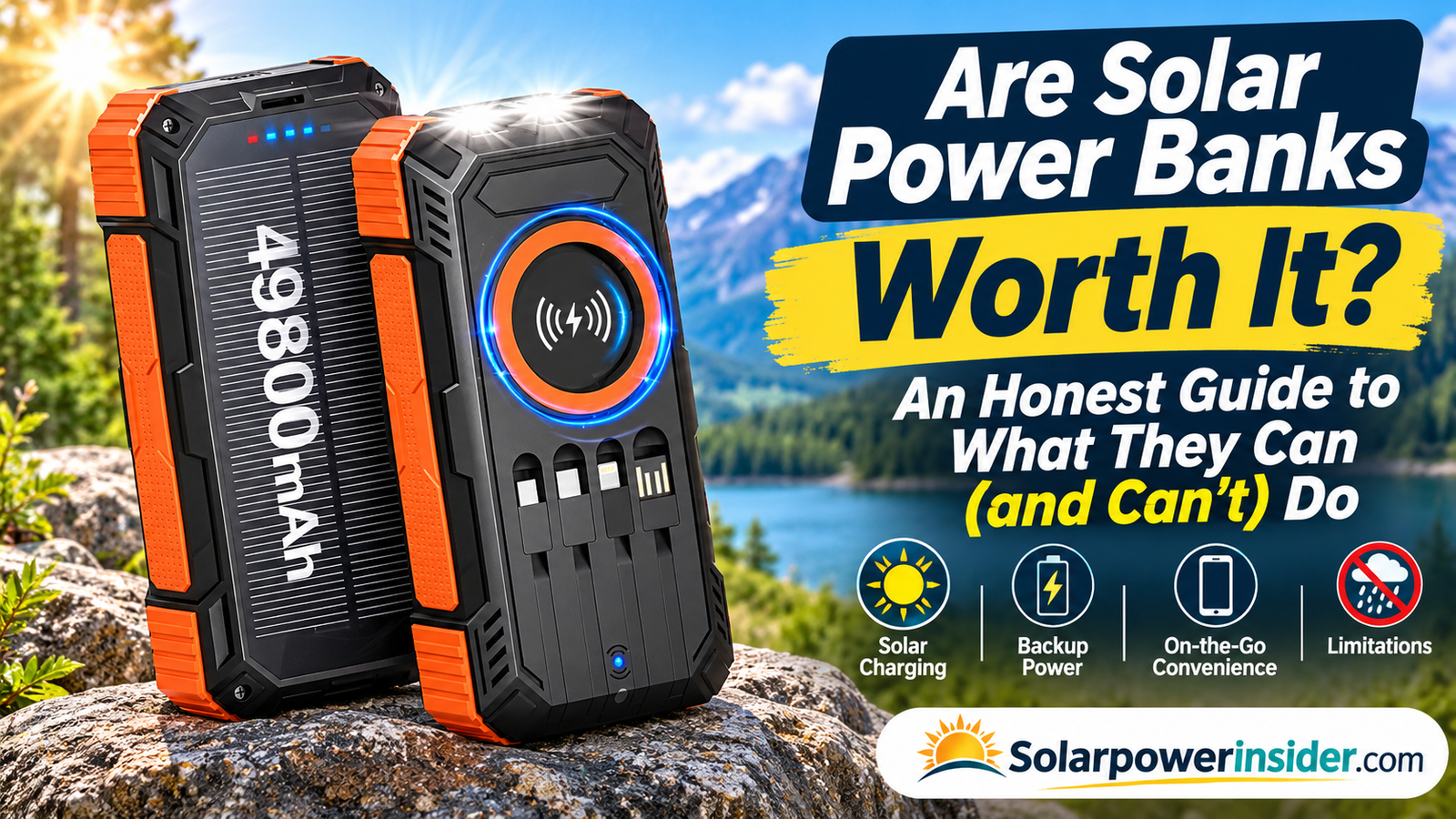
Are Solar Power Banks Worth It? An Honest Guide to What They Can (and Can’t) Do
Solar power banks promise endless free energy in your pocket. The reality is more nuanced — and more useful — than the marketing. Here is exactly who should buy one, who shouldn’t, and how to pick a unit you’ll actually be glad you own.
If you’ve spent any time browsing outdoor gear, airport electronics, or emergency-preparedness checklists, you’ve seen them: battery banks with a small solar panel glued to the face, promising to recharge themselves from sunlight forever.
The pitch is seductive. Free power, anywhere the sun shines. No wall outlet required. Endless phone charges on the trail, at the campsite, in the blackout, on the beach. And to be fair — when the product matches the use case, solar power banks are genuinely one of the most useful pieces of gear you can own.
But there is a stubborn mismatch between how these products are marketed and how they actually perform. A solar panel the size of a smartphone screen collects a fraction of the energy a wall adapter delivers. Expect a solar power bank to be your primary charging source and you’ll be disappointed. Understand it as a self-replenishing reserve battery — a slow, sun-fed top-up layered onto a normal power bank — and suddenly the value proposition becomes very clear.
This guide answers the question honestly and completely: are solar power banks worth it for the way you actually live, travel, and prepare? We’ll look at the physics without the jargon, the real-world charging math, the use cases where they shine and the ones where they don’t, the specs worth paying for, the ones that are pure marketing, durability and safety, and how to size one to your needs. By the end, you’ll know exactly what to buy — or whether to buy anything at all.
The same photovoltaic principle that runs a rooftop array also runs the small panel on a pocket-sized solar power bank — the only difference is scale.
What you’ll get from this guide
A plain-English explanation of how solar power banks work, an honest verdict on their value, a side-by-side comparison with solar chargers and portable power stations, a breakdown of the specs that matter, real use-case recommendations, care and safety guidance, and a practical buying checklist you can use before you spend a cent.
Ready to Start Shopping?
Compare today’s most popular solar power banks side by side.
Check Price on AmazonSection 01
What Exactly Is a Solar Power Bank, and How Does It Work?
Before we can judge whether something is worth buying, we need to be precise about what it is. The term “solar power bank” gets used loosely, and that vagueness is responsible for most of the disappointment people report.
A solar power bank is, first and foremost, a rechargeable battery bank — the same kind of device you’d use to top up a phone on a long flight — with a small photovoltaic panel built into the housing. The battery does the heavy lifting. The solar panel is best thought of as a slow, opportunistic trickle input that refills the battery whenever the unit happens to be sitting in the sun. Every drop of power it stores and later hands to your devices is buffered through that internal battery.
That buffering matters more than people realize. Your phone is not being powered “by the sun” in any direct sense. The sun charges the battery, and the battery charges your phone. This is why a solar power bank still works at night, still works indoors once it’s charged, and still works in the rain — and it’s also why the panel’s modest output is rarely the bottleneck you think it is.
The energy path, in plain language
Photons hit the panel and knock electrons loose in silicon cells, creating a small direct current. A charge controller — a tiny circuit board inside the housing — regulates that current so it can safely feed the lithium battery. When you plug in a device, a boost converter raises the battery’s voltage to the standard USB level and pushes power out through one of the output ports.
Each of those stages loses a little energy along the way, which is why the capacity printed on the box never equals the usable capacity you get at the other end of the cable. More on that in the specs section.
Why the panel is so small
The physics are unforgiving in a way that marketing sometimes glosses over. Solar panels produce power in proportion to their surface area and the intensity of the light hitting them. A panel the size of a playing card, angled imperfectly toward a moving sun, collects far less energy than a folding panel the size of a laptop screen — and enormously less than a rooftop array.
Put differently: the panel on a pocket-sized power bank is a convenience feature, not a power plant. It excels at replacing the trickle of energy a device draws while sitting idle, or slowly refilling the bank over a sunny afternoon on a backpack. It is not designed to fast-charge a phone from empty in an hour. Knowing this before you buy is the single biggest factor in whether you end up satisfied.
Solar power bank, solar charger, solar generator: the vocabulary problem
Three different products get blurred together in casual conversation, and it costs people money. A solar power bank stores energy in a built-in battery. A solar charger is usually just a folding panel with USB outputs and no battery — it charges devices directly, only while the sun is out. A solar generator, more properly a portable power station, is a large battery box that can run appliances and is often paired with separate folding panels.
These are three genuinely different tools. If you want the deep version of that distinction, we cover it properly in solar power bank vs. solar charger, and we look at the bigger class of gear in our guide to the best solar powered generators. For now, keep the mental model simple: battery in the middle, sun on one side, devices on the other.
Start With the Right Size
Browse solar power banks built for hiking, travel and emergency kits.
Check Price on AmazonSection 02
The Short Answer: Are Solar Power Banks Worth It?
Yes — for the right person, with the right expectations. And no, for plenty of people who would honestly be happier with something simpler.
That’s an unsatisfying answer if you want a clean verdict, but the clean version is this: a solar power bank is worth it when you need stored power away from outlets, and the ability to slowly replenish that power without a wall matters to you. If both of those things are true, the solar panel earns its place. If only the first is true, buy a regular power bank and skip the panel.
The worth-it test — four questions
- Will you be away from wall outlets for more than a day? If yes, the solar input starts to pay for itself.
- Do you carry the gear already? Weight matters on a trail; a solar panel that lives in a drawer is worth nothing.
- Are your devices small-draw? Phones, headlamps, GPS units, earbuds, cameras and drones love solar power banks. Laptops and appliances do not.
- Is resilience part of the goal? Blackouts, storms, evacuations, off-grid trips — this is where solar earns its badge.
Answer three or four “yes” answers and you’ll almost certainly be glad you bought one. Answer one or two and you’re likely paying a small premium for a panel you’ll never meaningfully use.
The insurance-policy argument
There’s a second way to judge the purchase that has nothing to do with daily use. A solar power bank is an emergency asset. It sits in a bag, a car, a boat, a go-bag, a kitchen drawer — and on the one day the grid goes down, or the flight gets cancelled, or the hike takes longer than planned, it quietly becomes the most valuable thing you own.
People evaluate gear like this on cost-per-use, and by that measure almost nothing in an emergency kit looks efficient. But we don’t buy fire extinguishers because we’ll use them weekly. A solar power bank in an emergency kit is judged not by how often it’s used but by how badly you’d want it when you need it. Judged that way, the answer is clear.
The everyday-use argument
On the other end of the spectrum, some people use one constantly: commuters who charge on a sunny windowsill, campers who set it on a rock at breakfast, contractors who work away from power all day, travelers bouncing between trains and hostels. For them, the solar panel isn’t an emergency feature — it’s a genuinely convenient trickle that keeps the bank from ever hitting zero.
If that sounds like your life, the value case is strong and the product category is worth exploring. Our roundup of the best solar power banks covers the models and configurations worth considering.
See What’s Available Now
Popular solar power banks across budget, mid-range and rugged tiers.
Check Price on AmazonSection 03
When Solar Power Banks Absolutely Make Sense
Let’s get specific. These are the situations where, in our view, a solar power bank isn’t just acceptable — it’s the right tool for the job.
Multi-day hiking and backpacking
This is the category’s home turf. On a two- to five-day trip you need to keep a phone, a headlamp, a GPS unit, and maybe a satellite messenger alive. Wall outlets don’t exist. A power bank alone will get you through if you sized it correctly, but strap a solar power bank to the top of your pack during the day and you’re recovering a meaningful amount of energy while you walk.
The key insight is that hikers don’t need fast charging — they need continuous small charging. A panel slowly feeding the internal battery over six hours of daylight, then handing that power to a phone at camp, fits the rhythm of trail life almost perfectly.
Camping, overlanding and van life
At a campsite, the solar power bank does its best work because it can be laid flat in direct sun for hours without anyone thinking about it. Campers routinely set one on the picnic table or the dashboard in the morning and find a substantially fuller battery by dinner. Add in radios, lanterns, fans and camera batteries and the case gets stronger.
Travel through unreliable power
Long bus rides, developing-region travel, festivals, remote guesthouses, and any trip where “the power is out again” is a regular sentence — this is where a self-replenishing battery earns its keep. Even a modest amount of daily sun removes the anxiety of hunting for a working outlet.
Emergency and disaster preparedness
Storm outages, wildfire smoke days with the windows shut, hurricane season, winter ice storms. When the power is out for days, the ability to recharge from a windowsill or a backyard table — however slowly — turns a finite battery into a renewable trickle. It is not a whole-home solution, but for keeping phones, radios and lights alive, it is exactly the right scale.
For people building out a more complete backup-power plan, a solar power bank is the pocket-sized entry point, and a portable power station is the next rung up. We compare those options in is a solar generator worth it, and size them in what size solar generator do I need.
Jobsites, fieldwork and outdoor events
Surveyors, photographers, market vendors, event staff, farmers — anyone spending a full day away from outlets with a phone and a couple of small devices will get real value. The solar panel won’t keep pace with heavy use, but it extends the working day, which is usually the actual goal.
Everyday carry for sunny routines
Some people simply live in the sun: cyclists, beach-goers, students who study outside, remote workers who set up on patios. If your power bank regularly sits in daylight anyway, a solar-equipped model quietly collects free energy while you work. It’s a small benefit, but it’s free, and it compounds over a season.
The common thread
Every scenario above shares two traits: you’re away from outlets, and you have time. Solar charging is a slow process that rewards patience. If your life leaves the device sitting in the sun for hours at a stretch, the panel is doing useful work.
Build Your Trail Kit
Compact solar power banks designed to clip onto a backpack.
Check Price on AmazonSection 04
When Solar Power Banks Are Not Worth It
Nothing is universally good, and an honest guide owes you the other half of the argument. Here are the situations where we’d tell a friend to spend their money differently.
You’re rarely away from an outlet
If your power bank lives in a bag for occasional commutes and weekend trips in cities, the solar panel is dead weight — literally. You’ll charge it from the wall like any other battery, and the panel will contribute almost nothing. A conventional power bank gives you more capacity for the same weight and price.
You need to recharge large devices
Laptops, portable fridges, power tools, CPAP machines, electric coolers — these draw power in a different league. A solar power bank cannot meaningfully service them. That’s portable power station territory, and the honest move is to size one properly rather than hope a pocket battery will cope. The mechanics of that larger class are covered in how does a solar powered generator work.
You expect the panel to fully refill the battery daily
This is the expectation that generates most negative reviews. A small panel in mixed light will not reliably refill a large battery every single day. What it does well is top up — recovering part of what you used, day after day, so the bank runs out far more slowly. If you need a guaranteed full recharge from sun alone, you need a larger folding panel, not a power bank with a built-in one.
Weight is your top constraint
Every gram counts on a thru-hike. If you’re counting ounces, a slim, high-efficiency power bank plus nothing else is often the smarter configuration. The solar panel adds weight and thickness you may not get back in energy over a short trip.
You live under persistent cloud or short winter days
Solar input scales with light. In deep shade, heavy overcast, or high-latitude winters, the panel’s contribution shrinks dramatically. It never stops working entirely — panels produce some output even in diffuse light — but the ratio of useful energy to carried weight drops. In those conditions, think of the panel as a bonus rather than a feature you’re paying for.
You want a “never charge it again” device
It doesn’t exist at this size, and being clear-eyed about that prevents buyer’s remorse. Even the best pocket solar power bank expects to be wall-charged before a big trip and then supported by sun along the way. If that framing bothers you, the category will bother you too.
Where solar power banks shine
- Multi-day trips away from outlets
- Slow, hands-free top-ups while you’re busy
- Emergency and blackout readiness
- Small devices: phones, lights, GPS, cameras
- Peace of mind on remote travel
Where they fall short
- Slow solar recharge in poor light
- Added weight versus a plain power bank
- Not suitable for laptops or appliances
- Marketing that overpromises panel output
- Useless if it never leaves a drawer
By the way, this trade-off isn’t unique to power banks. The same honest accounting applies to standalone panels — see our take on are solar chargers worth it for the parallel version of this argument.
Prefer Simplicity?
If you rarely leave an outlet behind, compare slim high-capacity power banks instead.
Check Price on AmazonSection 05
Solar Charging vs. Wall Charging: The Real-World Math
Numbers have a way of making this debate concrete, so let’s walk through the arithmetic in plain terms — no engineering degree required.
Think in watt-hours, not milliamp-hours
Most power banks are marketed in milliamp-hours, which sounds precise but hides the fact that milliamp-hours only tell the whole story at a fixed voltage. Watt-hours — the same unit your electricity bill uses — is the honest measure of stored energy. As a rough mental anchor, a typical smartphone battery holds somewhere around 10 to 15 watt-hours of energy. A mid-sized power bank might store several times that. A small solar panel, in good direct sun, produces a modest number of watts — often comparable to a slow USB charger — and only while the light lasts.
So the question “how long does solar take?” becomes: how much energy does the panel collect per hour of good light, versus how much did I use today?
The daily energy budget
Imagine a day of hiking where you use your phone for navigation, photos and a short call. You’ve consumed perhaps a large fraction of a phone charge. Now imagine your solar power bank spent four or five hours strapped to your pack in decent light. It has collected some meaningful fraction of what you spent — maybe half, maybe more on a brilliant day, maybe far less under tree cover.
That’s the real-world picture: solar doesn’t eliminate the need to charge, it bends the curve. Instead of your reserves falling by a full charge a day, they might fall by a third, or stay flat. Over a week, that’s the difference between carrying a bigger battery and carrying a smaller one.
| Charging Method | Speed | Where It Works | Best For |
|---|---|---|---|
| Wall outlet | Fast; the benchmark for full recharge | Anywhere with mains power | Pre-trip prep and hotel stops |
| Car / 12V outlet | Moderate; solid while driving | Vehicles, vans, boats | Road trips and overlanding |
| Built-in solar panel | Slow; a trickle that depends on light | Outdoors in direct or bright indirect sun | Daily top-ups on multi-day trips |
| Folding solar panel | Moderate; far better than a built-in panel | Outdoors with room to lay it flat | Basecamps where you need real sun-charging |
| Laptop USB-C port | Slow to moderate | Anywhere a laptop is running | Travel days and offices |
Why orientation and shade matter so much
Panel output is sensitive to the angle of the light. A panel lying flat at midsummer noon is doing its best work; the same panel at a steep winter angle or tilted away from the sun is doing a fraction of that. Shade is worse than most people think — a small patch of shadow across part of a panel can drop its output disproportionately, because cells wired in a chain are only as good as the weakest link.
The practical lesson: rotate and reposition the panel through the day, keep it clean, and don’t bury it under a mesh pocket or a jacket. Small habits like this are worth more than a marketing spec sheet.
The honest expectation to set
Set your expectations at “meaningful daily recovery” rather than “full recharge from the sun.” With that mindset, the device performs. Without it, almost any solar power bank on the market will disappoint you — and the problem will be the expectation, not the product.
Compare Solar Power Banks
Look at capacity, panel design and output options side by side.
Check Price on AmazonSection 06
Solar Power Bank vs. Solar Charger vs. Portable Power Station
These three categories overlap so much in marketing language that buyers routinely order the wrong one. Here’s the clean comparison, then guidance on choosing.
| Feature | Solar Power Bank | Solar Charger (panel only) | Portable Power Station | Solar Generator Kit |
|---|---|---|---|---|
| Stores energy? | Yes, built-in battery | No; passes power straight through | Yes, large battery | Yes, large battery plus panels |
| Works at night? | Yes | No | Yes | Yes |
| Powers small devices | Excellent | Good while sun is out | Excellent | Excellent |
| Powers appliances | No | No | Yes, model dependent | Yes, model dependent |
| Portability | Pocket or pack | Folds flat, very light | Carried by handle | Vehicle-based |
| Recharge from sun | Slow but convenient | Direct, moderate | With added panels | Designed for it |
| Ideal user | Hikers, travelers, emergency kits | Ultralight users with a small battery | Campers, home backup, remote work | Off-grid homes, long outages |
Who should buy which
Buy a solar power bank if your devices are small, your trips are measured in days, and you want one device that stores and slowly refills energy. It’s the simplest, most forgiving option and the one most people actually need.
Buy a standalone solar charger if you already own a good power bank, you travel ultralight, and you want maximum panel area for minimum weight. Pairing a folding panel with a slim battery is a classic, highly efficient setup — see our picks for the best solar chargers.
Buy a portable power station if you need to run anything beyond USB devices — a laptop all weekend, a CPAP machine, lights, a fan, a fridge. The step-up models from the major brands cover a wide range of needs: the Bluetti EB3A review covers a compact entry point, while units like the Goal Zero Yeti 500X review and the EcoFlow River 2 Pro review sit in the popular middle of the market.
Buy a full solar generator kit if you’re planning for extended outages or genuine off-grid living, where panels are sized to the battery and the whole system is designed to run together. Our comparison of the big three brands in Bluetti vs. Jackery vs. EcoFlow is a good place to orient yourself.
Where the line sits in practice
Most people end up owning two tiers: a solar power bank for daily and travel use, and a portable power station for the house, the van, or the big camping trips. That combination covers almost everything. Models like the Jackery Explorer 1000 review, the EcoFlow Delta 2 review, the Bluetti AC200 Max review, the Anker 767 PowerHouse review and the Goal Zero Yeti 1500X review all represent that larger tier, and any of them pairs well with a pocket solar power bank in the daypack.
Not Sure Which Category You Need?
Compare solar power banks against folding panel chargers first.
Check Price on AmazonSection 07
The Specs That Actually Matter When You Buy
Product pages are full of numbers, and not all of them are useful. Here is the shortlist worth reading closely, and the ones you can skim.
Capacity — and the honest version of it
Capacity is the headline spec, usually in milliamp-hours. Two things are worth knowing. First, converting between milliamp-hours and watt-hours depends on the battery’s voltage, so comparisons across different products can be misleading. Second, real-world usable capacity is always lower than the number on the box, because converting battery voltage up to USB voltage loses energy to heat and circuitry.
As a working rule: expect to get somewhat less than the rated capacity out of the port. The better the electronics and the newer the battery, the closer it lands to the label. This is normal and applies to every battery product on the market, not just solar models.
| Capacity Tier | Typical Real-World Use | Weight Feel | Best Suited To |
|---|---|---|---|
| Small | One to two phone top-ups, plus a headlamp or earbuds | Pocketable | Day hikes, festivals, commuting |
| Medium | Several phone charges or a couple of days of mixed small-device use | Pack-friendly | Weekend camping, travel, everyday carry |
| Large | A week of small-device top-ups with solar support | Noticeable in a daypack | Multi-day trips, emergency kits, extended travel |
| Oversized | Approaching power-station territory; best paired with larger panels | Heavy; better staged than carried | Basecamps, vehicles, home backup |
Panel size, cell type and efficiency
Panel area is the biggest lever on solar performance. All else equal, a physically larger panel collects more energy. Cell construction matters too: modern monocrystalline cells are the norm, and higher-quality laminates resist yellowing and micro-cracking over time. If two products are similar in size but one is dramatically cheaper, the panel is often where the compromise lives.
Output ports and charging protocols
Count the outputs you’ll realistically use simultaneously: a phone charging overnight while a headlamp battery tops up is a common scenario. USB-C is now the standard for modern phones and accessories, and support for fast-charging protocols makes a real difference to how quickly a device recovers during a short stop. If you plan to charge a laptop occasionally, look for higher-output USB-C delivery — and temper your expectations, since that use drains any portable battery quickly.
Pass-through charging
This is the ability to charge the power bank and a connected device at the same time. It’s useful at airports and in cars, where outlet time is limited. Not every model supports it well, and charging speed is usually shared across both paths, so treat it as a convenience rather than a performance feature.
Build quality and weather resistance
Look for a housing that feels dense rather than hollow, ports that are protected by covers, and a stated level of water and dust resistance. A rugged shell matters more than it sounds if the unit will live on the outside of a pack. More on this in the durability section.
Weight, thickness and attachment
A solar power bank you leave at home is worth zero. Check the weight and the thickness against the bag you’ll actually carry. Carabiner loops, textured grips and a flat back that sits stable on a rock or dashboard are small details that determine whether the panel ever gets used.
Indicators, extras and warranty
A clear charge-level indicator is genuinely useful on multi-day trips. Built-in flashlights are common and occasionally handy in a pinch. Compasses, carabiners and the like are decoration. What actually matters at the end of the list is the manufacturer’s warranty and the availability of support, because this is a device that will be dropped, rained on and left in hot cars.
The three specs to prioritise
If you only read three things: usable capacity, panel area, and output options. Everything else is refinement. Get those right and the product will serve you well regardless of the brand name on it.
Shop by Capacity
Filter solar power banks by the capacity tier that matches your trips.
Check Price on AmazonSection 08
Real-World Use Cases: Trail, Travel, Home and Emergencies
Specs are abstract. What convinces people is hearing how a device behaves in the specific situation they’re buying it for. Here’s how solar power banks hold up across the four lives they get used in.
On the trail
Strapped to the top of a pack, panel facing skyward, the unit charges while you walk. The habit that makes this work is simple: clip it on in the morning, not at lunch. By the time you stop to eat, it’s already banked several hours of light. At camp, you transfer that energy to your phone and headlamp overnight.
Two trail tips. First, don’t bury it in a mesh pocket where fabric shades the panel. Second, if you stop for more than twenty minutes in open sun, lay it flat and re-angle it — those micro-adjustments add up over a week.
Traveling
Airport layovers, overnight trains, hostel dorms with one working socket, long bus journeys through regions where power is intermittent. A solar power bank takes the pressure off finding an outlet, and if you’re traveling in sunny climates, a windowsill or balcony rail becomes a free charging station. If you’re weighing a battery-only alternative, the difference comes down to how often you’ll be somewhere the sun can reach it.
At home and in the garden
It sounds modest, but plenty of people keep one on a sunny windowsill to support outdoor devices — wireless security cameras, garden sensors, solar lights’ battery replacements, or a phone used while gardening. The overlap with other solar gear is real; if you’re already running outdoor solar devices, it’s worth understanding how that ecosystem works, starting with how do solar lights work.
Emergency and blackout readiness
This is where the emotional case for the purchase lives. When the grid drops, the priorities become communications, light and information. A solar power bank handles all three: keep a phone charged to call for help or check alerts, run a headlamp or lantern through the evening, and recharge from a window during the day so the reserve never fully empties.
The practical setup is unglamorous: charge it fully, store it with a short cable, and check it a couple of times a year. For households building out from there, the natural next step is a portable power station sized to essentials — worth reading about if you want to keep a fridge running through an outage, which we address directly in can a solar generator run a refrigerator.
Work, events and long days outdoors
Photographers running mirrorless batteries, market vendors with card readers, festival staff on radios, contractors with cordless accessories — the pattern is the same. Devices are small, the day is long, and outlets are nowhere near. A solar power bank on the tailgate or the equipment case quietly keeps the day going.
One habit worth building
Charge the unit fully before you leave, then treat solar as your safety net rather than your plan A. Users who do this rarely think about their power at all — which is exactly how good gear should behave.
Kit Out for Emergencies
Rugged, water-resistant solar power banks built for go-bags and vehicles.
Check Price on AmazonSection 09
Durability, Weather Resistance and How Long They Last
A solar power bank lives a harder life than most electronics. It gets clipped to packs, dropped on rocks, left on dashboards and stuffed into damp bags. Build quality isn’t a luxury here; it’s the difference between a five-year companion and a two-trip disappointment.
Understanding water and dust resistance
Look for a stated IP rating rather than the word “waterproof,” which means very little on its own. The two digits tell you the level of protection against solids and liquids respectively. A rating that covers dust ingress and low-pressure water jets is genuinely reassuring for outdoor use. Even so, “resistant” is not “submersible” — no portable power bank should be dropped in a stream or used in heavy rain while ports are open.
Heat is the quiet battery killer
Lithium batteries dislike heat more than almost anything else. A black power bank left on a car dashboard in summer, or cooking in direct sun all afternoon at a desert campsite, will degrade faster than one kept in the shade. The irony is real: the solar panel wants sun, the battery wants moderation. The solution is to charge in the sun and store in the shade, and to avoid leaving the unit in a parked vehicle.
Cold weather behaviour
Cold doesn’t destroy batteries the way heat does, but it does temporarily reduce available capacity and slow charging. Keep the unit inside a jacket pocket or a sleeping bag overnight in freezing conditions and it will perform far better than one left on a frozen tent floor. Cold-morning recovery is usually instant once the device warms up.
Cycles and long-term capacity
All rechargeable batteries lose capacity over hundreds of charge and discharge cycles. It’s gradual and usually invisible until, one season, you notice the reserve doesn’t seem as deep as it used to be. That’s normal aging, not a defect, and it applies equally to power stations — if you’re curious about the larger scale of that question, we cover it in how long does a solar generator last.
| Habit | Effect on Battery Health | What to Do Instead |
|---|---|---|
| Leaving it fully drained for weeks | Accelerates ageing and deep-discharge stress | Store around half to three-quarters charge |
| Storing it hot (cars, attics, direct sun) | The single biggest source of permanent capacity loss | Store cool, dry and out of sunlight |
| Leaving it at 100% for months | Adds unnecessary voltage stress | Top up occasionally rather than permanently keeping it full |
| Charging a device and the bank in extreme heat | Compounds thermal stress | Charge in shade when temperatures are high |
| Keeping ports open in rain or dust | Risks corrosion and circuit damage | Close port covers and dry the unit before use |
Panel durability
Front laminates scratch, yellow and craze over years of sun exposure. Higher-quality materials resist this far better. In practice, keeping the panel face out of keys and grit in a bag, wiping it with a soft cloth, and not flexing it beyond its design all extend its useful life meaningfully.
Look for Rugged Build Quality
Water-resistant, dust-sealed solar power banks made for real outdoor use.
Check Price on AmazonSection 10
Cost and Value: What You Really Get for Your Money
Value isn’t just the number on the receipt. It’s what the device replaces, prevents and enables over the years you own it. Let’s look at it from a few angles.
Compared with a plain power bank
A solar power bank typically asks a modest premium over a battery-only bank of similar capacity. For that premium you get a slow, free, off-grid trickle of energy. If you’ll use it, that’s excellent value; if you won’t, you’ve paid extra for weight. The honest comparison isn’t “which is cheaper” but “how many days a year will I be somewhere the sun is more available than a socket.”
Compared with buying disposable batteries
People running headlamps, lanterns, radios and cameras on single-use batteries spend real money over a season without thinking about it. A rechargeable setup powered from a solar bank flips that cost into a one-time purchase. The environmental argument runs parallel: fewer cells into landfill, less packaging, less waste on the trail.
Compared with a portable power station
A power station is a far larger purchase and a far larger device. If your needs genuinely stop at phones and small accessories, the solar power bank delivers the same outcome for a fraction of the cost and weight. The step up only makes sense when your device list includes something bigger — and at that point, the value calculation shifts decisively toward the larger unit.
| Option | What You Pay For | Ongoing Cost | Best Value When |
|---|---|---|---|
| Solar power bank | Battery plus a small self-replenishing panel | Essentially none after purchase | You’re regularly away from outlets |
| Standard power bank | Capacity and fast charging only | None, but it must be wall-charged | You’re near mains power most days |
| Disposable batteries | Convenience in the moment | Constant repurchasing and waste | Rare, single-use situations |
| Portable power station | Large stored capacity and high output | Panel purchases if you want solar input | You need to run more than USB devices |
| Full solar generator kit | A matched battery-and-panel system | Panel and expansion upgrades over time | Extended outages or off-grid living |
Hidden costs worth counting
Very few, honestly. You may want a short cable that lives with the unit, a carabiner if none is included, and a dry bag for wet climates. Beyond that, the cost of ownership is mostly the discipline to keep it charged and stored sensibly — which is free.
Resale and second life
A well-cared-for solar power bank ages gracefully and often gets handed down to a family member, kept as a permanent car accessory, or demoted to the emergency kit when a newer one arrives. That second life is where a lot of the value quietly accumulates.
For readers who are also weighing the larger investment, our broader guide to solar generator vs. gas generator puts the whole home-power question in context.
Get the Most for Your Budget
Compare well-reviewed solar power banks across price tiers.
Check Price on AmazonSection 11
Safety, Battery Care and Air Travel Rules
Solar power banks are extremely safe when treated with ordinary care. They are, after all, lithium batteries — and the small amount of respect those require is worth understanding rather than fearing.
The basics of lithium battery care
Keep the unit away from sustained heat, don’t puncture or crush it, don’t expose it to open flame, and stop using any device that is visibly swollen, leaking, unusually hot, or damaged. These are simple rules that apply to every phone, laptop and battery product in your life, and following them means you will almost certainly never have an issue.
Charging habits that keep batteries healthy
- Avoid extremes. Both long-term full charge and long-term empty storage are harder on a battery than a comfortable middle.
- Keep it cool. Charge in the shade on very hot days, and never leave it baking on a dashboard.
- Use decent cables. Cheap, damaged cables are a common source of heat and poor connections.
- Don’t charge unattended on flammable surfaces. A hard, flat, ventilated spot is ideal — the same advice you’d give for any battery.
- Check it periodically in storage. A quick look every few months keeps it ready and healthy.
Flying with a solar power bank
Power banks travel in carry-on luggage, never in checked baggage — that rule is consistent across most airlines and aviation authorities because a thermal event in the hold is far harder to manage than one in the cabin. Most carriers follow a widely used watt-hour threshold below which batteries travel without special approval, with a limited allowance above it. Rather than quote a rule that may change, the sensible approach is to check your airline’s current lithium battery policy before you fly, and to make sure the capacity marking on your unit is legible.
Water, dust and kids
Water resistance protects against splashes and rain, not immersion. Dry the unit thoroughly before charging, and keep port covers closed when not in use. Store out of reach of small children and pets, and don’t let anyone use a damaged unit — that advice is universal and non-negotiable.
Disposal and end of life
When a power bank finally retires, it shouldn’t go in household waste. Most municipalities and electronics retailers offer lithium battery recycling; a quick local search will find a drop-off point. It’s a small effort that keeps heavy metals and reactive materials out of landfill.
Two safety rules that solve 95% of problems
Keep it out of sustained heat and retire anything damaged. Almost every reported battery incident traces back to one of these two. Follow them and you’ll use the device for years without a second thought.
Section 12
How to Choose the Right One (and the Mistakes to Avoid)
Everything above converges here: a practical, step-by-step way to pick a unit you’ll be happy with.
Step one: list your devices
Write down what you’ll actually charge. Phones, headlamps, earbuds, GPS units, cameras, a drone battery, a lantern, a fan. If the list includes a laptop or anything that plugs into a wall, you’ve left solar power bank territory and should be looking at a portable power station instead. Our sizing guide for that step is what size solar generator do I need.
Step two: count your days away from outlets
One day away from power is a normal power bank problem. Three or more days, repeatedly, is a solar problem. The longer the trip and the more frequently you take it, the more the solar panel earns its place in the design.
Step three: pick a capacity tier, not a specific number
Choose the tier that matches your use — small for day trips, medium for weekends, large for extended travel and emergency kits — then compare products within that tier on panel quality, outputs and build. Getting hung up on precise milliamp-hour figures rarely changes the outcome; getting the tier wrong does.
Step four: weight-check against the bag you’ll carry
Hold the product’s weight against your actual pack. If it changes what else you bring, or if you suspect you’ll leave it behind on lighter trips, size down. A smaller unit that travels with you beats a larger one that doesn’t.
Step five: read for panel and build, not slogans
Ignore phrases like “infinite power” and “unlimited charging.” Look instead for panel material, stated water and dust resistance, port covers, a clear charge indicator, and a warranty from a brand that answers support emails.
| What to Check | What Good Looks Like | Why It Matters |
|---|---|---|
| Usable capacity | Matches your trip length with some margin | Determines whether you run out on day three |
| Panel area and material | The largest, best-laminated panel you can carry | Drives how much free energy you recover daily |
| Output ports | At least one modern USB-C alongside standard USB | Keeps the unit useful as your devices change |
| Water and dust resistance | A stated rating plus covered ports | Survives real weather and trail life |
| Weight and thickness | Comfortable in the bag you actually use | Gear left at home has zero value |
| Warranty and support | A brand with a clear warranty policy | Covers the years of hard use ahead |
Mistakes to avoid
- Buying for the fantasy rather than the use case. If you’ll mostly charge at home, buy the simpler product.
- Assuming the panel refills the unit daily. Plan for top-ups, not miracles.
- Oversizing for a single trip. A heavy bank you resent carrying becomes a bank you leave behind.
- Ignoring cable quality. A bad cable wastes more energy than a good panel collects.
- Storing it empty and forgotten. Give it a quick check a few times a year.
- Skipping the manual. Charging inputs, port behaviour and indicator patterns vary more between models than people expect.
When to scale up instead
If your list of devices keeps growing — a laptop, a fridge, a fan, medical equipment, workshop tools — the right answer is a portable power station rather than an oversized power bank. Popular models worth researching include the EcoFlow Delta 2, the Jackery Explorer 1000, the Bluetti AC200 Max and the Goal Zero Yeti 1500X, all of which we’ve written up in depth. Understanding the underlying technology first — see how does a solar powered generator work — makes those comparisons far easier to judge.
Found Your Match?
Compare current solar power banks and pick the one that fits your trips.
Check Price on AmazonFrequently Asked Questions
Are solar power banks worth the money?
For most people who spend time away from wall outlets — hikers, campers, travelers and anyone assembling an emergency kit — yes. The solar panel turns a finite battery into one that recovers energy outdoors, which is genuinely valuable on multi-day trips. If you’re almost always near a socket, a standard power bank is the better value, since the panel would rarely do useful work.
How long does it take to recharge a solar power bank in sunlight?
It depends heavily on panel size, sunlight intensity and angle. Think in terms of hours of good direct light for a partial recovery, and considerably longer for a full one. The practical approach is to leave it in the sun through the day while you’re active, rather than expecting a fast recharge during a short break.
Do solar power banks work on cloudy days?
They work, but output drops noticeably. Panels produce energy from diffuse light as well as direct sun, so an overcast day still contributes something — just much less. In consistently grey or heavily shaded environments, treat the solar input as a bonus rather than a reliable source.
Can a solar power bank charge a device and recharge from the sun at the same time?
Many models support some form of pass-through operation, but behaviour varies between products and charging is often slower in both directions. It’s best treated as a convenience feature for travel days rather than a performance one, and worth confirming in the product’s own documentation.
Can a solar power bank charge a laptop?
Some higher-output models with USB-C power delivery can give a laptop a partial charge, but it will drain the power bank quickly and most solar panels cannot keep up with that demand. For regular laptop use away from outlets, a portable power station is the appropriate tool.
Are solar power banks allowed on planes?
They travel in carry-on baggage rather than checked luggage, which is a near-universal rule. Most airlines also apply a watt-hour threshold for lithium batteries, with allowances above it requiring approval. Because policies do change, check your specific airline’s current battery rules before you fly and make sure your unit’s capacity marking is readable.
How long do solar power banks last?
With normal care, most owners get several years of solid service before noticing meaningful capacity loss. Batteries age with every charge cycle and age faster in heat, so storing the unit cool and avoiding full discharge over long periods extends its life considerably.
What size solar power bank do I need for camping?
For a weekend of phone, headlamp and camera charging, a medium-capacity unit is usually comfortable. Add capacity for each additional day and each additional device, and remember that sunny campsite time helps recover energy daily. If you’re running anything bigger than USB devices, look at a power station instead.
Are solar power banks waterproof?
Some are water and dust resistant to a stated rating, and many are not at all. “Waterproof” on a marketing page is not a standard — look for an IP rating and covered ports. Even with protection, avoid immersion and dry the unit before charging.
Is a solar power bank better than a standalone solar charger?
They solve different problems. A solar power bank stores energy and works day or night; a standalone charger is lighter and usually collects more energy per hour but only works in the moment. Many experienced users pair a folding panel with a slim battery for the best of both, and we cover that comparison in depth in solar power bank vs. solar charger.
Do solar power banks need direct sunlight?
Direct sun gives the best results, but they will collect energy in bright indirect light too. Avoid shade, glass with coatings, and any covering over the panel. Re-angling the unit toward the sun through the day is one of the simplest ways to improve what it collects.
Can a solar power bank run a refrigerator or medical equipment?
No, and it’s important not to plan around that. Refrigerators, CPAP machines and similar devices need the output and capacity of a portable power station. We cover the fridge question specifically in can a solar generator run a refrigerator, which is the right place to start if that’s your goal.
Still Deciding?
Browse today’s solar power banks and compare the details that matter.
Check Price on AmazonConclusion: So, Are Solar Power Banks Worth It?
They are — with the right expectations, in the right hands. A solar power bank is not a magic energy source, and any product claiming otherwise is selling you a story. What it actually offers is more useful than the story: a genuinely portable battery that quietly refills itself whenever the sun cooperates, so your devices stay alive longer, your trips go further, and your emergency kit stays ready without you babysitting it.
If your life includes multi-day trips away from outlets, travel through places where power is unreliable, long days outdoors with small devices, or a quiet corner of the house where preparedness matters — buy one and don’t look back. Charge it fully before you go, keep it out of the heat, let the panel do its slow work during the day, and it will repay you many times over.
If instead your power bank lives in a drawer between commutes and city weekends, spend the premium on capacity rather than a panel. You’ll get more of what you actually use.
And if your ambitions run bigger — laptops, fridges, whole-home backup, real off-grid capability — the solar power bank is the perfect first step into an ecosystem that scales all the way up. Start with a best solar powered generator roundup to see where the ceiling is.
Ready to Pick Yours?
Take the checklist from this guide, match a capacity tier to your trips, and compare the solar power banks available today. The right one is out there — and once it’s clipped to your pack, you’ll wonder how you managed without it.
Check Price on AmazonYou May Also Like
More guides and reviews from Solar Power Insider to keep building out your off-grid setup.
Solar Power Bank vs. Solar Charger
Which portable solar setup actually fits the way you travel and camp?
Read the guide Buyer’s GuideBest Solar Chargers
Folding panels and portable chargers worth carrying on your next trip.
Read the guide Honest AnswerAre Solar Chargers Worth It?
The other half of this debate — standalone panels, weighed honestly.
Read the guide Buyer’s GuideBest Solar Power Banks
Our top picks across budget, mid-range and rugged categories.
Read the guide ExplainerHow Does a Solar Powered Generator Work?
Panel, charge controller, battery, inverter — the full energy path explained.
Read the guide SizingWhat Size Solar Generator Do I Need?
Match capacity and output to the devices you actually want to run.
Read the guide Honest AnswerIs a Solar Generator Worth It?
When a portable power station earns its price — and when it doesn’t.
Read the guide LongevityHow Long Does a Solar Generator Last?
Battery cycles, degradation and the habits that extend service life.
Read the guide ComparisonSolar Generator vs. Gas Generator
Noise, fuel, maintenance and runtime — the trade-offs side by side.
Read the guide PracticalCan a Solar Generator Run a Refrigerator?
Surge, runtime and the sizing math behind keeping food cold.
Read the guide Buyer’s GuideBest Solar Powered Generators
The complete roundup for home backup, camping and off-grid use.
Read the guide Brand BattleBluetti vs. Jackery vs. EcoFlow
How the three biggest portable power station brands compare.
Read the guide Brand BattleGoal Zero vs. Jackery
Two household names in portable power, compared honestly.
Read the guide ReviewJackery Explorer 1000 Review
A popular mid-size power station for camping and home backup.
Read the review ReviewJackery Explorer 2000 Plus Review
A high-capacity expandable unit for longer outages and bigger loads.
Read the review ReviewEcoFlow Delta 2 Review
A fast-charging, expandable power station built for everyday backup.
Read the review ReviewEcoFlow River 2 Pro Review
A compact, travel-friendly station that punches above its size.
Read the review ReviewEcoFlow Delta Pro Ultra Review
Whole-home backup thinking in a scalable solar power system.
Read the review ReviewBluetti AC200 Max Review
An expandable mid-size station with serious off-grid ambitions.
Read the review ReviewBluetti AC500 Review
A high-output modular system aimed at home backup users.
Read the review ReviewBluetti EB3A Review
A small, affordable entry point into portable power stations.
Read the review ReviewAnker 767 PowerHouse Review
A robust high-capacity station from a trusted charging brand.
Read the review ReviewGoal Zero Yeti 1500X Review
A refined, app-connected station for camping and home backup.
Read the review ReviewGoal Zero Yeti 500X Review
A portable mid-size unit sized for weekend trips and short outages.
Read the review Buyer’s GuideBest Solar Lights for Garden
Path lights, spotlights and string lights that actually last.
Read the guide ExplainerHow Do Solar Lights Work?
Panel, sensor, battery and LED — the simple science behind them.
Read the guide LongevityHow Long Do Solar Lights Last?
What determines lifespan, and how to squeeze more seasons from them.
Read the guide TroubleshootingWhy Do My Solar Lights Stop Working?
The most common causes and the fixes that usually solve them.
Read the guide ReviewRing Solar Pathlight Review
Smart, solar-powered path lighting for connected homes.
Read the review Buyer’s GuideBest Solar Security Cameras
Wired-free surveillance that keeps running on daylight.
Read the guide Honest AnswerAre Solar Security Cameras Any Good?
Where they shine, where they struggle, and what to expect.
Read the guide ReviewRing Stick Up Cam Solar Review
An indoor-outdoor camera paired with a solar charging accessory.
Read the review ReviewEufy SoloCam S340 Review
A dual-lens solar camera aimed at cord-free home security.
Read the review ComparisonReolink vs. Arlo vs. Eufy Solar Cameras
Three popular ecosystems compared across features and fit.
Read the guide Buyer’s GuideBest Solar Pool Heater
Extend your swimming season without extending your energy bill.
Read the guide Honest AnswerDo Solar Pool Heaters Really Work?
Climate, sizing and expectations — the realistic performance picture.
Read the guide Buyer’s GuideBest Balcony Solar System
Compact plug-in solar setups for apartments and small spaces.
Read the guide Buyer’s GuideBest Solar Attic Fan
Ventilation options that cool your attic on sunlight alone.
Read the guide Honest AnswerDo Solar Attic Fans Really Work?
What they can realistically change in your home’s temperature.
Read the guide