Solar Power Buying Guide
Solar Power Bank vs Solar Charger: Which One Actually Keeps Your Devices Alive?
One stores the sun’s energy for later. The other converts it in the moment. Here is exactly how they differ, where each one shines, and how to pick the right setup for travel, hiking, emergencies, and everyday carry.
Two Solar Gadgets, One Confusing Aisle
Search for a way to charge your phone with sunlight and you will immediately run into two products that sound almost identical: the solar power bank and the solar charger. They share the same vocabulary, the same glossy marketing photos of panels pointed at a blue sky, and in some cases a suspiciously similar price tag. Yet they solve genuinely different problems, and buying the wrong one is one of the most common outdoor gear regrets people report.
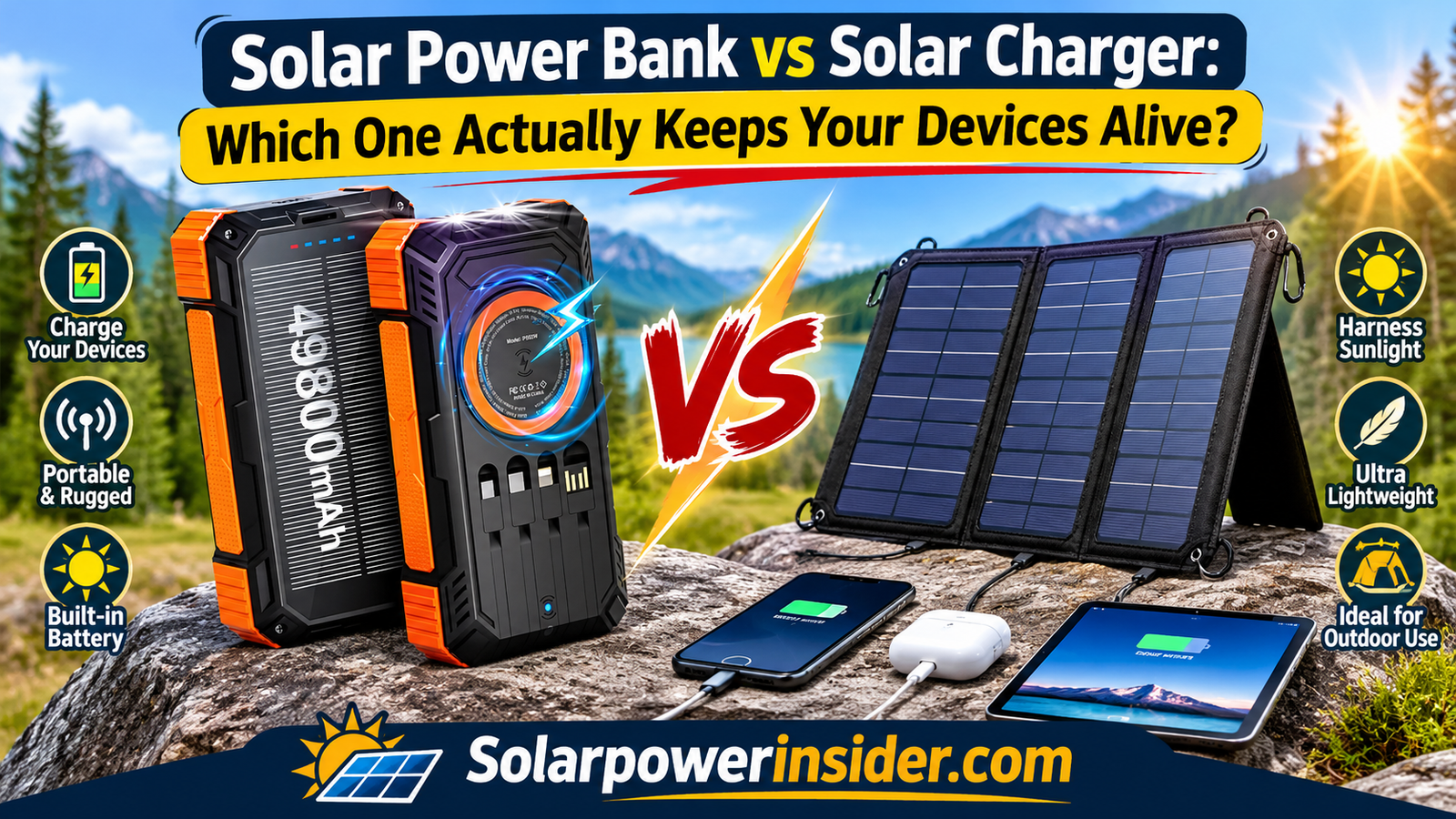
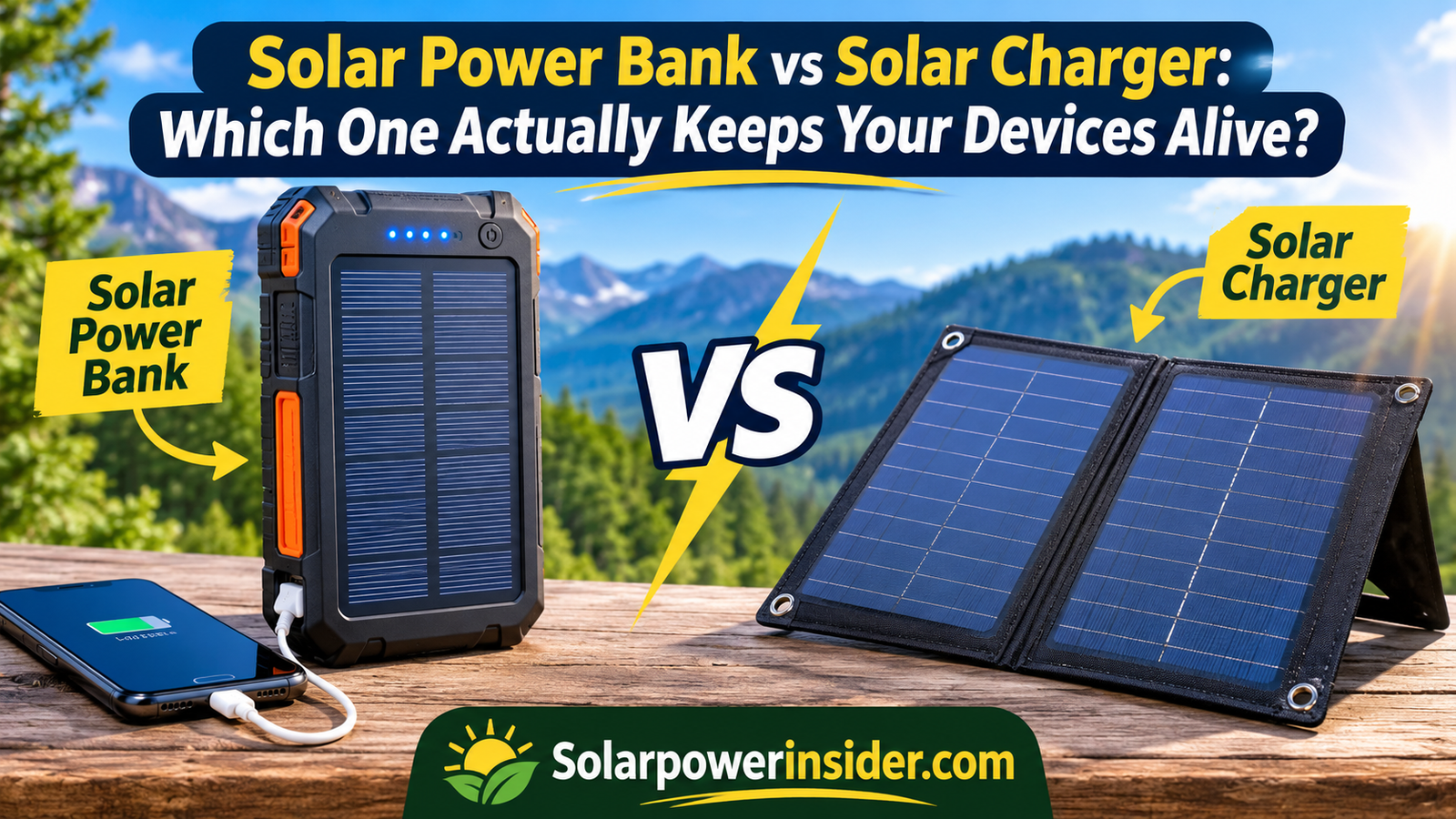
The core difference is simpler than the marketing suggests. A solar power bank is a battery with a small solar panel attached. It stores electrical energy now so you can use it later, in the dark, on a plane, inside a tent, or at 2 a.m. when the power has been out for six hours. A solar charger is a panel — and nothing else. It converts sunlight into electricity in real time and passes that electricity straight to whatever you plug in. No sun, no power. Add a battery and it becomes a power bank. Leave the battery out and it stays a charger.
That single distinction — store versus stream — cascades into everything else: how much each one weighs, how fast it charges your devices, how it behaves in bad weather, what it costs per usable watt, and how long it survives being stuffed in a backpack. This guide walks through all of it in plain language, with the numbers you actually need and the marketing fluff stripped away.
Who This Guide Is For
Maybe you are building a weekend hiking kit and every gram matters. Maybe you are assembling a home blackout box and you want something that still works when the grid does not. Maybe you travel for work, live out of a carry-on, and need power in airports, hostels, and rental cars. Or maybe you have already bought one of these devices, discovered it does not do what you expected, and you are trying to figure out what you actually need. All four of those situations lead to different answers, and this article is built so you can jump straight to the part that matters to you.
If you want the very short version before we dig in: solar power banks win on convenience and predictability; solar chargers win on raw output, weight efficiency, and long off-grid trips. The rest of this guide explains why that sentence is true, and when it stops being true.
And if your power needs keep growing past phones and headlamps — a mini-fridge, a CPAP machine, a power tool, a sump pump — you are leaving the world of handheld solar entirely and entering the world of portable power stations. We will cover where that line sits in our guide to the best solar-powered generators, because plenty of people buy three small devices before realizing one mid-size station would have been cheaper and simpler.
Start With the Right Gear
Browse today’s most popular solar power banks and portable panels.
Check Price on AmazonQuick Comparison: Solar Power Bank vs Solar Charger at a Glance
Before the deep dive, here is the side-by-side view. Read down the left column for the thing you care about most, then see which device handles it better and why. The final column gives you a plain-English verdict, and each category links straight to the relevant Amazon search results.
| What Matters | Solar Power Bank | Solar Charger | Verdict & Where to Buy |
|---|---|---|---|
| Primary function | Stores energy in an internal battery for later use | Converts sunlight to power and delivers it immediately | Most Versatile Power bank wins for everyday carry Check Power Banks |
| Works in the dark | Yes — stored energy is available anytime | No — output stops when sunlight stops | Clear Win Power bank, by definition |
| Weight per usable charge | Heavier — the battery adds bulk to every trip | Lighter over long trips — the sun does the storing | Clear Win Charger for multi-day routes Check Solar Chargers |
| Charging speed | Predictable, often fast from the stored battery | Variable — depends entirely on sun angle and sky | Power bank for consistency; charger for peak sun |
| Best trip length | Weekends, day trips, commuting, travel days | Long expeditions, base camps, extended off-grid stays | Match the trip, not the gadget |
| Weather tolerance | Battery dislikes heat, cold, and moisture | Panels tolerate weather better; electronics still need care | Charger edges ahead outdoors |
| Typical price behavior | You pay for both panel and battery capacity | You pay for panel quality and output only | Compare cost per usable charge, not sticker price |
| Who should skip it | Ultra-light hikers counting every gram | Anyone who charges mostly at night or indoors | Honest self-assessment beats feature lists |
Category-level comparison. Individual models vary widely in capacity, output, weather resistance, and build quality, so treat these as the default tendencies rather than absolute rules.
See Both Categories Side by Side
Compare current models, sizes, and output ratings in one place.
Check Price on AmazonSolar Power Banks 101: What You Are Actually Buying
Strip away the packaging and a solar power bank is a lithium battery pack — the same technology as any phone charger you have owned — with one or more small photovoltaic cells laminated onto the outside. The battery is the point. The panel is a bonus.
That framing matters because it explains almost every behavior you will observe in the field. A solar power bank will charge your phone in a tent at midnight, because the energy was stored hours earlier. It will also charge slowly from sunlight compared with a dedicated panel, because the cells glued to its surface are small and the internal charging circuitry is tuned for safety rather than speed. Both of those facts come from the same design decision.
The Battery Is the Product
When shopping, the number that dominates the spec sheet is capacity, usually printed in milliamp-hours or watt-hours. Watt-hours are the more useful figure because they let you compare across voltages; milliamp-hours are usually quoted at the battery’s internal voltage, which makes large packs look more impressive than they are. If you see only milliamp-hours, look for the watt-hour figure in the fine print before you compare two products.
Capacity is not the same as usable capacity. Energy moves through voltage conversion and circuitry, and some is lost as heat along the way. A pack that looks like it should charge your phone four times might realistically deliver three full charges after accounting for conversion losses and the fact that phones rarely drain to absolute zero. Plan on getting meaningfully fewer cycles than the marketing math suggests.
The Panel Is an Emergency Top-Up
Most solar power banks carry a panel measured in single-digit watts. In full, direct, high-altitude sunlight with perfect orientation, that panel can return a meaningful amount of energy over a long day. In a forest, behind a car window, on a partly cloudy afternoon, or clipped to a moving backpack, output drops dramatically — sometimes to a trickle. This is the single most misunderstood thing about the product category, and it is worth repeating: the solar panel on a power bank is best thought of as a slow emergency refill, not a primary charging method.
None of that makes the panel useless. On a week-long trip where you have a few hours of sun each day, the panel can stretch stored capacity noticeably. In a genuine emergency where the grid is down and you have no other source, a slow charge is infinitely better than no charge. Just set expectations correctly before you rely on it.
Build Features Worth Paying Attention To
Multiple Output Ports
Lets you top up a phone and a headlamp at once, or share power with a companion.
Pass-Through Charging
The ability to charge the bank while it charges your device — handy, but it generates more heat.
Integrated Cables
Built-in cables reduce clutter and eliminate the classic “forgot the cable” failure.
Rugged Casing
Reinforced housings, dust covers over ports, and honest water-resistance ratings all matter outdoors.
Carabiner Loop
Clipping the pack to the outside of a bag lets it collect sunlight while you walk.
Status Indicators
Clear charge-level lights or a small display remove guesswork when every percent counts.
Pros and Cons of the Solar Power Bank
Where It Wins
- Works day or night, rain or shine, with no setup
- Predictable charging speed regardless of weather
- One compact device replaces a battery bank and a panel
- Great for travel days, commuting, and short trips
- Requires zero technical knowledge to use well
Where It Struggles
- Battery weight adds up quickly on long hikes
- On-board solar recharging is genuinely slow
- Batteries degrade over time and with heat exposure
- Less energy captured per dollar than a standalone panel
- Capacity is finite — eventually it runs out
If you want to see how the best models stack up against one another — including the rugged ones built for real outdoor abuse rather than desk duty — we keep a dedicated roundup in our best solar power bank guide. And if you are still deciding whether a solar-topped pack is worth the premium over a plain battery bank, our analysis of whether solar power banks are worth it breaks down the cost math honestly.
Ready for a Solar Power Bank?
Compare capacities, ports, and rugged ratings before you buy.
Check Price on AmazonSolar Chargers 101: Panels Without the Battery
A solar charger is honest about what it is: a foldable sheet of photovoltaic cells, a voltage regulator, and a USB output. There is nothing to remember to charge, nothing to go flat, and nothing that degrades over years of sitting in a drawer. It also has a hard dependency that some buyers only discover in the field — it needs sun, right now.
Solar chargers generally come in three shapes. The most common is the foldable fabric panel that opens like a book and hangs off the back of a backpack. Above that sits the briefcase or folding-frame panel, which uses rigid cells in a sturdible frame and delivers considerably more power. Below both is the small integrated panel built into lanterns, speakers, and similar devices, which we will treat separately since it is rarely a standalone purchase.
What Determines How Fast One Charges
Output wattage is the headline number, but it is a theoretical ceiling rather than a promise. A panel rated at a certain wattage delivers that figure only under ideal conditions: strong, direct, midday sunlight; the panel angled squarely toward the sun; clean, unobstructed cells; and moderate temperatures. Real-world output fluctuates constantly. A cloud drifts over and output dips. You turn a corner and the panel is now partly shaded. A single shaded cell can pull down the output of an entire string.
This is why experienced users attach a small battery to their panel. The panel charges the battery during peak sun hours, and the battery charges the phone whenever it is convenient. It is the same two-device workflow that a solar power bank compresses into one unit — except here you get far more panel area for the same weight, and you can choose a battery sized to your trip.
Cell Types and Why They Matter
Portable panels use different photovoltaic technologies, and they behave differently. Monocrystalline cells are the mainstream choice for portable use because they convert a higher share of sunlight into electricity and keep working reasonably well in less-than-perfect light. Thin-film and flexible laminates bend and pack more easily but usually give up efficiency in exchange. You do not need to memorize chemistry — you need to look at the output-to-weight ratio and read field reports about how the panel performs in partial shade.
The Practical Details Nobody Mentions
Output ports matter more than people expect. Some panels expose only one USB port, which means you cannot charge a battery and a phone simultaneously. Some include connectors for portable power stations, which is convenient if you own one and dead weight if you do not. Kicking stands, grommets, and carabiner loops are not decorations — they determine whether the panel can actually be positioned toward the sun instead of lying flat in the shade of your own body.
Pros and Cons of the Solar Charger
Where It Wins
- Delivers far more power per unit of weight on long trips
- No battery means no degradation over time and no fire risk from a swollen cell
- Effectively unlimited energy as long as the sun keeps rising
- Excellent for base camps, overlanding, and extended off-grid stays
- Can feed a battery, a station, or a device directly
Where It Struggles
- Useless at night and marginal under heavy cloud
- Requires setup, orientation, and a clear view of the sky
- Output is inconsistent throughout the day
- Large unfolded panels are awkward indoors and in transit
- You still need a battery to store what it collects
Our current standouts, along with how we test output consistency in variable light, are covered in our best solar chargers guide. For a straight cost-benefit view of whether a panel earns its place in your kit, our breakdown of whether solar chargers are worth it covers the scenarios where the answer is genuinely no.
Looking for Raw Panel Power?
Foldable and briefcase-style solar chargers for longer trips.
Check Price on AmazonHow the Technology Works: From Sunlight to a Charged Phone
You do not need a physics degree to buy these devices well, but understanding the energy path explains a dozen “why is this so slow?” moments that would otherwise feel like defects.
It starts with photovoltaic cells. When light strikes a solar cell, it knocks electrons loose from the semiconductor material and creates a flow of direct current. The amount of current depends on the intensity of light and the surface area of the cell, which is precisely why a palm-sized panel on a power bank cannot compete with a panel the size of a bath towel. More cell area, more electrons, more power. There is no trick that changes this relationship.
The Regulator: Small Part, Big Consequence
Raw solar output is unstable. Voltage and current swing with every cloud and every slight shift in angle. Something has to smooth that output into a stable, device-friendly stream, and that is the job of the charging controller inside the unit. Cheaper circuits simply cap the voltage; more sophisticated designs actively hunt for the maximum power point of the panel as conditions change. In practice, better regulation shows up as a panel that keeps delivering useful output in mixed light instead of collapsing the moment a shadow falls across it.
Two Energy Paths, Two Different Devices
In a solar power bank, the regulated current feeds an internal lithium cell. That cell stores chemical energy. When you plug in a phone, the stored energy is converted back to electricity, regulated again, and delivered at the voltage and current your phone requests. Every conversion step costs a little energy to heat.
In a solar charger, the regulated current goes straight to the output port. There is one fewer conversion step and one fewer component to fail or degrade. The trade-off is that you have no reservoir, so the moment the sun goes, the electricity goes with it.
Why Heat Is the Silent Enemy
Photovoltaic cells actually lose efficiency as they get hot, which is why a panel baking on a car dashboard at midday may produce less than the same panel on a cool, bright spring afternoon. Batteries dislike heat even more, and a black power bank left in direct sun is being asked to do two conflicting things at once: harvest energy and survive high temperature. This is one of the practical reasons experienced users prefer separating panel and battery — the panel sits in the sun and the battery stays in the shade.
The Energy Chain, Summarized
Sunlight → photovoltaic cell → charge regulator → battery (power bank only) → voltage conversion → your device. Each arrow represents a place where output can drop, and each additional step is one more reason that real-world performance sits below the number printed on the box.
Understanding that chain is exactly why the solar generator world looks so different from the handheld world. Bigger panels, smarter controllers, and much larger batteries change the math entirely — which you can see in our explainer on how a solar-powered generator works if you are curious where the technology goes once it outgrows a backpack.
Want More Efficient Panels?
Higher-efficiency cells mean more usable power in less space.
Check Price on AmazonPower, Speed & the Real Math Behind the Numbers
This is the section where most buyers either nod along happily or realize they have been comparing the wrong numbers for weeks. The good news: the arithmetic is not complicated. It just has to be applied to the right figures.
Watts, Amps, and Watt-Hours
Think of watts as the speed of energy flow — how fast electricity is moving at a given moment. Think of watt-hours as the total amount of energy available. A device that draws a certain wattage for a certain number of hours consumes a corresponding number of watt-hours. Milliamp-hours describe charge rather than energy, and only translate cleanly once you know the voltage involved, which is why watt-hours are the honest comparison unit.
Once you internalize those two ideas, you can estimate almost anything. Want to know whether a power bank can top up your phone? Compare the bank’s watt-hour figure against your phone’s battery watt-hours, then subtract roughly a quarter for conversion losses. Want to know whether a panel can refill that bank in a day? Compare panel watts against hours of strong sun, and again expect less than the headline figure.
A Worked Example You Can Copy
Imagine a phone battery somewhere in the range of a modern flagship, and a power bank with a mid-range capacity. Multiply the bank’s usable watt-hours by an efficiency factor around three-quarters, then divide by the phone’s watt-hours. The result is your realistic number of full charges — usually one less than the marketing implies. Now imagine a modest foldable panel in good sunlight for several hours. Multiply its wattage by the strong-sun hours and again apply an efficiency factor. That is roughly what it will put into a battery over the course of a day.
| Question You Are Asking | Numbers to Compare | Reality Check |
|---|---|---|
| How many phone charges will I get? | Power bank watt-hours ÷ phone watt-hours | Subtract roughly a quarter for conversion loss and partial charges |
| How long to refill the bank from the sun? | Bank watt-hours ÷ (panel watts × strong-sun hours) | Only realistic in direct midday light with good orientation |
| Can this panel charge my laptop? | Panel output wattage vs. laptop charger wattage | Some laptops refuse to charge below a minimum input threshold |
| Will it run all trip? | Daily device watt-hours vs. daily harvested watt-hours | Plan around the worst weather day, not the best one |
| Is a bigger unit better value? | Total usable energy vs. total weight and cost | Oversizing costs you in your pack and on the trail |
Use these formulas as planning estimates. Real-world results move with weather, altitude, temperature, device age, and how you position the panel.
Why Solar Recharging Feels So Slow
The math above explains the most common complaint in reviews. A power bank that recharges from a wall outlet in an evening might take many hours of strong sunlight to refill from its own panel, because the panel is producing a fraction of what a wall adapter produces. Users who expect sunlight to behave like a wall outlet are setting themselves up for disappointment. Sunlight is a trickle compared with mains power, and the honest way to plan is to let solar supplement a charged bank rather than replace the wall.
Those same calculations scale upward into the power station category, where the numbers get much more favorable — and much easier to get wrong in the other direction. If you are sizing a unit to run appliances rather than phones, our guide to choosing the right solar generator size walks through the load math step by step.
Compare Output Ratings
Filter panels and power banks by wattage and stored capacity.
Check Price on AmazonPortability, Weight & Packability: What Actually Ends Up in Your Bag
On paper, both devices are “portable.” In a loaded backpack at the end of a long climb, portability stops being an adjective and becomes a number: grams, and the awkward shape those grams take up.
A solar power bank is dense. Batteries are heavy for their size, and a unit with serious capacity has real mass. It also packs beautifully — a rounded brick slides into a pocket or a side compartment and disappears until you need it. Nothing unfolds, nothing catches the wind, nothing needs to be aimed. For commuters, travelers moving through airports, and anyone who values simplicity over theoretical performance, that convenience is difficult to beat.
A solar charger is the opposite profile. Unfolded, it is large and light — a wide, thin sheet that weighs surprisingly little for the amount of power it can produce. Folded, it becomes a flat rectangle that slides against the back panel of a pack or straps to the outside. The catch is that it only performs when it is deployed, which means either pausing to set it up or wearing it where it can see the sky.
The Weight Conversation Nobody Has
For a weekend trip, the difference is trivial. Bring the power bank and stop thinking about it. For a multi-day route where every hundred grams earns its place, the equation flips. A single lightweight panel can produce more total energy over a week than any battery you would willingly carry, which is exactly why ultralight hikers often carry a small panel plus a modest battery rather than a large battery alone. The panel does the heavy lifting; the battery smooths out the gaps.
Deployment Friction Is Real
There is a behavioral cost that weight charts do not capture. A power bank requires no decisions. A panel requires you to notice the sun, find a clearing, angle the surface, and leave it alone long enough to matter. On a moving trip with frequent stops, that friction means the panel gets used less than it could. Be honest with yourself about your habits: if you will not stop to deploy a panel, the panel’s theoretical advantage never materializes.
Commuter & Business Travel
Power bank. You are rarely in direct sun long enough for a panel to pay off.
Weekend Hiking
Power bank, sized to your trip. Simple, reliable, and it works in the rain.
Multi-Day Backpacking
Panel plus a small battery. Weight advantage grows with every extra day.
Base Camp & Overlanding
Panel, or panel plus station. You have space and time to harvest properly.
Family Camping
Both. A bank for the tent, a panel for the picnic table during the day.
Emergency Home Kit
Power bank kept topped up, plus a panel for multi-day outages.
And there is a third option for the vehicle-based crowd: skip handheld gear entirely and let a larger station live in the trunk. The trade-offs between a portable station and a conventional fuel generator are laid out in our solar generator versus gas generator comparison if your real need is campsite or home power rather than pocket power.
Traveling Light?
Compact, packable solar gear that earns its weight in your bag.
Check Price on AmazonWeather, Durability & What Happens in Tough Conditions
Outdoor gear earns its reputation in bad conditions, not on sunny product photos. This is where the two categories diverge in ways that surprise people.
Water, Dust, and Rough Handling
Solar panels are, at heart, laminated sheets of glass or polymer with sealed edges. They shrug off rain far better than most electronics, and a wipe-down is usually all the maintenance they need. Their weak points are the junction box where the cables attach, the cable itself, and the exposed USB ports — which is why the best portable designs bury the electronics in a sealed pouch or flap.
Power banks carry a lithium cell inside a plastic shell, plus a screen, buttons, and multiple open ports. Every one of those is a potential failure point when exposed to moisture and grit. Units built for outdoor use address this with port covers, tighter seams, and reinforced housings, but no amount of marketing changes the fact that a battery is more fragile in the wet than a panel.
Heat and Cold
Heat is the great battery killer. Leaving a power bank on a car dashboard, in direct sun on a rock, or inside a sealed tent in summer accelerates chemical aging permanently — you do not get that capacity back by cooling it down. Cold produces a different problem: temporary capacity loss. A cold battery delivers noticeably less energy until it warms up, which is why hikers in winter keep their power bank inside a sleeping bag or an inner jacket pocket rather than in the outer pack.
Panels tolerate both extremes better. Their output does sag in very high heat, and heavy snow will obviously block them completely, but they do not suffer permanent damage from a cold night the way a battery does.
Wind, Sand, and Trail Abuse
Unfolded panels act like sails. Anyone who has watched one cartwheel across a beach knows this. Grommets, tie-down points, and a decent surface grip matter more than they look in product photos. Sand and dust are more damaging to USB ports and cable connections than to the cells themselves, so keep ports covered when not in use and blow debris out before connecting.
Field Habits That Double the Lifespan of Either Device
Keep ports covered. Keep batteries out of direct sun. Dry everything before it goes back in the bag. Avoid dropping either device onto rock. Never charge a device and the power bank simultaneously in hot conditions. And keep a small dry bag in your kit — it weighs almost nothing and protects electronics that cost far more than it does.
Weather performance also depends on what you are powering. Outdoor lighting and cameras face these same conditions continuously and are engineered very differently from handheld gear, which is worth knowing if your real project is the garden rather than the trail — see our solar garden lighting guide for that side of the topic.
Shopping for Weather-Ready Gear?
Rugged, water-resistant solar devices built for real outdoor use.
Check Price on AmazonBest Use Cases: Where Each One Actually Earns Its Keep
Specs are abstract. Scenarios are not. Here is how the two devices perform across the situations people actually buy them for.
Scenario 1: Daily Commuting and City Travel
Overwhelmingly a power bank win. You spend most of the day indoors, in transit, or in shadow. A panel would collect very little usable energy, and you would be carrying folded fabric you never deploy. A compact power bank handles headphones, phones, and the occasional tablet between meetings without a second thought.
Scenario 2: Weekday Hiking and Day Trips
Still a power bank, sized to your actual device list. On a single day you will not harvest enough sunlight to justify a panel’s bulk, and a bank with modest capacity covers a phone, a watch, and a headlamp comfortably. Add a short cable and you are done.
Scenario 3: Multi-Day Backpacking and Thru-Hiking
This is where the pendulum swings. Over four or more days with limited resupply, the cumulative energy a panel collects in bright conditions starts to outstrip what any reasonably carryable battery can store. The ideal setup is a foldable panel clipped to the pack plus a modest battery to buffer output — you get unlimited theoretical energy and a reservoir for cloudy stretches and nighttime charging.
Scenario 4: Camping, Festivals, and Base Camps
Both, genuinely. A panel set up at camp during the day keeps a battery topped up, and that battery charges devices in the evening when everyone is actually around. This two-device system is the classic setup for a reason: it decouples energy collection from energy use, which is precisely what you want when your group’s needs peak after sunset.
Scenario 5: Emergency and Blackout Preparedness
A power bank that you keep charged is the first line of defense, because an emergency rarely announces itself with a sunny forecast. The panel becomes essential during a prolonged outage, when stored capacity runs low and the grid is not coming back soon. The professional approach is a charged bank for the first day or two and a panel for everything after that.
Scenario 6: International Travel
A power bank travels well in carry-on luggage, subject to airline rules on battery capacity, and gives you power in airports, overnight buses, and unreliable hostel outlets. A foldable panel adds value if your trip involves a lot of time outdoors — beach weeks, treks, camping — and very little if you are hotel-hopping between cities.
| Situation | Power Bank | Solar Charger | Best Setup |
|---|---|---|---|
| Daily commuting | Excellent | Poor | Compact bank only |
| Day hike | Excellent | Fair | Bank sized to your devices |
| Multi-day backpacking | Fair | Excellent | Panel plus small battery |
| Family camping | Good | Excellent | Both, working together |
| Extended blackout | Good | Excellent | Charged bank plus panel |
| International travel | Excellent | Fair | Bank, panel only if outdoors |
| Vehicle overlanding | Good | Excellent | Panel feeding a larger station |
Notice the pattern in the final column: the strongest setups usually combine both. That is not fence-sitting — it reflects the fact that the two devices solve the two halves of the same problem. And once your situation moves past phones into fridges, fans, or power tools, the honest recommendation shifts to a proper station; our take on whether a solar generator is worth it helps you decide where that line sits for you.
Phones, Laptops, Cameras & Knowing When You Have Outgrown Handheld Solar
Both categories are designed around small electronics. The interesting question is what happens when your needs creep upward — and how quickly the answer changes from “buy a better gadget” to “buy a different category of product.”
Phones, Earbuds, Watches, and Headlamps
This is the sweet spot for both devices. Phones sip relatively modest amounts of energy, which means a power bank can deliver several charges and even a small panel can make a visible dent in a single sunny afternoon. Wearables and headlamps are almost negligible by comparison, and multiple low-draw devices can share one bank without issue.
Cameras, Drones, and Tablets
Here the demands rise sharply, particularly for drone batteries and camera battery packs that want higher current. A power bank with a decent output rating handles this well, especially if you can charge between shoots. A panel can do it too, but only during good sun, and you need to check that its output matches what the device will accept. Some cameras and accessories simply will not charge from a weak source.
Laptops: The First Real Test
Laptops are where handheld solar starts to strain. Many modern laptops charge over USB-C at higher voltages, which means you need a power bank that explicitly supports those standards rather than a generic pack. Even then, a single full laptop charge consumes a large share of a compact bank’s total capacity. A panel large enough to charge a laptop meaningfully is no longer a pocket item — it is a wide, folding sheet that you set up and leave in place.
Mini-Fridges, CPAP Machines, Fans, and Power Tools
Once the load is an appliance rather than a gadget, handheld solar is the wrong tool entirely. These devices draw power continuously or in high bursts, and they want household-style outlets along with substantial stored energy. This is the domain of portable power stations — units with large batteries, inverters, and proper solar inputs. Our guide to running a refrigerator on a solar generator shows what those loads actually demand.
A Few Stations Worth Knowing About
If you do cross that line, the market offers compact stations that sit neatly above a power bank and below a home backup system. In our testing and reporting, units such as the Jackery Explorer 1000 and the EcoFlow Delta 2 represent that mid-range sweet spot for weekend camping and short outages — you can read the full assessments in our Jackery Explorer 1000 review and our EcoFlow Delta 2 review. For a broader look at how the leading brands compare on design philosophy and expandability, see our Bluetti versus Jackery versus EcoFlow comparison.
Even for refrigerator-level loads, the size question has a real answer rather than a guess. Our guide to how long a solar generator lasts covers both runtime and battery lifespan, which are two very different conversations people tend to have at once.
Scaling Up Your Power?
Portable stations and panels for devices beyond your phone.
Check Price on AmazonBattery Health, Lifespan & Maintenance: Getting Years Instead of Months
A solar charger, stored properly, is essentially the same product five years later. A power bank is not. How you treat the battery between trips determines how much of its original capacity survives, and most people unknowingly shorten that life with perfectly ordinary habits.
How Lithium Batteries Actually Age
Lithium cells age through chemistry, and three things accelerate it: time spent at a very high or very low state of charge, exposure to heat, and heavy cycling. This is why a power bank that lives at one hundred percent on a sunny shelf degrades faster than one kept around a partial charge in a cool drawer. It is also why the practice of topping a bank up before every trip and immediately draining it shortens its service life more than occasional, moderate use.
Storage Habits That Matter
- Store at a partial charge. Roughly half to three-quarters full is the comfortable zone for long-term storage, not a full top-up.
- Store cool. A closet or drawer beats a car trunk, a garage, or a sunny windowsill by a wide margin.
- Use it occasionally. A bank left idle for a year will self-discharge and can fall into a deeply depleted state that damages the cell.
- Keep it dry. Moisture and lithium chemistry are not friends, even when the housing claims resistance.
- Avoid cheap chargers. The adapter you use to refill the bank affects its health as much as anything else.
Pass-Through Charging and Heat
Many banks advertise the ability to charge a device while the bank itself charges. It works, but it stacks two heat-generating processes into one small enclosure. Used occasionally in mild temperatures, it is fine. Used daily in a hot environment, it is one of the fastest ways to bake a battery. When you can, charge the bank and the device separately.
Caring for Solar Panels
Panel maintenance is refreshingly simple: keep the surface clean, avoid scratching the laminate, keep connectors dry and dust-free, and store them flat or loosely rolled rather than crushed at the bottom of a heavy pack. There is no state of charge to manage and no chemistry to preserve. If your use is seasonal — a summer camping panel, for instance — a panel will greet you next season exactly as you left it.
When to Retire a Power Bank
Warning signs are straightforward: noticeable swelling of the casing, a pack that no longer delivers anywhere near its original number of charges, excessive heat during use or charging, damaged ports, or a screen that reports erratic capacity. A swollen battery is not a maintenance issue, it is a disposal issue. Stop using it, do not puncture or crush it, and take it to an electronics recycling point rather than the household bin.
The Longevity Comparison in One Line
A solar charger’s lifespan is measured in the durability of its laminate and cables. A solar power bank’s lifespan is measured in charge cycles and thermal history. Same product aisle, entirely different aging curves.
Replace, Don’t Repair
Fresh lithium cells perform better and are far safer than tired ones.
Check Price on AmazonSafety, Certifications & the Red Flags That Should Stop You Buying
Cheap electronics and lithium batteries are a combination that deserves respect. A few minutes of inspection before purchase can prevent a genuinely unpleasant surprise later.
What Certification Marks Actually Mean
Look for established safety and compliance marks on the product and packaging. These indicate that the device has been tested against recognized standards for electrical safety, electromagnetic compatibility, or transport of lithium cells. Marks are not a guarantee of quality, but their complete absence — particularly on an unfamiliar brand with an implausibly low price — is a meaningful warning.
Red Flags at Purchase Time
- Impossible capacity claims. If a tiny, featherweight unit claims enormous capacity, the number is either fabricated or measured in a way that does not translate to usable energy.
- No brand identity. No support contact, no documentation, no traceable warranty is not a bargain — it is a liability.
- Extraordinary charging speed claims from tiny panels. Physics sets the ceiling here, and marketing cannot raise it.
- Suspiciously vague water resistance. “Waterproof” without a defined rating is a marketing word, not a specification.
- Missing or flimsy port covers. A design that leaves electronics exposed was not built for the outdoors.
Safe Handling in the Field
Do not charge devices or banks inside a closed vehicle in hot weather. Do not use a battery that is swollen, punctured, or unusually hot. Keep metal objects away from exposed connectors. Avoid charging overnight on soft surfaces like bedding or inside a sleeping bag, where heat cannot escape. And when flying, carry batteries in your hand luggage rather than checked bags, where regulations and airline policies typically require it.
Insurance, Warranty, and Support
Outdoor gear takes abuse. A warranty that actually covers defects, backed by a company with a reachable support channel, is worth paying a modest premium for — especially on a power bank, where a failure is both an inconvenience and a potential safety event. Read the warranty terms before the trip, not after the incident.
These same safety considerations scale dramatically when you move into larger energy storage. Station-class devices have far more sophisticated battery management, and understanding what that system actually protects you from is covered in our explainer on solar generator internals.
Buy Certified, Buy Once
Devices from established brands with real support and warranties.
Check Price on AmazonCost, Value & the Long View on Spending
Sticker price is the least useful number in this category. Two devices at the same price can deliver wildly different amounts of usable energy over their lifetimes, and the cheaper option is frequently the expensive one.
Think in Cost Per Usable Charge
The useful metric is not what the device costs today but what each delivered charge costs over the life of the product. A power bank with a solid cell and honest capacity that survives several years of travel is a bargain compared with a budget unit that loses a third of its capacity after a season and must be replaced. Solar panels invert the logic: a higher-quality panel produces more usable energy in mixed light, which means a smaller, lighter panel can outperform a cheaper, larger one exactly when conditions are not perfect.
The Hidden Costs of Each Category
| Cost Factor | Solar Power Bank | Solar Charger | What to Watch |
|---|---|---|---|
| Upfront purchase | Covers both panel and battery | Covers panel only | A charger needs a battery too — budget for both |
| Replacement cycle | Battery ages and eventually needs replacing | Panel lasts far longer with basic care | Amortize cost over realistic years of use |
| Accessories | Cables, cases, carabiners | Battery, cables, mounting hardware | Factor the full system, not the headline item |
| Failure risk | Battery failure means total replacement | A cable or connector is usually the weak link | Warranty terms and brand support |
| Opportunity cost | One device, fewer decisions | Two devices, more flexibility | Your own habits and trip style |
When the Cheap Option Is the Right Option
There is a genuine case for budget gear: a device used twice a year for weekends does not need expedition-grade construction. The mistake is buying a budget unit for a demanding use case — a long trek, an emergency kit, daily professional travel — where a failure has real consequences. Match the build quality to the stakes, not to the wishlist.
When Paying More Pays You Back
Premium devices usually justify themselves in three areas: energy efficiency in imperfect light, honest capacity ratings, and construction that survives drops and weather. Those benefits compound. A panel that performs better in partial shade keeps producing energy on the days you most need it, and a battery that holds its capacity through years of use replaces the need for a second purchase.
For reference points on how this value equation plays out one size up, our coverage of whether solar generators justify their price applies the same cost-per-usable-energy logic to larger systems.
How to Choose: A Decision Framework You Can Run in Five Minutes
Everything above collapses into a short series of honest questions. Answer them in order and the right device falls out almost automatically.
- When do you actually charge? If the answer is mostly at night, indoors, or in transit, the solar panel part of a power bank is decoration. Prioritize battery capacity and output.
- How long are you away from a wall outlet? One to three days favors a power bank. A week or more with no resupply favors a panel.
- How much weight can you carry without resentment? If grams matter intensely, a light panel plus a small battery beats a heavy all-in-one over a long trip.
- What devices are you actually powering? Phones and wearables fit either category. Laptops stretch both. Appliances move you to a power station.
- Will you deploy a panel reliably? If you know you will not stop to set one up and angle it toward the sun, buy the battery and skip the guilt.
- How harsh are the conditions? Wet, dusty, or freezing environments punish batteries and favor sealed panels.
- What happens if it fails? Emergency gear deserves better components and warranty support than holiday gear.
The Honest Verdict, Split by User
Buy a solar power bank
If This Sounds Like You
You charge your phone daily, travel for work or school, take weekend trips, want one device that just works, and value predictability over maximum harvesting. You are rarely in direct sun for hours at a time and you do not want to think about gear while you are moving. You also want something that doubles as a home emergency backup for the first day or two of an outage.
Buy a solar charger
If This Sounds Like You
You spend consecutive days outdoors, you already own a battery you like, you count grams, or you have a base camp with space to set up a panel properly. You are comfortable with a two-part system and you want energy that keeps arriving as long as the trip lasts rather than a fixed reserve that eventually runs out.
Pros and Cons, Side by Side
| Device | Pros | Cons |
|---|---|---|
| Solar Power Bank |
|
|
| Solar Charger |
|
|
For most people reading this, the practical answer ends up being a modest power bank for daily life plus a compact foldable panel for longer trips and emergencies. It is not the most exciting conclusion, but it is the setup that keeps working across the widest range of real situations — and it is genuinely cheaper than buying a large bank first, discovering its limits on day three of a trip, and then buying a panel anyway.
Make Your Decision
Compare your shortlist side by side and pick with confidence.
Check Price on AmazonFrequently Asked Questions
Is a solar power bank the same thing as a solar charger?
No. A solar power bank is a battery with a small solar panel attached, so it stores energy for later. A solar charger is a panel only, converting sunlight into power in real time. Some products blur the line by pairing both, but the underlying functions are different.
Do solar power banks actually work?
Yes, with an important caveat. The battery side works exactly as advertised and is the main reason to buy one. The built-in solar panel does produce electricity, but slowly, and only under decent sunlight. Treat it as a supplement and emergency backup rather than your primary way of refilling the pack.
How long does it take to charge a solar power bank using sunlight?
Longer than most people expect. Because the built-in panels are small, refilling a fully depleted pack from the sun alone can take a full day of strong, direct light — often more in poor conditions. Charging from a wall outlet remains dramatically faster and is the practical way to top up before a trip.
Can a solar charger charge a power bank?
It can, and this is one of the most effective combinations available. The panel collects energy during the day and fills a separate battery, which then charges your devices whenever it suits you. This decoupled setup is how most experienced off-grid travelers operate.
Which is better for hiking?
It depends on trip length. For a day hike or a weekend, a compact power bank is simpler and more reliable. For multi-day routes with no resupply, a foldable panel plus a small battery delivers more usable energy for less carried weight.
Do solar chargers work in cloudy weather?
They work, but output drops substantially. Panels respond to the total light reaching the cell, so an overcast day can reduce output considerably compared with direct sun. Diffuse light is not useless — it just means charging takes much longer, which is why a buffer battery is so valuable.
How many times will a power bank charge my phone?
Divide the bank’s usable energy by your phone’s battery energy and then discount by roughly a quarter for conversion losses and partial charges. The realistic number is almost always a little below the one implied by the marketing math, so size up slightly if you depend on it.
Are solar power banks waterproof?
Some are water-resistant, and the distinction matters. Genuine water resistance comes with a defined rating and sealed port covers, while many budget units use the word loosely. Even on rated devices, salt water, drops, and charging while wet shorten service life.
Can I take a solar power bank on a plane?
Generally yes, in carry-on baggage, and subject to airline rules on battery capacity. Spare lithium batteries are typically not allowed in checked luggage. Solar panels themselves are usually fine, but always confirm the specific airline’s current policy before you fly.
Can I charge a solar power bank from a wall outlet?
Absolutely, and you should. Wall charging is faster, more efficient, and easier on the battery than relying on the built-in panel. The solar function is best reserved for topping up in the field or extending capacity when you have no outlet access.
How long do these devices last?
A well-cared-for solar charger can deliver useful service for many years, since panels degrade slowly. A power bank’s lifespan depends on charge cycles and thermal exposure, and its capacity gradually declines over time. Cool, partial-charge storage extends both.
Do I need both a solar power bank and a solar charger?
Not always. If your life is mostly urban with occasional trips, a power bank alone is enough. If you regularly spend multiple days outdoors or want serious emergency readiness, the combination of a foldable panel and a battery gives you the best of both worlds without excessive cost.
Which One Should You Buy?
The solar power bank versus solar charger debate is not really a contest. It is a question about how, when, and where you use energy away from a wall socket.
A solar power bank gives you certainty. It charges in the dark, it charges fast, it fits in a pocket, and it requires no thought. It is the right device for daily life, travel days, weekend trips, and the first stretch of any emergency. Its weakness is that it is a finite reservoir with a slow solar refill, and that its battery ages whether you use it or not.
A solar charger gives you abundance. Deployed in good light, it produces more energy over a long trip than any battery you would reasonably carry, and it keeps performing for years. Its weakness is dependency: without sun, it delivers nothing, and it demands a little attention to positioning and setup.
Put plainly — choose the power bank if you value convenience and predictability; choose the solar charger if you spend long stretches off-grid and already own a battery. And if you are still uncertain, buy the power bank first. It is the more broadly useful device, and adding a compact panel later is an easy upgrade that instantly turns your kit into a self-renewing system.
Whatever you choose, buy for your actual habits rather than your aspirational ones. The best solar setup is not the one with the largest number on the box — it is the one you will actually deploy, maintain, and rely on when the sun is behind clouds and your phone is at nine percent.
Get Yours Before the Next Trip
Find the right solar power bank or charger for your adventures.
Check Price on AmazonThis article is for general information and product education. Actual performance varies with weather, temperature, altitude, device compatibility, and usage habits. Always follow the manufacturer’s safety instructions, observe airline rules for lithium batteries, and dispose of damaged batteries through proper electronics recycling.